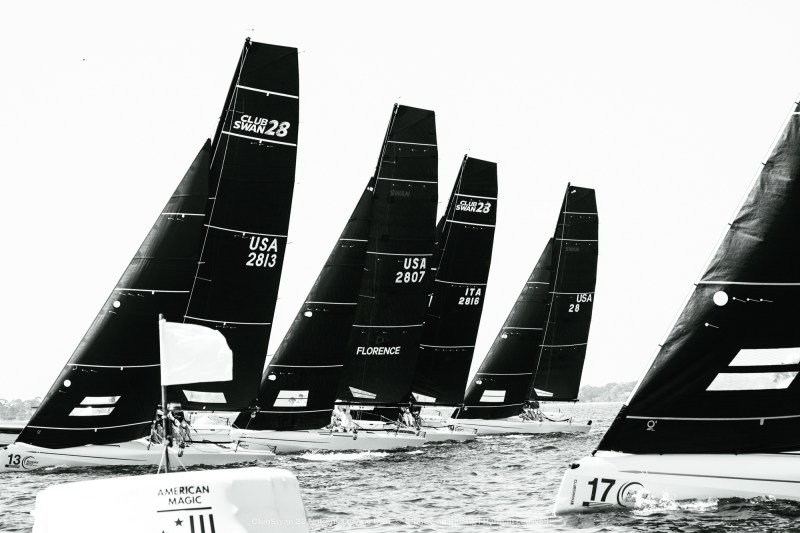
Racing a big fleet requires unique approaches to fleet management, especially with crowded starting lines, fewer lanes, and chaotic mark roundings. But the vast majority of local fleets we race in are much smaller, say 10 boats or less. A smaller fleet calls for a different sort of mindset. With fewer boats, there are fewer points available and even more of a premium on consistent top finishes. This much was obvious at the ClubSwan 28 class’ first U.S. regatta in Pensacola in March, which had five pro-level teams that were new to the fleet. Quantum Sails’ veteran pro, Brett Jones, served as the fleet coach, observing with a keen eye every boat’s sail trim and speed, but also winning tactics and strategies. We asked him for insight from the regatta and what we can apply to our own small fleet skillsets.
Let’s start with the big picture, what are a few fundamentals of success in small fleets, starting with regatta prep and knowing who we’re sailing against.
Identifying who is good and who is the main competition is key. Mentally, give each of them a grade and think about how and where they typically start and how they tend to manage the racecourse. Also, and this is true of racing in a big fleet — give yourself a goal for the day. If you have a three-race day and you have a small fleet, maybe it is a case of no less than six points for the day, or maybe no more than 12 points. Whatever it is, just give yourself a reasonable goal. It gives you a strategy and a bit of motivation.
Fewer boats on a starting line does not necessarily make it easier to win the start, right? So how do we make sure we get a good one?
Identifying the line bias is always important. Typically, the line bias is your first shift, so if you get that right, that is like getting the shift right away. I always try to visualize what is going on upwind and see how the patterns are working down the course. If you draw a line up the center of the course, ask yourself which side of the course looks favored in your eyes? Is the best pressure to the left or right of the center line, or out on an edge? Geography plays a big part, and when you are sailing smaller boats you will likely be sailing close to shorelines. So, remember air follows the edges; it’s going to curve around the bay, or the point, and there’s going to be some acceleration or compression on an edge. This is all part of your strategy going forward. Then, there is also keeping an eye on your competition in the pre-start, noting which side of the line or the course they are looking at.
With a smaller fleet the line is much shorter, so what takes priority: winning the favored end, avoiding density, or simply getting a clear start wherever you can?
Density impacts boatspeed, so you would rather be to leeward of a group, so you can build speed. If you are in the group, you could be forced into a higher mode to try and live off the guy to leeward of you, or you might be trying to get to the guy on your hip to force him off. When it comes to deciding what’s more important: low density or line bias, you have to weigh the length of the course. If it is a shorter course, and the pin is favored, you might want to give up a bit of the line bias and stay more toward the middle of the line so you do not get dragged all the way out to the port lay line. If you have to go for the density, make sure you get your elbows out and go in fighting.
How about getting off the line with speed?
Even if you are at the favored end your trigger pull is critical — when you start your acceleration make sure you’re managing your build angle as well. In the final few seconds — at 15 seconds for instance — you might have the boat at a certain angle for the true-wind angle for your speed build, and you will be rotating the boat down without using the rudder. It might be a bit of jib, or pull the jib on and leave the main off, which will pull the bow down. Then, you pull the main on to match the angle. When you go to start, the two trimmers should pull the sails on together, which is what I call “fanning the sails.”
It is like a pump, and that helps your acceleration, gets the flow going across the keel or the centerboard. Then, it’s just a matter of being at the line as close as possible to your target angle and speed. But remember, it is not just the moment you get across the line that matters, it is the first 30 to 60 seconds after maintaining your speed and angle. I see a lot of teams hit the line at speed, but they shoot right through the angle and get too high and thin, and they slow the boat, hit a wave, and then they have to press. And when you hit that press again, that’s a loss. So, your build angle is essential for your starting procedure. The first 60 seconds of concentration off the line is as important as getting the first shift.
On the first upwind leg, what should the priority be with a small fleet: play the fleet or sail your own race?
Smaller fleets tend to sail faster because there is more space to mode the boat properly, and boatspeed always wins. It may be different if you are at a point in the regatta where you are keeping a closer eye on the points and might have to match race, but if you know what you have to do, then do it. Just get the best start you can, go for boatspeed and let the racing do the work for you. Win your side and accept that you cannot win both sides.
In a small fleet, penalties and turns can quickly take you from first to last, so would you favor low-risk tactics going into crowded top-mark roundings?
This is all about risk versus reward, and remember that karma is going to get you somewhere down the road. That said, if you are coming in on port, for instance, and there is a starboard boat that is overlaid a little bit, then that might give you a bit of opportunity to tack underneath. If you’re on port, you need to identify whether the guys on starboard are overlaid by a little bit, or if they are on a tight lay. You can usually tell by their heel angle and by their sheet tensions; if the sails are twisted or not. If they are heeled a lot, they might be pressing on the jib a little bit harder and trying to sail a bit faster. If they’re a little bit more upright, maybe they’re thin and trying to make it around themselves. So that is all opportunity there. But if you are on starboard, you want to make sure that you are in a fast mode and aim just a little bit below the mark to make sure that anybody coming in on port is going to go take your stern, rather than tack underneath you. If they do tack underneath, you can go into a bit of a higher mode and wiggle around the mark.
On the weather mark exit: stay with the fleet or make a quick move to separate?
Like the upwind legs, smaller fleets tend to sail faster around the top mark, so you are higher and a little bit faster forward on the exit. In bigger fleets, everyone seems to get into that squash mode right away because they are trying to get strong for the first jibe. In smaller boats, there is a bit of opportunity to actually gain by sailing slightly hotter. When you sail off target and really deep, the boat tends to get into a displacement low heel-angle mode. With modern wedge-shaped boats, they drag transoms very easily. They might be getting stronger to leeward, but the guy in front, staying with a little bit of a hotter angle, typically makes a gain forward. When it comes time to jibe there is a little bit more speed to make the jibe and get across. If you do jibe away, know where your apparent wind is, and account for any wind wake off the boats in front of you so that when you do jibe you are not jibing into the wind wake off another boat that has jibed earlier than you. The heavier the breeze, the narrower the wind wake will be. The lighter the breeze, the wider the wind wakes off the main and the spinnaker will be.
Downwind tactics: stray or stay with the group?
That depends on the strategy, but if you’re staying with a group, you’re always trying to match, or better, the boatspeed of the boats around you, regardless of your targets.
What takes priority at the leeward gate? Freedom or getting in phase right away?
That’s really determined by your observations on the run. What side of the course paid upwind and downwind? What has the wind done on the run: left, right, same, increased or decreased? And is there any geography to play in that? They are all decisions you have to make well before the gate, and then, of course, there’s which gate is closer. You want to make sure you are not driving into the dead zone between the marks, where you are right in the middle and you cannot capitalize on the advantages of either.
The fleet is a bit more spread out and now leveraged to both sides after the leeward gate, then what?
You are going to play looser covers with the competition. If you are clear ahead, it is making sure that you are keeping yourself between the opposition and the top mark. You do not have to smash everybody every time they tack near you. You can pick your side, but always keep the strength of the right, especially if you are right shifted. Just keep the boat fast and stay cool. Keep the competition close, and do not stress it.