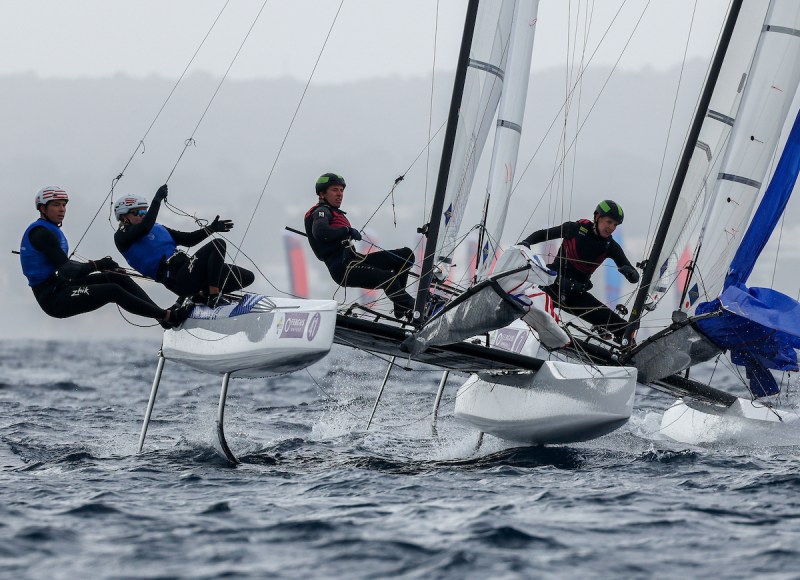
The smell of orange blossoms filled Mallorca’s ancient streets during the first week of April as solemn Semana Santa processions wound through the Spanish island’s capital city of Palma. With the towering Cathedral Santa Maria Palma behind them, 1,100 of the world’s best sailors in 10 Olympic classes launched off the beaches below and toward their respective start lines.
“It’s pretty special being here,” said 49er FX sailor Maddie Hawkins. “You look back at shore and see the cathedral. It doesn’t feel like a normal regatta venue.”
The Trofeo Princesa Sofía is an early annual proving ground for Olympic-class sailors, and this year, it’s more than just a return to racing after the long months of winter training. It’s a benchmark on the road to the 2028 Summer Olympics in Los Angeles. For American sailors with their sights set on qualifying for the U.S. Olympic team, the race offered up a chance to see how they stack up against each other and against the international fleets, which this year included representation from 62 countries.
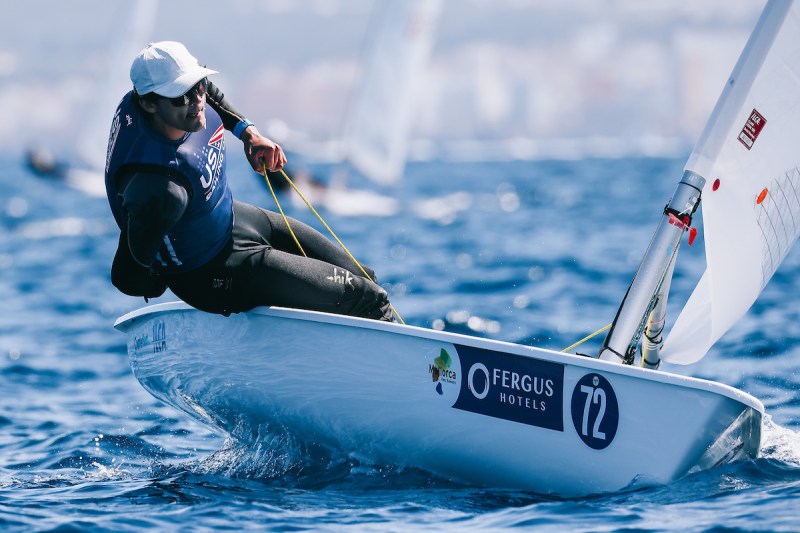
“I’m trying to stay in touch coming off the winter, school, and sailing in 420s and team racing,” said ILCA 7 singlehander and Harvard senior Robby Meek, who hails from Annapolis, Maryland.
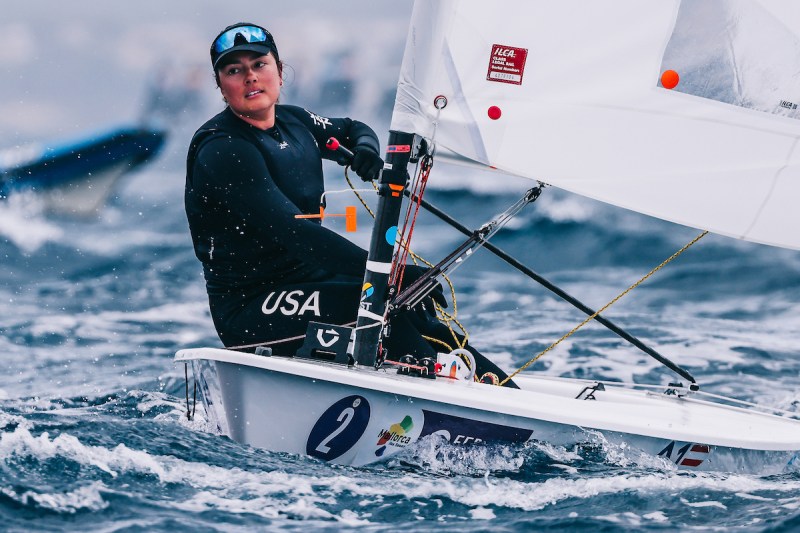
Meek was among 342 laser sailors in the ILCA 6 and 7 fleets, including Americans Leo Boucher of West River, Maryland and Charlotte Rose of Houston, Texas. Rose, who is a year into her second Olympic campaign, described the week’s racing as an important opportunity to train focus on process, strategy, and technique.
“This venue, because of the sea breeze, makes you wait and play the long game. If you have a good start and you hold your lane, you do fine.”
The Mediterranean offered up a full range of weather conditions, from shifting breezes to wide swells, confused seas states, and steep chop. There was even a visit from the Mistral, a weather phenomenon that results from cold, powerful wind gusts that originate in France’s Rhone Valley and grow to speeds of up to 60 kts as they rush southwest into the Med.
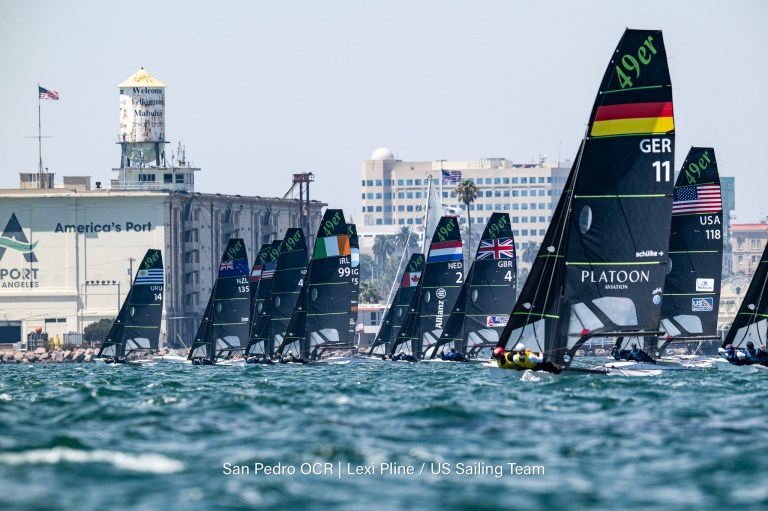
By and large, lighter morning breezes rewarded patience and positioning, while the stronger afternoon winds favored fitness and boat handling, particularly in the ILCA and 470 classes, where hiking endurance and wave management led to strong finishes. More boats on the start line added even more demands.
“This regatta is already competitive, and the number of boats on the line – it’s quite a bit,” said Meek. “It’s more than last year. Those extra boats make a difference. The most challenging thing is always getting off the line.”
Along with Rose and Meek, sailors in every fleet emphasized the importance of getting reps in off the start line during the six-day racing event. Nacra 17 sailors Louisa Nordstrom and Riley Gibbs, IQFOIL windsurfers Dominique Stater and Noah Lyons, and Formula Kite boarder Adam Keaton, all described it as a focal point of their race week.
“We’re getting as many practice starts as we can and treating every lineup like a gold situation,” said Gibbs, who is in his second Olympic campaign following stints on the big boat circuit in the America’s Cup and Sail GP.
While a handful of athletes targeted gold and silver fleet results, the majority spent the week zeroing in on specific performance objectives that varied from in-boat communication to strong first-leg execution.
“We’ve been working on role definition – who’s in charge of saying what,” said Helena Scutt who was racing the 49er FX with teammate and fellow 2016 Olympian Paris Henken. “If we can be building on that, then that’s a huge win.”
49er pair Nevin Snow and Ian MacDiarmid said that tempering results-oriented expectations is challenging for everyone in the early season racing. However, they noted that attention to things like technique along with more abstract motivations like attitude management and mental toughness, are convenient in their tendency to reflect progress up the leaderboard.
Gold and Silver Fleets – Why They Matter
While it varies slightly for each regatta, Gold Fleet represents the top 20 to 25 boats at the end of the qualifying races that take place during the first few days of each event. The remainder of the fleet is divided into Silver and Bronze fleets. At the end of the week, the top 10 teams in the Gold Fleet are selected to participate in Medal Races, where sailors compete for the podium. What’s more, U.S. Sailing and other supporting organizations and sponsors account for Gold and Silver Fleet status when assigning resources like coaching, coach boats, and expensive equipment and personnel that assist racers pursuing Olympic campaigns.
“You almost drop the results goal,” said MacDiarmid. “You work on starts or whatever you want to work on, but you pick these things because they’re important. And when you do that, when you dial in on what’s important, you end up performing really well.”
“We’ve been working hard on mindset,” added Snow. “Deriving joy and accomplishment from achieving small goals as opposed to saying that the podium is the most important thing at this event.”
The strategy paid off for Snow and MacDiarmid, who did find themselves on the podium, taking 2nd out of 101 boats after narrowly beating the Chinese by a single point in the regatta’s exciting finale race. The result made them the second U.S. pair to medal in a 49er at Palma in the 28 years the event has hosted the class, following in the path of Hans Henken and Ian Barrows, who won silver in 2022. Only 9 Americans have been recorded on the podium in the 55-year history of the race, including Noah Lyons, who also brought home a silver medal this year in the Men’s IQFOIL fleet.
Still, Snow and MacDiarmid gave a lot of credit to the racers finishing mid-fleet at the early season race.
“Finishing in the gold fleet or the silver fleet – those are big accomplishments in the Olympic classes,” said Snow. “These boats are very, very difficult to sail.”
With the Los Angeles games just two-and-half years away, this regatta, for many sailors, serves as an important data point in a long campaign. Results matter – but so does trajectory.
“It’s early,” said Hawkins, also of Annapolis, who together with crewmate and Sarasota-native Lilly Myers are in the second year of their first Olympic campaign. “You’re trying to put together a solid week and build from there.”
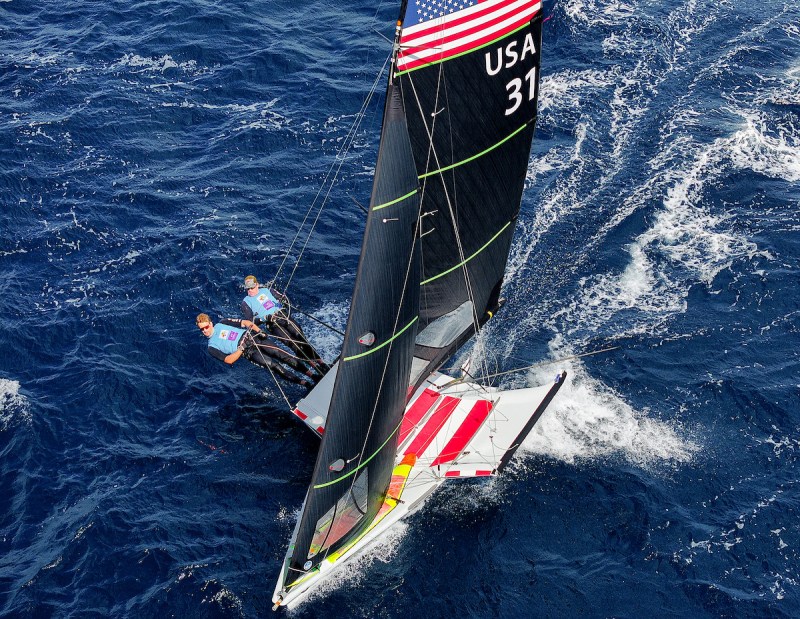
Hawkins and Myers finished in silver fleet, 13 spots ahead of their 2025 result.
Ask any of these very technically oriented sailors why they do it, and the answers drift toward something more intangible.
“I’d regret it if we didn’t go all-in on this campaign,” Hawkins said. “I’ve worked so hard at it for so many years. I love it. It’s as simple as that.”
“It’s satisfying in a way that’s hard to explain,” said Meek. “You’re always trying to get better, and you can feel when you are. It’s about chasing perfection. And when the boat’s going well, it just clicks.”
NEXT UP: Olympic hopefuls will compete again in Hyeres, France at French Olympic Week April 20-26 (all classes); in Port Bourgas, Bulgaria April 29-May 3 for Bourgas Sailing Week (470s); in Viana do Castelo, Portugal May 9-16 for the Formula Kite World Championships; in Quiberon, France May 12-17 for the 49er, 49er FX, and Nacra 17 World Championships; and in Kaštela, Croatia May 15-22 for the ILCA European Championships.