In 2005, the wealthy Australian yachtsman and businessman Bob Oatley commissioned Reichel/Pugh to design a 98-footer called Wild Oats XI with one clear intention in mind: Take names and kick butt on the annual 635-mile Aussie offshore fracas known as the Rolex Sydney Hobart Race. Sixteen Hobart contests later—with nine line-honors victories—the results confirmed that the original mission had been accomplished.
Oatley’s right-hand man for the entire run was Mark Richards, an accomplished pro sailor who’d spent years match racing with Peter Gilmour; competed for the America’s Cup; and founded his own boatbuilding company, Palm Beach Motor Yachts, named after the beach north of Sydney where he’d grown up. Last winter, Richards sailed the 20-year-old yacht on its 17th dash to Hobart, but this time under a new name: Palm Beach XI.
The name, however, wasn’t the only thing that had been changed. Lengthened to 100-feet in 2009, since its launching two decades ago the boat has undergone constant alterations, but none more extreme than its latest series of turbo-charged modifications after Richards took ownership last year.
“We did a lot of different things over the years,” Richards says. “It was during fierce competition on the racecourse but it was a lot of fun. New masts, keels and bulbs. Different sails. Lengthening the bowsprit. Moving the rig. Radical stuff. Now, in its latest modification, along with a state-of-the-art sail inventory from North Sails, we’ve upgraded the entire appendage package: a deeper keel, new daggerboards and of course the C-foils. It’s been a really cool thing to do. It’s a great machine. And I wouldn’t have done what we’ve done without believing it’s capable of doing something really special.”
The transformation of older yachts into modern rocket ships, particularly in the stratified grand-prix ranks where 100-footers roam, is something of a trend that was clearly in play during the 2025 Sydney Hobart Race, with a scratch sheet that included Law Connect (formerly Speedboat 100 and Rambler 100), SHK Scallywag (formerly Ragamuffin 100) and Master Lock Comanche (formerly Comanche). Another member of the club is Black Jack 100, the original Alpha Romeo II, a near-identical R/P boat to Palm Beach XI that was also launched in 2005. The line-honors victor in last summer’s Rolex Fastnet Race, Black Jack remains a formidable beast.
At the outset, in 2005, in its first incarnation the current Palm Beach XI sported canting-ballast/twin-foil appendages meant to ensure stability by countering its massive sail plan. Six years later, the forward canard was removed and replaced with a pair of midships daggerboards. A year after that, a bow centerboard was affixed along with winglets to the bulb keel. Then came a set of Dynamic Stability Foils (DSS), retractable blades deployed to leeward, not unlike the boards on a performance catamaran. Richards was clearly never shy about shaking things up.
Frankenstein? More like “Frankenboat.”
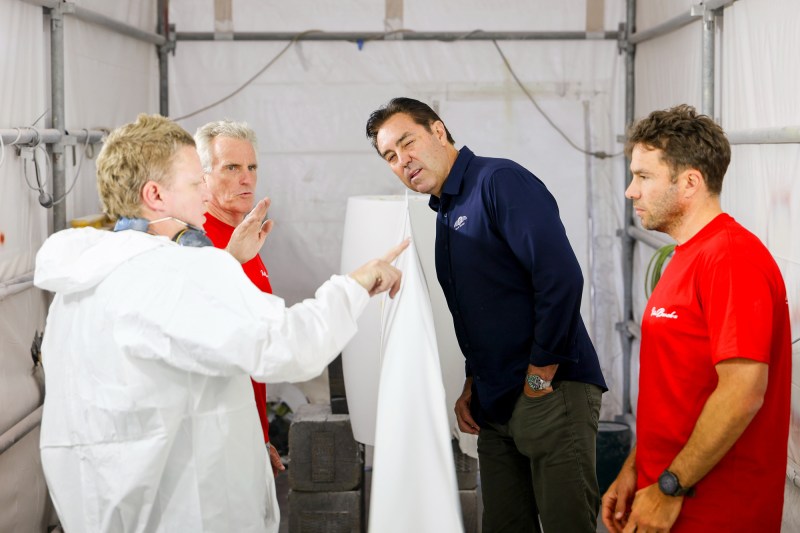
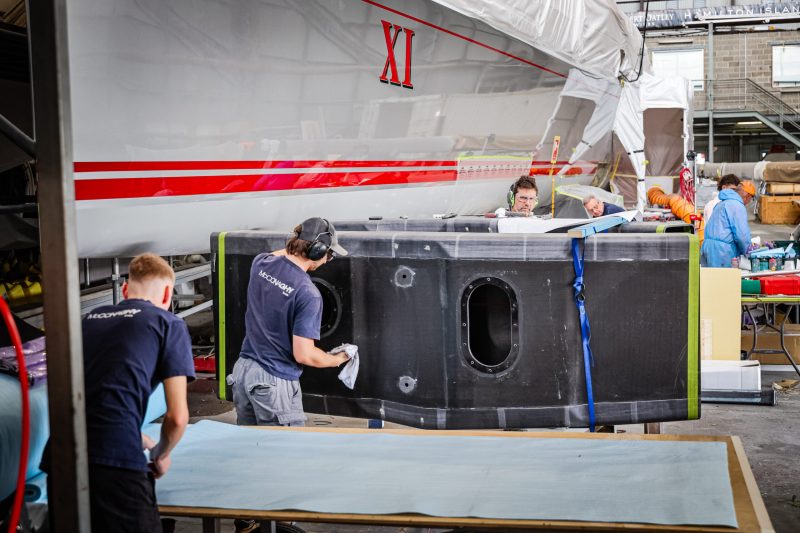
The latest transformation has taken place in a partnership with the ubiquitous Juan Kouyoumdjian—aka Juan K—and the Aussie composite boatbuilding wizards McConaghy Boats, the yacht’s original builders. The new, deeper keel and yet another pair of daggerboards are meant to reduce drag and maximize lift. But the greatest gains to be made are with the new C-foils (or curved foils), a twin set of 900-pound carbon-fiber blades that, when deployed, transition the yacht from displacement mode by generating dynamic lift, reducing drag, increasing the righting moment and unlocking off-wind performance.
“With these C-foils, we’re talking about a boat that’s 25- or 30-percent quicker,” Richards says. “I mean, it’s not a small number. It’s a large number. And then once you start sailing with them, and get them refined, and actually break free, who knows where you’re going to end up? In rough seas, in proper blue water, the boat will skim over the surface with more stability. If you can get settled down and skim nicely long, I think skimming is actually better than flying. The average speed will probably be quite a bit quicker. We’ll see what happens. We’ve got to get it dialed in. But it’s all exciting stuff.”
Regarding this current crop of revamped super-maxis, Richards said the platforms remain highly competitive. “In this sport, you need two things: passion and money. Building a new 100-footer today would be big money. The good thing about all these boats, like Comanche and the others, is that they’ve been built by the best boatbuilders in the world, all of them. They’re extremely well-engineered. They may be 20 years old but they’re as structurally capable as they were when they were built. That’s the cool thing about the technology and the materials, like carbon fiber. They’re pretty well infinite.”
Cash is no object when campaigning super-maxis, and new rigs and sail packages are obvious and necessary matters to address to maintain a competitive edge. But Richards says, for the most part, in the big picture those changes provide incremental improvements. “We’ve been with North Sails and Southern Spars all along and we’ve built a lot of sails and rigs over that time. If you get a one- or two-percent improvement with new sails and rigs you’re jumping for joy. The big change in sails is the durability and the triple-headsail foretriangle, which has really been developed by the Volvo [The Ocean Race] guys. A nicely balanced, triple-head rig, when that’s on fire, it’s really cool.
“But,” he added, “when you combine all that technology with the C-foils, you’re going to see some pretty amazing performance with this boat.”
Richards says that the success of the IMOCA 60 foilers played no role in Palm Beach’s C-foil approach. “We also tried the DSS boards but they just weren’t big enough,” he says. “There wasn’t enough area close to the surface. These C-foils came about through one-hundred percent computer simulations. Juan K has access to some of the most powerful prediction software in the world. With this virtual tank, it’s as accurate as a real tank, but you can do so much more with it. The predictability is very accurate. I worked very closely with Juan throughout the entire design process so I could understand it, because it’s the first big boat he’s been doing it on. I think we nailed it.”
In the most recent running of the Rolex Sydney Hobart Race, just days out of the shed, Palm Beach XI placed fifth overall. The C-foils, which hadn’t had time to be properly tested, played no factor in a heavy air, predominantly upwind race. Unfortunately, due to logistical challenges, the original plan for Palm Beach XI to sail in this summer’s Newport Bermuda Race and subsequently chase offshore speed records in the North Atlantic has been scuttled. Instead, moving on to Plan B, the boat has been undergoing sea trials in the Tasman Sea, and early results have been promising.
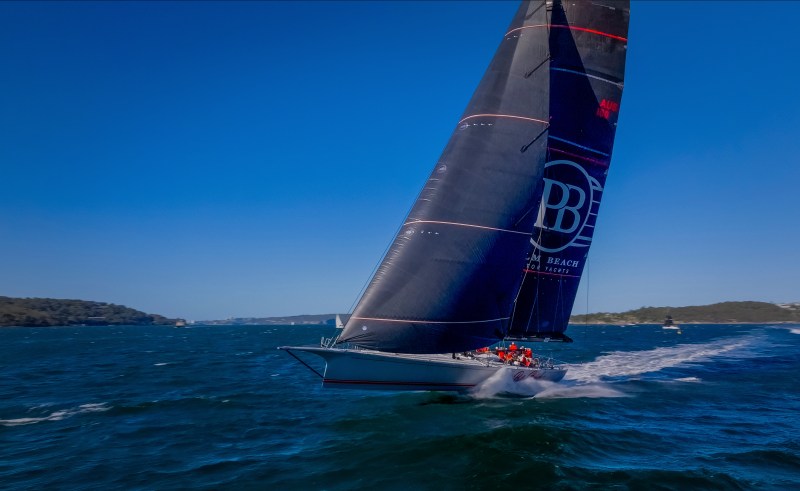
Last spring, on a picture-perfect Sydney Harbour summer afternoon in 22-knots of northeast sea breeze, Palm Beach XI took flight, the C-foils performing flawlessly. Power reaching at 29 knots, with spray whipping off the foils, everything worked according to plan. What lies ahead remains to be seen, but in that moment, there was no doubt about it. Palm Beach XI was skimming toward the future.