Good sailors can sail plenty fast, but their race results don’t always match that speed. I am coaching a guy like that. He has great focus; he can stare at the jib telltales as well as the fleet champ does. But he often forgets to look around, and when he does, he swerves all over the place.
Great sailors know how to go fast while still being aware of their surroundings. From the outside, it looks like they do everything at once. Although partially true, there is more to their success than that. They know how to multitask and context switch. What does that mean? Let’s dig into it.
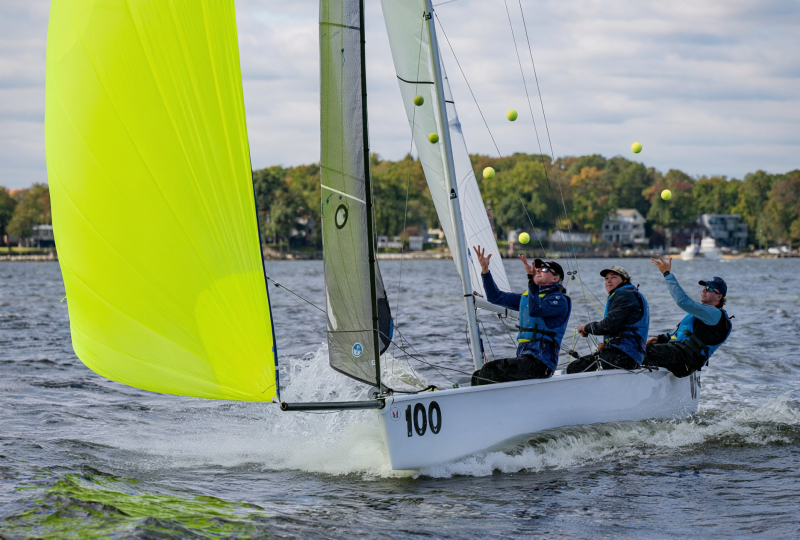
The first step my guy needs to learn is multitasking. Some things we do are committed to muscle memory. We are so familiar with them that we can do them in the background without specifically thinking about them, like walking. While we do background tasks we don’t need to think about, we can layer on top of that one thing that we do have to think about, like a physicist can contemplate a complex math problem while he walks. The focus can be on something physical too, like I can juggle, but not well, so I have to think about it. And like the physicist thinking while he walks, I can juggling with some success while I walk when I put my mind to it.
Unfortunately, the human brain can’t actively think about more than one thing at once. We can’t just layer multiple things I have to focus on. While walking, I can think about physics, or I can think about juggling, but I can’t do both of those, let alone a third.
But we can have more than one task in our muscle memory. For example, I can juggle, and I can ride a unicycle, but neither is in my muscle memory, so I can’t do both at the same time. Yet a showman can ride and juggle so well that he can do them at the same time subconsciously. That frees him up to add one conscious task, like joking with the audience.
My guy needs to become so good at the basics of sailing that they become part of his muscle memory. Like riding and juggling, he needs to steer, trim, and move his body subconsciously. This will free him up for his one focus outside of his muscle memory. That could be a rounding, a bad set of waves, or whatever else is important at the moment.
There are times that our singular focus task is speed. Sure, the basics of speed should be in our muscle memory, we should be able to steer to the jib luff telltales in the background. But we will go even faster if we can instead put all our full focus on speed. Great sailors are always focused on something while their muscle memory is on speed, even if that focus is speed.
That brings us to Context switching. After my guy gets comfortable enough with his boat to rely on muscle memory, we will work on directing his focus to the immediate priority. He needs to learn to rotate through, constantly changing his focus from one thing then the next. This is called context switching. For example, he may be interrupted from concentrating on speed to manage a crossing. His duck complete, his focus turns back to speed again.
Unfortunately, context switching is inefficient. Suppose you are deep in thought on your taxes, then you get a phone call. You disrupt your taxes to context switch to the phone call and since you can only think of one thing at a time, you stop thinking about your taxes. When the conversation is done, it takes some time to get back into your taxes again. Getting interrupted to decide about a crossing will take away from speed focus and it will take some time to get it back to full speed.
Recognizing this inefficiency of switching means we need processes in place to prioritize the right things at the right time. For example, if I have a good start, all my attention is dedicated to speed for the first minute or so. I settle into a 20-second routine. I stare at the jib luff telltales for 15 seconds, then I look up at my leech tales and adjust my trim for 5 seconds, all while feeling the heel and adjusting my body to keep at a constant heel. Then, with my eyes back to the jib tales, I start the speed loop over again. This is my 100-percent speed mode focus. On the other hand, if I had a poor start, my focus is completely different, I am completely consumed with finding a good escape.
Either way, once I am free and established on the open course, I go into a mix of speed and tactics. I focus on steering to the jib luff telltales for 10 seconds, then I look at my leech and adjust trim for 5 seconds, then I look around for 5 seconds memorizing what I see, I paint a picture in my mind. Then back to the jib tales, and while I look at them, I subconsciously steer to them while I think about tactics based on that picture. Maybe half of my focus on speed, the other half on tactics.
The timing of the routine is not that exact; I do not count or have a stopwatch running to remind me. And the cycle constantly morphs depending on changing priorities. For example, I might glance up and be happy with my trim in just a few seconds instead of 5, or I may linger much longer to fine tune it to my liking if I don’t like what I see. Often the priorities will change based on what I see when I cycle through the “look around” part of my loop. Perhaps if I see a wind line that was not there before, I will take some more time to look for more clews, then ponder what I saw longer. Maybe I invest 75 percent of my focus on tactics and 25 percent on speed.
Success comes from having enough of a loop routine to cover all the bases efficiently yet having enough flexibility to reprioritize and adjust the focus.
Sometimes, I need to pull myself out of the routine completely.
Suppose that when I glance up, I see that mother nature has thrown me a curveball and the other side of the course is crushing my side. I immediately switch into full muscle memory speed mode while I put 100 percent of my conscious thought into what I should do tactically. Is it a persistent shift? If so, I need to change my strategy and switch sides as fast as I can. Or is it still oscillating and I need to wait my turn? I take my eyes completely out of the boat while I study both sides of the course. With none of my active mind on speed. I know I will be going a little slower while I sort it out, but with the decision so consequential, it is well worth it. The better my muscle memory is, the better I will survive.
The number of people on your team changes the degree of multitasking and context switching required. In a singlehanded boat, you do everything yourself, so you need to use the full range of these skills. The other extreme is if you sail a boat with a full crew where you can specialize on your assigned task. Whatever your team makeup, the more you can commit the basics of your position to muscle memory, the more you will be able to layer your focus on top of that. For example, if you are the jib trimmer, you might automatically ease in big puffs, then concentrate on fine tuning your trim by looking at the leech, then communicate with the driver to get their feedback.
We only have so much mental energy and we need to put it to good use. Good sailors know how to go fast. Great sailors can still go fast enough while not thinking about it that they can manage the ever changing complexities of the race as it’s happening.