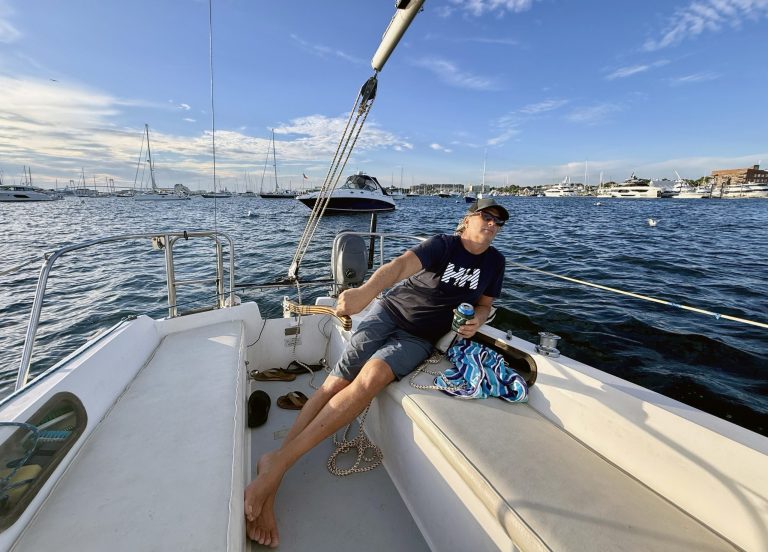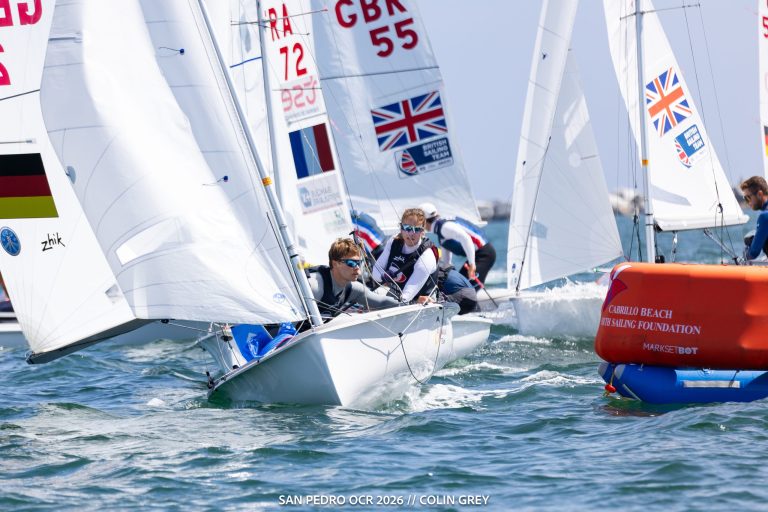
Over the past few years I’ve been racing aboard the highly optimized 66-footer Temptation. The boat is usually at the top of the handicap rating list, and as a bigger boat amongst smaller competitors, let’s just say it is nice to have the ability to get out in front of the fleet and focus on sailing the boat to its potential. Sometimes it can be tough being the smallest boat in the fleet, and after a recent regatta, I know how that feels. I was also reminded, however, that being the small boat at the back of the fleet is like being the scratch boat out front—when everyone else is on the horizon all we can do is sail our boat to its rating and hope the wind works in our favor.
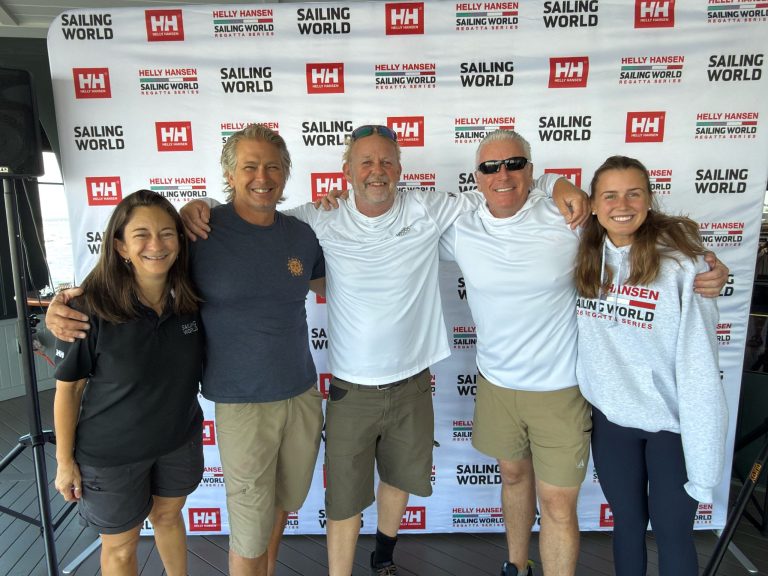
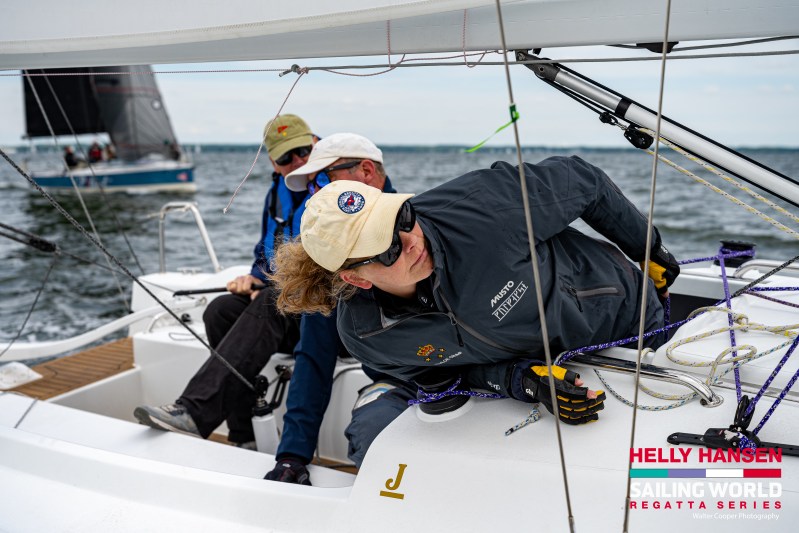
The opportunity came through an invitation to race the new J/7 from J Boats, a pure and simple 23-foot daysailer. I jumped at the opportunity to race the J/7 in my hometown at the Helly Hansen Sailing World Regatta in Annapolis. I recruited a pair of top sailors in Will and Marie Crump, promising them a good time on a new boat. Thankfully, they were available and interested in sailing the J/7.
There were eight PHRF boats in our class and it was certainly an eclectic fleet. Our boat, named Blue J, was by far the smallest and had the lowest handicap at 156 (non-spinnaker, issued by PHRF of the Chesapeake). Our schedule was one distance race per day. Sailing World Editor and Regatta Director Dave Reed prefers to call them “long-course” races because they don’t demand the complexities of a traditional distance race. The idea is to sail an enjoyable random-leg course that finishes in time for everyone to get to the party before the bar opens or the buffet starts serving.
On Saturday, the first of two days, our PHRF division PRO, Dick Neville, sent us on a 9.8-mile racecourse. We “won” the start at the favored end, but quickly watched four of the boats sail past us on the reach. One team deployed a Code Zero while my crew, Will Crump and Marie Crump tried to get the best shape out of our small non-overlapping jib. I soon realized we had a big task ahead trying to save our time.
Making our task even more difficult was the fact that we did not have a spinnaker unlike the other seven boats. The first leg was a tight reach, but we hung in there. The next leg turned into a dead downwind angle. We used our whisker pole to wing the headsail and by sailing straight downwind we were able to surf a few Chesapeake Bay breakers. We watched as a few of our competitors struggled to control their spinnakers in the morning’s puffy winds. Without the challenges of a spinnaker, we were able to sail fast and straight, keeping us in the mix. The third leg was a 6-mile beat against a strong 1.5-knot current. We sailed into shallow water to avoid the worse of it while the other boats struggled out in the deeper water. We kept ourselves in the game for as long as we could, but when we were about a mile from the finish the wind plummeted from 14 knots to 5. Suddenly we were at risk of losing on corrected time. Our nightmare became reality and we slowed to 3 knots after the leaders finished. We placed fifth out of the eight-boat fleet. It was a disappointing result, but our true purpose was to experience the J/7 anyway.
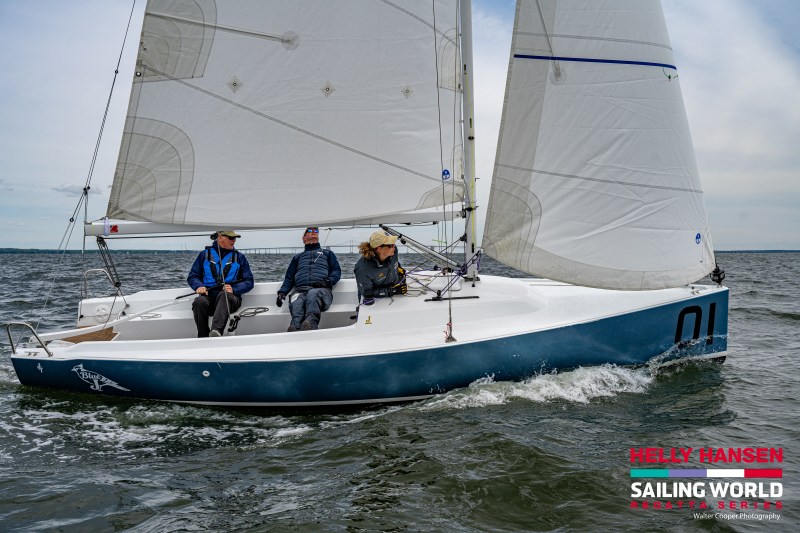
I found the boat to be lively and comfortable to steer. Marie trimmed the jib, Will trimmed the main and I steered. Marie worked the jib sheet constantly as if it were a spinnaker sheet. There isn’t much at all to adjust beside the basic sail controls, so we spent more time discussing our tactical options. On long legs there is plenty of time to talk things over, and crew engagement is always a morale booster, so there was plenty of input going around the boat’s long cockpit. The J/7 features 8-foot seats in the cockpit that made steering comfortable. They’re long enough for me to enjoy a mid-race nap, but there would be none of that. In big gusts I sat out on the coaming, but most of the time I sat in the cockpit. The backrest is angled perfectly for me when sitting inboard, so that’s where I perched. From here, the sails are easy to see and the sight line for waves and puffs is unobstructed. There is room for a fourth crew member, which would be helpful with a spinnaker, but three is perfect for JAM racing. In big blasts of wind, we stayed under control as long as both sheets were eased a few inches. We never spun out in either race, confirming the boat’s balance is good and the rudder bite is excellent.
The boat displaces 2,300 pounds and only draws 3’8”. There is a modest cabin below, but when we got to the boat in the morning, Blue J was filled with a lot of extra gear from its road trip from Charleston. We left it all on the dock.
The boat has a roller furling headsail which is handy when waiting for the starting sequence on our windy days. Two nifty ratcheting Harken Snubber cabin top winches allowed Marie to crosssheet. J Boats describes the J/7 as a “hassle free” boat and I would agree. While all the fundamental sail controls are easy to adjust, if I had one minor suggestion it would be to lead the adjustable backstay further forward. I found it difficult to reach behind me in order to make an adjustment.
The course had a fair bit of downwind sailing, so without a spinnaker we didn’t have much of a fair fight. Still, we finished fifth and chalked it up to a learning session, and a wonderful day to race a new boat around my favorite bay.
After a good night’s sleep, we arrived at Annapolis YC for the second day of racing. The stiff spring northwesterly was strong enough to have the Harbor 20s and Lightnings cancel their races for the day, so we were happy that all eight boats were in the starting area.
Neville announced over the VHF that he was giving us a custom course that totaled about 19 miles. We had a winning start, alone at the pin end of the line on a close reach and took off. One of the bigger boats eventually sailed over us and I was able to catch a ride on its wake. We gained one knot of speed, thank you very much. When everyone rounded the first mark and set spinnakers, however, we watched the fleet sail away.
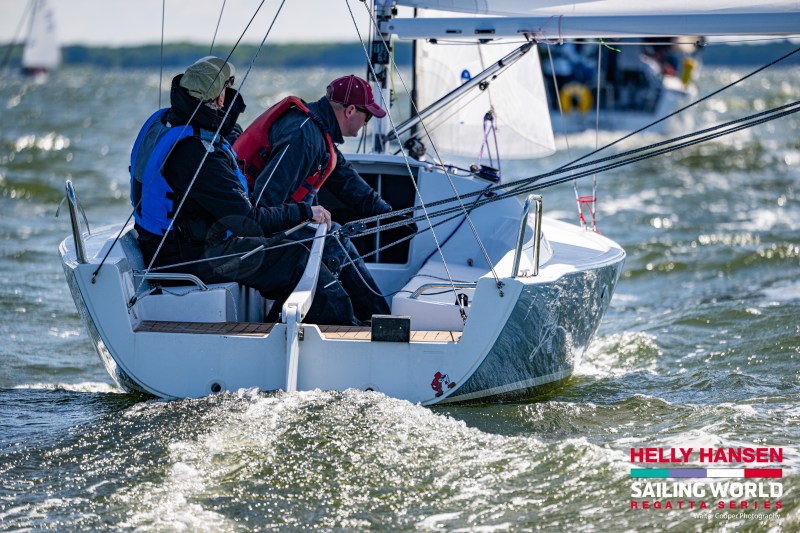
On the third leg, which was a beat. The four leaders headed on a course well below the layline. We rounded the leeward mark and headed straight for the next turning mark, using our cell phone navigation app. Three of the leading boats kept sailing on a low course. After about 20 minutes they collectively realized they were sailing too low and tacked over. Their fifteen minutes on port tack was wasted distance for them. But that’s OK, because we were back in the race on handicap. With the breeze holding strong all day and a swift ebb tide, we sailed the 19-mile course in 3 hours and 20 minutes. That’s pretty darn good for a 23-foot boat and no spinnaker. We ended up third on corrected time, and better yet, third for the series. A podium finish was worth the long miles.
James Sagerholm, racing his ancient J/35, Aunt Jean, won the regatta with 2-1 finishes. Bruce Irvin in his Corby 40, Time Machine had a 1-2, but the tie breaker goes to the boat with the best score in the last race. Our third-place finish, while a surprise, was a great reminder that you don’t have to be the biggest, or fanciest boat in the fleet to do well. You just have to work hard, have fun and sail your boat and the course to the best of your abilities.