Robert “Ted” Edward Turner III, Born November 19, 1938
Ted Turner is one of the most famous champion sailors in yachting history. He’s also noted for creating the Cable News Network, his role as a passionate environmentalist, and for being one of the largest landowners in the world, with 2.1 million acres. His philanthropy turned many heads when he donated $1 billion to the United Nations Foundation.Turner has excelled at every endeavor he’s pursued, and along the way, he’s won some of the world’s biggest yacht races, including the America’s Cup and the world’s great ocean races— the Fastnet Race and the Sydney Hobart Race. Turner’s virtues are grounded in hard work, loyalty, and kindness. Anyone who has ever met Ted will always say nice things about him. He is down to earth and cares about making the world a better place. Turner has a bumper sticker on all his vehicles that states, “Save Everything.”
Turner started out sailing at the age of eight in Savannah, Georgia. He will tell you his early days didn’t produce good results. “I wasn’t losing, I was just learning how to win,” he says. That philosophy has served Turner well over many years as a sailor, business executive and philanthropist. For the sailors who’ve raced with Turner, the friendship has extended for a lifetime. He’s been a champion in the Flying Dutchman class, the 5.5 Meter class and was a top intercollegiate sailor at Brown University.
He got into offshore racing in his twenties and made quite a splash when he acquired the 12 Meter American Eagle in 1969. He finished fourth in the Fastnet Race, crossed the Atlantic Ocean aboard her, then won the Sydney Hobart Race after having the boat shipped down under
His credentials earned him a berth as skipper of Mariner in the 1974 America’s Cup Defense Trials. Mariner was seriously off the pace and was eliminated early from the competition. Turner took considerable blame for the failure but resolved to give the America’s Cup another try. He made a deal with a new syndicate led by Olympic gold medalist and business leader Lee Loomis and sailmaker Ted Hood to be the skipper of the team’s stablemate, Courageous. In 1974 Hood had skippered Courageous to victory in the Cup.
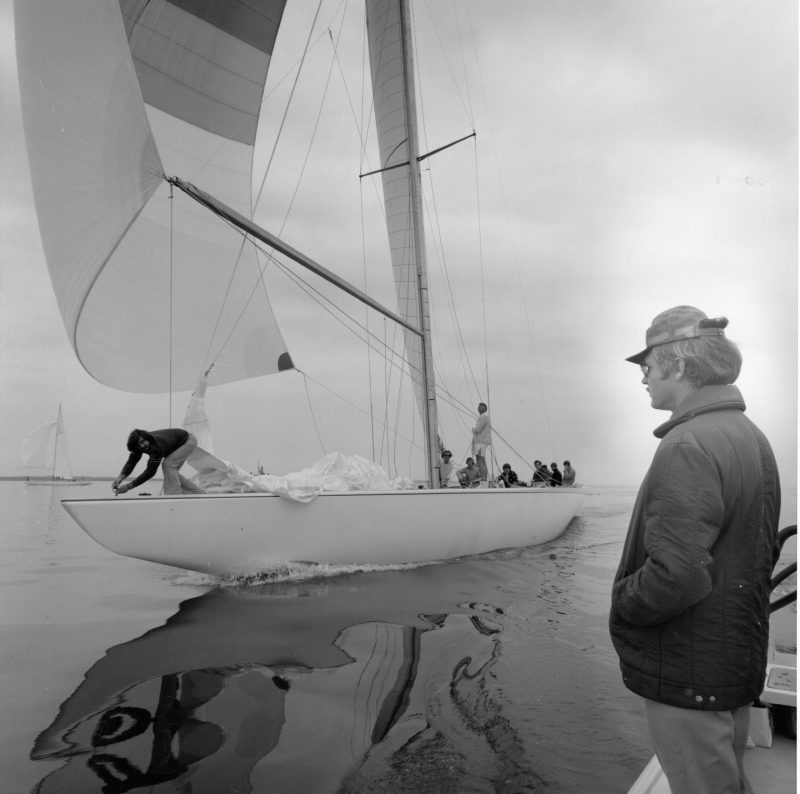
Courageous became a favorite around the Newport waterfront in 1977. Turner and his young crew won early, fell into a slump in the middle of the summer and rebounded to win the defense trials and successfully defend the Cup. In the process, Turner became a household name.
He was colorful and always drew a crowd. As an example of how Turner demonstrated leadership and earned loyalty, I recall a race on Courageous that had gone very well. After the race Turner invited his tactician and mainsail trimmer — me and Robbie Doyle — to the post-race press conference.
John Ahern, a 58-year-old writer from The Boston Globe, asked “What was the key to your victory?” Without missing a beat, Turner answered, “With a tactician like Gary calling the wind shifts and a trimmer like Robbie making us go fast it was easy. I steered, but these guys and the rest of the crew are the reason we won.”
The very next day we had a terrible race. I missed a wind shift, and Robbie had the wrong jib up. Ted invited us to the post-race press briefing again. I was not looking forward to it. Once again John Ahern asked, “After yesterday’s great race, what happened today, Ted?”
Turner looked straight at Ahern and said, “I had a bad race today, it was on me, we will try to do better in the next race.” I stood there listening and realized what Ted was all about — when we won, he spread the credit around, but when we lost he took the blame. That lesson has resonated with me throughout my life.
In March of 1963, at the age of 24, Turner was shocked when his 53-year-old father committed suicide. It was a horrible blow to the young man. He spoke about the sad event throughout his life. He desperately strived to gain his father’s approval and no longer had that opportunity. Turner picked up the pieces of his father’s failing outdoor billboard advertising company and built it into a success.
He met Judy Nye at a collegiate sailing regatta while he was attending Brown University. She was the daughter of a prominent sailor, Harry Nye, who was a two-time International Star class World Champion (1942, 1949) and owned a national sail making company, Murphy and Nye. They married in 1960. The Turners had two children, Laura Lee and Robert Edward “Teddy” Turner IV. The marriage didn’t last long; they divorced in 1964. One year later Turner met and quickly married Jane Shirley Smith, who had been a flight attendant for Delta Airlines. She was a graduate of the University of Alabama and was somewhat overwhelmed when Turner took her to dinner in his Ferrari sports car. The couple had three children, Rhett, Ginny and Beau. Turner was consumed by his business and yacht racing and was rarely at home. Janie Turner stayed in the background as her husband gained national notoriety and wealth. They divorced in 1988.
Turner’s next love made the society pages. The Academy Award-winning actress Jane Fonda started accompanying him to business and social events all over the world. They married in 1991. Fonda was a liberal activist and controversial due to her Vietnam protests and visit to Hanoi. It was an unfortunate event that has haunted her ever since. The couple seemed to be everywhere. They split in 2001 and divorced.
Interestingly, all three former wives, along with several past and current girlfriends attended Turner’s 80th birthday party in Atlanta. Fonda sang two songs at the festive evening. Turner’s five children are close to their father and have had active lives along with serving on the board of the Turner Foundation. Turner enjoys his time with his grandchildren when they visit at one of his properties.
His wealth was accumulated through his crystal-clear vision of how to expand his media empire. He was ambitious and soon expanded into radio and television broadcasting. Years later he said that he never understood radio. However, he had a knack for putting programs on his television station that people wanted to watch. His breakthrough came in the mid 1970s when he figured out how to broadcast his station on satellite, which stretched his viewing audience across the U.S. Turner acquired film libraries and professional sports teams to add content for his growing network. His greatest achievement was coming up with the concept of broadcasting news 24 hours a day and creating the Cable News Network, CNN.
With CNN’s growth, Turner became an influential voice domestically and throughout the world. CNN broadcast major events including the protests in Tiananmen Square, the fall of the Berlin Wall, and the Gulf War in Iraq. His America’s Cup victory gave investors’ confidence that they were working with a winner, and as it turned out, they were. CNN’s broadcasts were bold, with production teams operating in hostile environments. Turner was named Time magazine’s “Man of the Year” for his groundbreaking broadcasts in 1991.
Turner learned how to be a bold and strong leader thanks to his years of ocean racing. He is the rare billionaire who sails his own boats in the mold of Harold S. Vanderbilt, who steered his J-Class boats to victory three times in the 1930s, and Bill Koch, who won the America’s Cup in 1992 as co-helmsman with Buddy Melges on America3.
Turner, Koch and Melges sailed together twice. The first time was aboard the J-Class sloop Endeavour at an exhibition regatta in 1989, a huge event. Endeavour raced against Shamrock V off Newport, R.I. Over 1,000 spectator boats were on the water. As an aside, Donald Trump invited himself aboard Endeavour for one of the races. Little did anyone know the turn his career path would take.
The trio also sailed together one time in San Diego in a practice race leading up to the America’s Cup Class World Championship in 1991. During one starting sequence Buddy was at the helm and having trouble deciding which way he should approach the line. Turner couldn’t help himself and asked Buddy, “Are you having trouble making up your mind?” Without missing a beat Melges responded, “Yes and no.” Koch and the rest of the crew had a good laugh.
After racing that night Turner told me how amazed he was at the advanced technology Koch was putting into his America’s Cup campaign. Turner had a good quote, “My God, I’m locked in analog in a digital age.” Turner was a seat-of-the-pants sailor who never embraced computerized sailing. His philosophy was simple, as he remarked in “The Best Defense,” a film by Dick Enersen. “Get a good boat, put a good crew on it, and then go out and sail the devil out of it,” he said.
The attributes of a great ocean racing sailor are analogous to what is required of successful business leaders. As an owner of a major league baseball team, the Atlanta Braves, Turner struggled in his early years, but eventually the Braves won the World Series and have long been a top National League contender. He has produced feature films. The epic “Gettysburg,” about the ferocious battle during America’s Civil War, won many awards. He funded production of the 2003 Academy Award winner “The Lord of the Rings: The Return of the King.” Turner also produced many documentaries with the mission of making the world a better place.
His methods for achieving success seem easy on paper but are difficult in practice. Turner uses a pragmatic approach by setting an ambitious goal, recruiting talented and motivated team members and then arranging the financing to put the enterprise in place. The true test of character is revealed when things get tough. Turner learned how to overcome adversity by racing in extremely stormy weather conditions. In 1979 he skippered his 62-foot-yacht Tenacious to victory in the Fastnet Race. The race was a calamity, and to this day is known as “the roughest ocean race on record.” Of the 303 boats that started, only 87 would reach the finish line. Sadly, 15 lives were lost and 23 yachts either sank or were abandoned. Turner was the first overall finisher in the 1979 Fastnet. He had come close to winning in 1971 and was inspired to try to win it again. Many years later he would tell people it was his greatest victory, even more so than defending the America’s Cup.
As mentioned, it is unique in sports for a team owner to participate on the playing field, or in Turner’s case, on the racecourse. He was good at sailing because he started at a young age and had an inner desire to excel. He pushed himself and his crews hard. There was never any “half way” with Turner.
On the water, he had a reputation for being noisy. Turner suffers from hearing loss and speaks in a loud voice. In truth, he was calm under pressure and listened to the advice of his crews. Turner also rebounded from his mistakes. He was a quick learner and rarely, if ever, repeated a mistake in any of his endeavors. At the helm of any boat, he had the skill to make it sail at its peak potential for hours at a time. His commands to his sail trimmers came in one-word sentences. Everyone understood what he needed to do to keep the boat at top speed.
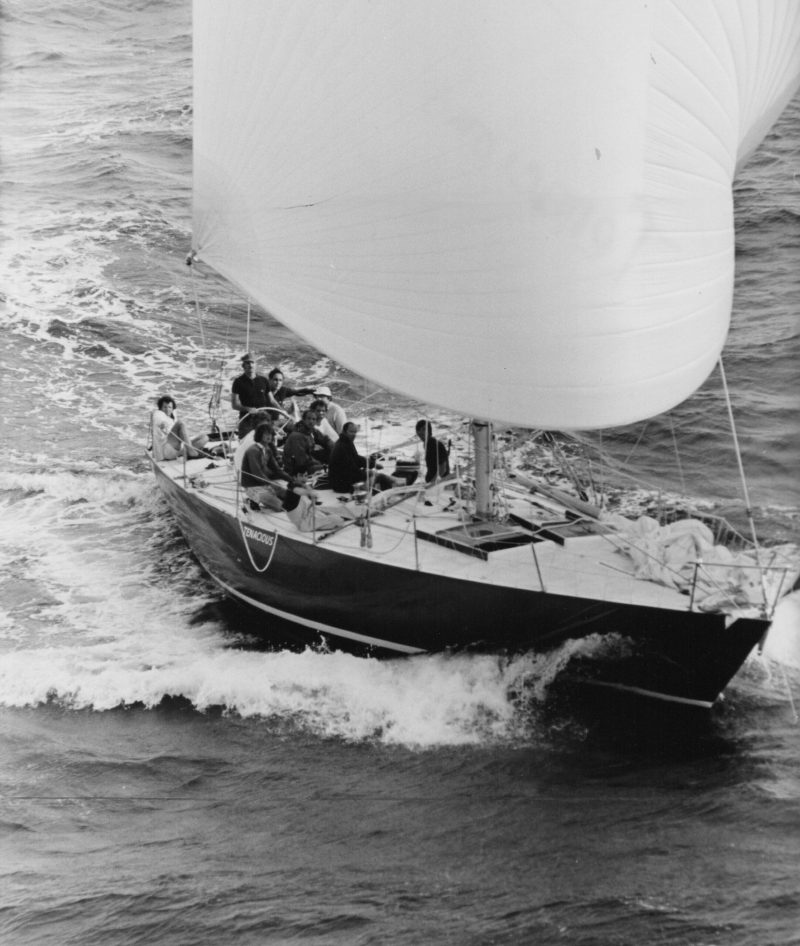
After winning the prestigious Queen’s Cup in Cowes in 1979, a representative of the Royal Yacht Squadron arrived at Tenacious with four invitations for the prize giving that evening. Turner looked at the invitations and said to the well-dressed courier, “There are only four invitations here, but we have 16 on our crew. Unless all our crew are invited, we will not be attending.” About 30 minutes later the courier returned with 16 invitations and the entire crew attended the event. It was a vintage Ted Turner moment.
Winning big races was his hallmark. He had a way of getting good publicity, which certainly helped him to win awards. Turner was named the United States Sailing Association’s “Yachtsman of the Year” award four times: 1970, 1974, 1977 and 1979. It is an extraordinary record that has held up through this book.
One of Turner’s strengths is forecasting; the night of the Fastnet Race he predicted there would be fatalities as the storm built into a fierce hurricane-level blow. He is also honest to his core. Turner’s comments can be insightful, clever, funny, and sometimes horrifying. His ability to accurately predict the future isn’t simply coincidence.He has a huge appetite for reading about history and people; In college he was a classics major. Turner put that knowledge of lessons from the past to good use as he marched from one endeavor to the next, on and off the water.
As mentioned, Turner is colorful. Immediately after winning the fourth race of the 1977 America’s Cup, he was obligated to attend the post-race press conference. Ted got sidetracked on his way down Thames Street in Newport to the cavernous Armory building that was bulging with the assembled press corps.
We all knew Ted had a low tolerance for alcohol. Someone handed him a bottle of the Swedish liquor Aquavit. He took several generous swigs and by the time he arrived at the Armory he was brash, colorful, and outrageous.
The press loved the moment. Turner had been asked to behave all summer and now he could let loose — and he did. Some 33 years later at a 12 Meter reunion in Newport, someone at a well-attended forum asked Turner about the infamous press conference. Ted placed the almost empty bottle of Aquavit on the press table and one of his television managers, named Sid Pike, was sitting in the front row. Pike took the bottle and put it under the table. A bottle of Mount Gay Rum appeared, and Ted took a swig. Pike tried to put the rum bottle under the table as well. Turner, yelled at Pike, “Pike, give me that back.” Ted slid under the table trying to retrieve one of the bottles. Unfortunately, three television cameras recorded the scene. It will live on the internet forever. Back in Newport three decades later Ted put his head down, paused for a moment and with a half-smile said, “I would like to apologize, once again, for my behavior that afternoon.” His comment brought the house down.
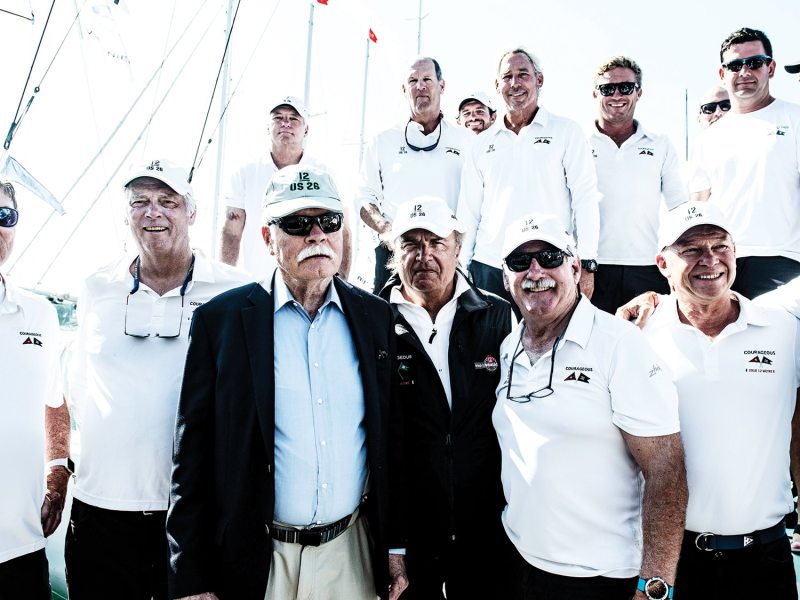
At the 30th reunion of the Courageous America’s Cup victory Turner recalled; “The ’77 Cup race was a high point of our lives. It would be hard to beat. We all had such a great time together. We pulled together. We all knew if we were going to have any chance to win, we were going to have to all perform at an absolutely superlative level. It was a crew of 100% winners. There was not a loser in the bunch. Everyone rose to the occasion, otherwise we would not have won.”
Over the years I have given nearly 3,000 lecture presentations. While the topics have varied, one subject is always included — The America’s Cup. And the most frequent question I am asked is “What is it like to sail with Ted Turner?”
I always take my time when I answer. Ted is a gifted sailor, and he recruits top sailors. Ted always says he likes when decisions are made at the lowest level. He is quite methodical when working with a tactician and navigator. He will ask probing questions that challenge you to think hard. He appreciates people who think through all the possible options available. He will often surprise me with an alternative option that I might not have thought about. In sum, Ted does three things well on long distance races: 1. He is a superb helmsman. 2. He is very good at trimming spinnakers and will spend considerable time continuously adjusting the sail. 3. He is at his best as a leader. When Ted makes a decision, the crew buys in and executes.
I’ve attended many business meetings and a few board meetings with him over the years. His routine on the water is analogous to his work in the boardroom. He considers all the options, makes a decision, and presses ahead at full speed. He has a good way of lifting everyone’s game.
Turner had an extraordinary run on the water, but he had to give up sailing to focus on his media business. Turner retired from grand prix yacht racing at the young age of 41. He continued to sail at exhibition and charity regattas. His business grew into multiple television networks. Eventually, he sold the company to Time Warner and became a multibillionaire in the process.
During the next phase of his career Turner was an inspiring philanthropist. On September 18, 1997, Turner surprised a group at a United Nations dinner with a $1 billion dollar donation to the UN Foundation. It was the largest single gift anyone had made up until that point in time.
Within days, Turner received phone calls from Warren Buffett and Bill Gates asking why he had given such a huge gift. Soon Buffett, Gates and many other billionaires were donating to large foundations. Turner explained his reasoning to me: “It just seemed like the right thing to do. CNN became a financial success along with our other cable networks. I wanted to put money to work and there’s no better way to do it than to help those in need. My main interest is in trying to help humanity save itself from disaster. Between nuclear arsenals and nuclear proliferation and global warming and environmental derogation and over-population, we are facing a real crisis.”
Turner has a unique ability to not hold grudges against people who have been his rivals or worked against him. He does stick up for himself and his employees. One verbal volley erupted with Rupert Murdoch. Turner even challenged Murdoch to a boxing match.
Eventually, they buried the hatchet, but it was a colorful few months as Fox was gaining ground at CNN’s expense. Even with that rare spat you never hear Turner say a bad word about anyone. In 2008 he published his memoirs, co-written with Bill Burke. Turner narrated the whole book himself for the audio edition. The book is a very personal and honest report of one of the greatest business leaders of our era. It is fascinating to read and think about how he had the time to race in the America’s Cup and in the world’s great ocean races while building his company. He was inducted into the America’s Cup Hall of Fame in 1993 and the National Sailing Hall of Fame in 2011.
In his later years Turner has suffered from Lewy body dementia and Parkinson’s disease. His spirits are always upbeat even as the disease has progressed.
At his 80th birthday celebration in Atlanta, he got up on stage, sang two songs and recited some of his favorite poetry from memory. It was a heartfelt evening. I was lucky to be one of the 300 people invited to the evening at the St. Regis Hotel. The group included baseball hall of fame player Hank Aaron, basketball hall of fame player Dominick Wilkins, the leaders of CNN, movie stars and media personalities such as Larry King and Jay Leno, business leaders, government officials and, of course, the entire crew of Courageous. It was a special night. I was one of nine people who spoke to the full audience about Ted’s life and his contribution to the world.
More recently, he spends time with family and friends at one of his ranches and takes part in outdoor sports like fly fishing, hunting, and riding horses. When asked what the highlight of his remarkable career is, Ted Turner says, “Racing sailboats was the greatest time of my life.”