
From the Archives: Calm Conditions
Stuart Walker explains why management of calm requires recognition that is transient. From the Experts “Tactics” from our March 1995 issue.

Stuart Walker explains why management of calm requires recognition that is transient. From the Experts “Tactics” from our March 1995 issue.

From weight-saving designs to the transition from wood to fiberglass, Lippincott Boatworks stayed ahead of three decades of change. Article from our January 1997 issue.

In this article from our January 1996 issue, John Reichel predicts what we can expect from yacht design as the turn of the century approaches.

In this article from 1991, Stuart Walker explains why heads-up tactics and some quick forethought are often better than a red flag when it comes to dealing with Rule 54.3.

A second visit to sailing’s most demanding racecourse serves as a reminder that to be there is one thing, to return unscathed is another. “Gaining Bearing” from our June 2012 issue.
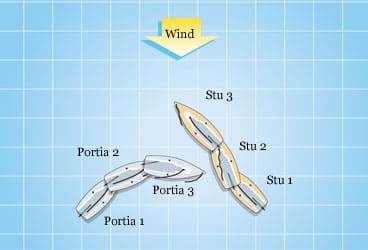
There are clear-cut rules to minimize the potential for contact, but when it comes to close encounters there’s still “room” for interpretation. “Rules” from our June 2012 issue.

Our experts get the most out of a two-boat J/24 tuning session.

In this article from our April 1995 issue, Scott Iklé describes the best methods for a Gate Start, also known as a Rabbit Start.

In this article from our February 1985 issue, world champion Ed Baird presents a simple, reliable method for finding the favored end of a finish line and adds some tips for getting there as quickly as possible.

Olympic gold medalist Robbie Haines shares his thoughts on when, where, and how to call a jibe set in a keelboat. From our April 1996 issue.

This throwback article from our July/August 1997 issue originally came out soon after it was announced that the 49er had been selected for the 2000 Olympics. As ISAF has recently announced that the 49er FX will be the women’s skiff boat at the 2016 Olympics, Kevin Hall’s tips and tricks prove to still be relevant today.

A first-time big boat tactician discovers that it’s not nearly as easy or as much fun when everyone else is expecting you to make the right calls.
Stuart Walker explains why management of calm requires recognition that is transient. From the Experts “Tactics” from our March 1995 issue.
From weight-saving designs to the transition from wood to fiberglass, Lippincott Boatworks stayed ahead of three decades of change. Article from our January 1997 issue.
In this article from our January 1996 issue, John Reichel predicts what we can expect from yacht design as the turn of the century approaches.
In this article from 1991, Stuart Walker explains why heads-up tactics and some quick forethought are often better than a red flag when it comes to dealing with Rule 54.3.
A second visit to sailing’s most demanding racecourse serves as a reminder that to be there is one thing, to return unscathed is another. “Gaining Bearing” from our June 2012 issue.
There are clear-cut rules to minimize the potential for contact, but when it comes to close encounters there’s still “room” for interpretation. “Rules” from our June 2012 issue.
Our experts get the most out of a two-boat J/24 tuning session.
In this article from our April 1995 issue, Scott Iklé describes the best methods for a Gate Start, also known as a Rabbit Start.
In this article from our February 1985 issue, world champion Ed Baird presents a simple, reliable method for finding the favored end of a finish line and adds some tips for getting there as quickly as possible.
Olympic gold medalist Robbie Haines shares his thoughts on when, where, and how to call a jibe set in a keelboat. From our April 1996 issue.
This throwback article from our July/August 1997 issue originally came out soon after it was announced that the 49er had been selected for the 2000 Olympics. As ISAF has recently announced that the 49er FX will be the women’s skiff boat at the 2016 Olympics, Kevin Hall’s tips and tricks prove to still be relevant today.
A first-time big boat tactician discovers that it’s not nearly as easy or as much fun when everyone else is expecting you to make the right calls.