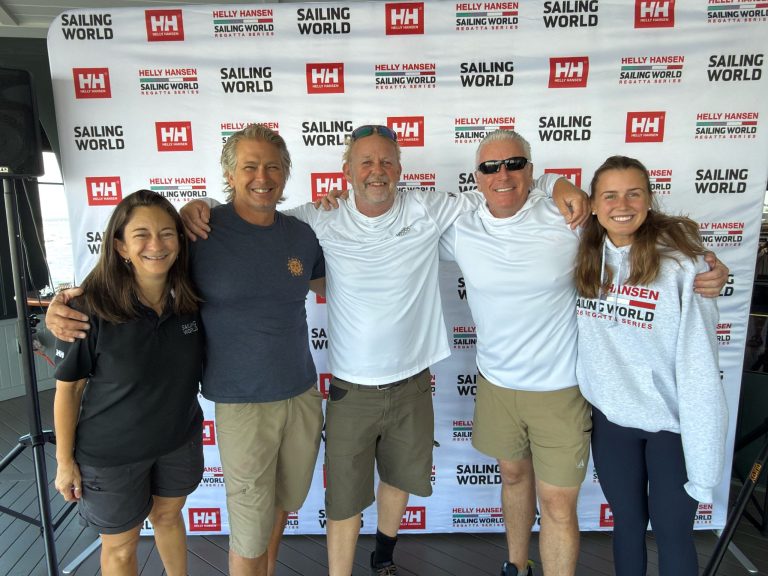
In May, I was the host of a reception featuring six American athletes who have won medals in sailing at the Olympic Games spanning from 1972 to 2024. The sport of sailing has changed dramatically over the past 54 years and yet each sailor was enthused to share their stories. For me, as well as our audience at the National Sailing Hall of Fame in Newport, Rhode Island, it was fascinating to hear the crystal-clear memories of their moment of Olympic glory. In that spirit here are some of the highlights of these remarkable sailors.
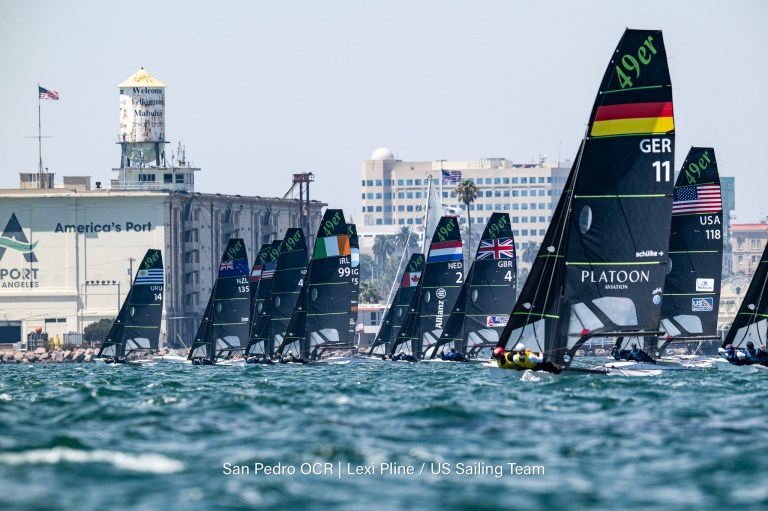
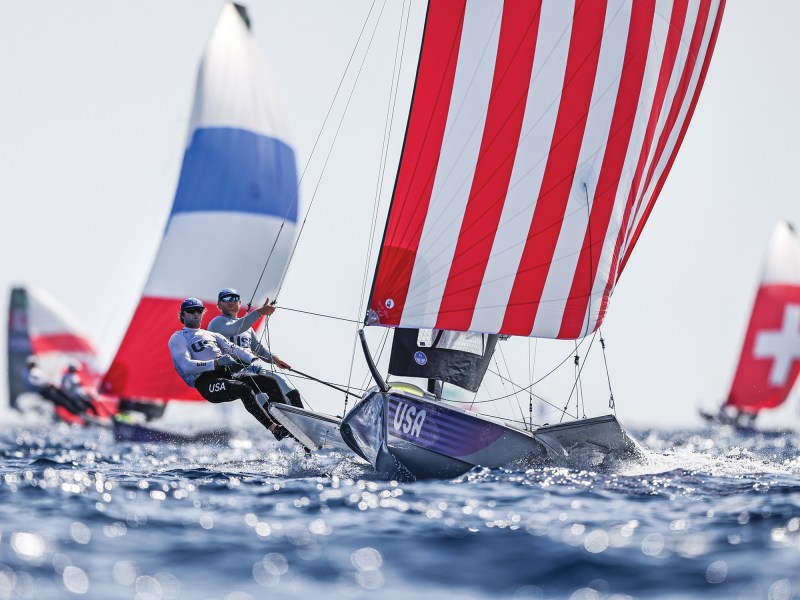
Hans Henken won a bronze medal at the 2024 Paris Games as crew with Ian Barrows in the 49er skiff class. They had a slow start in the preliminary series but improved as the regatta progressed. Henken and Barrows finished 8-7-17-9-9-5-10 in the first seven races. Remarkably, eight crews were close in the standings throughout the light-wind Olympic regatta off Marseille, France. One pair, Diego Botin and Florian Trittel from Spain, were clearly stronger than the rest of the fleet. Henken and Barrows were just off the podium going into the final medal race. Henken explained, nearly two years after the medal race, what happened that day: They talked about how they “loved light wind” on the way out to the starting line. Unlike the other teams, they had adequate water to stay hydrated during the long day waiting for wind. Finally, the race started but the wind died and the race was abandoned. The race committee tried again a few hours later, but the time limit expired.
Now late in the day, the race committee was forced to reschedule the race on the last possible day of the competition. The Americans reminded themselves that their goal was to win a medal, not necessarily a gold medal. That factored into their strategy on the starting line. They avoided a pack at the starboard end and took off with clear air in the middle of the line. They also didn’t worry about the light-wind strength—remember, they “loved light wind.”
Barrows and Henken finished fourth in the medal race to claim the bronze medal.
In 1988, Charlie McKee won a bronze medal as crew with John Shaddon on a 470, and another bronze medal sailing with his brother, Jonathan, in the 49er in 2000. McKee was an All-American sailor at the University of Washington and is a student of the game. He speaks in a philosophical style and at one point during the forum, Anna Tunnicliffe, Jonathan McKee, and Lynne Jewell Shore talked about winning their gold medals.
Charlie interrupted and remarked, “Too much talk about gold medals, bronze is good too.”
The audience had a good laugh and McKee explained what it takes to win a medal in this era of intense physical training, analytics, artificial intelligence, and extraordinary international competition. He explained that it takes four years to get the skill level to be competitive enough to be in the top ten. And then, he continued, athletes spend the next four years working their way on to the podium.
McKee also talked about the importance of good coaching, something that was just beginning when he first sailed in the Games 42 years ago. In the 49er in 2000, the McKee brothers were 38 and 40 years old, which is ancient in the 49er skiff these days. The pair won four of the 14 races and finished with 64 points for a 4.6 average. Charlie gave credit to Gary Bodie who was hired as the “high performance coach.” The position was new for the 2000 Games in Sydney, Australia.
Jonathan McKee spoke about the value of a competitive in the Flying Dutchman Class in the1984 USA Olympic Trials. He and his crew, Carl Buchan, an Intercollegiate Sailor of the Year, were virtually tied with two other boats going into the final race off Long Beach, California. It was a tough battle that came down to the final leg. McKee and Buchan prevailed by just 1 point. The experience was invaluable according to McKee when it came to the Olympics two months later. The America crew posted finishes of 2-1-2-3-1-4-6, finishing just 3 points ahead of Canadians, Terry McLaughlin and Everett Bastet.
Anna Tunnicliffe talked about the value of physical training for her run for the gold in the Laser Radial class. The racing in China in 2008 ended up being in mostly light winds, but the physical and mental toll was exhausting. She talked about her final race when she rounded the leeward mark ninth out of 10 boats with her chance of a gold medal slipping away. She kept her eyes open and looked for any wind pattern changes. On the next beat she found a 40-degree wind shift on the port side of the course and passed six boats.
At the windward mark she was in third and on her way to the gold medal. I had the feeling that Tunnicliffe was surprised by the accolades she received that night in Newport, 18 years after the Olympics.
At the 1988 Olympic Games, Lynne Jewell Shore and her skipper Allison Jolly were not favored to medal in Pusan, South Korea. They had trained on San Francisco Bay even though the wind was generally light in the September time frame. However, the wind off Pusan was strong all week and they were prepared thanks to their time training on the Berkeley Circle. In the first six of seven races the Americans finished with 3-1-1-2-3-DSQ-2. They could throw out their DSQ with a good finish in the seventh and final race.
One bad finish, however, would knock them out of a gold-medal position. The wind for the finale blew more than 30 knots. Unfortunately, their jib halyard broke soon after the start. In a blink, they were in last place, the gold medal was slipping away. They had some kind of disagreement over the proper fix, but Shore jury-rigged the halyard and off they went. The wind was so strong that most of the fleet did not set spinnakers. The Americans went for it, set their kite and took off. Jewell and Jolly passed 12 boats to finish 9th and win the gold medal. They were the first women in the history of Olympic sailing to win a gold medal.
John Marshall was a 30-year-old sailmaker working for Lowell North when 42-year-old Don Cohan asked him to crew in the Dragon class for the 1972 Games. Cohan told Marshall, “I will steer the boat, you call the tactics and make us go fast. Charles Horter joined the crew and handled the crew functions of trimming the jib and handling the foredeck. It was a very competitive class, and it would be the last time the Dragon class sailed in the Olympics. The American crew finished with a 4-5-6-1-12 in a shortened series and ended up tied with Germany.
On the tiebreaker, under the rules at that time, the Americans ended up third and earned a bronze medal. Marshall talked about how the Olympic experience helped him in later years for his nine America’s Cup campaigns (he won three America’s Cups). The Olympics were an opportunity to coach a relatively new sailor (Cohan) and learn about international competition.
It was an engaging evening and made me think that the aspiring athletes looking to compete in Los Angeles in 2028 and Brisbane, Australia in 2032 would do well to talk with these heroes of the past on how they achieved their goals. They speak from and with experience.