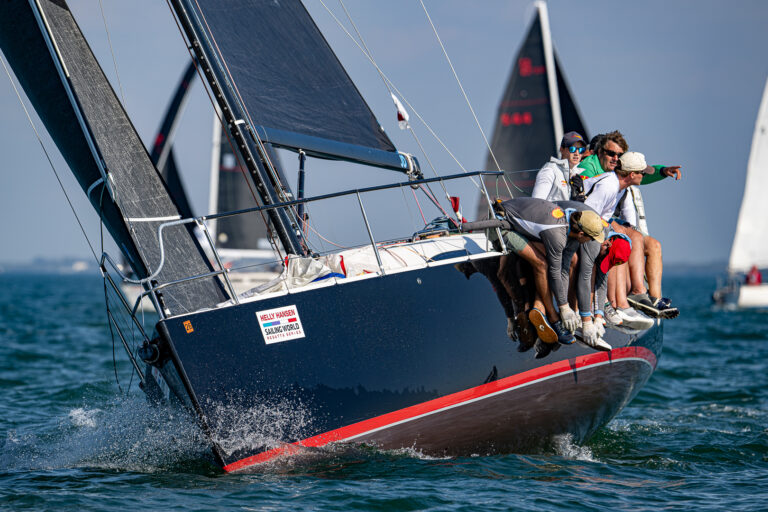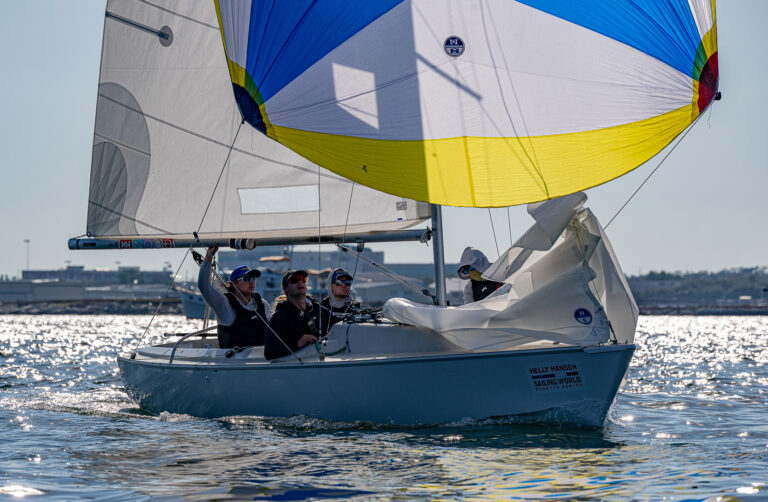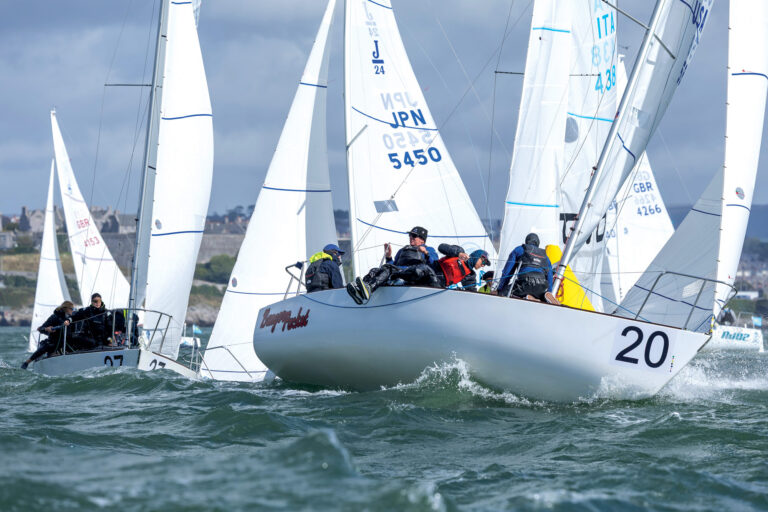
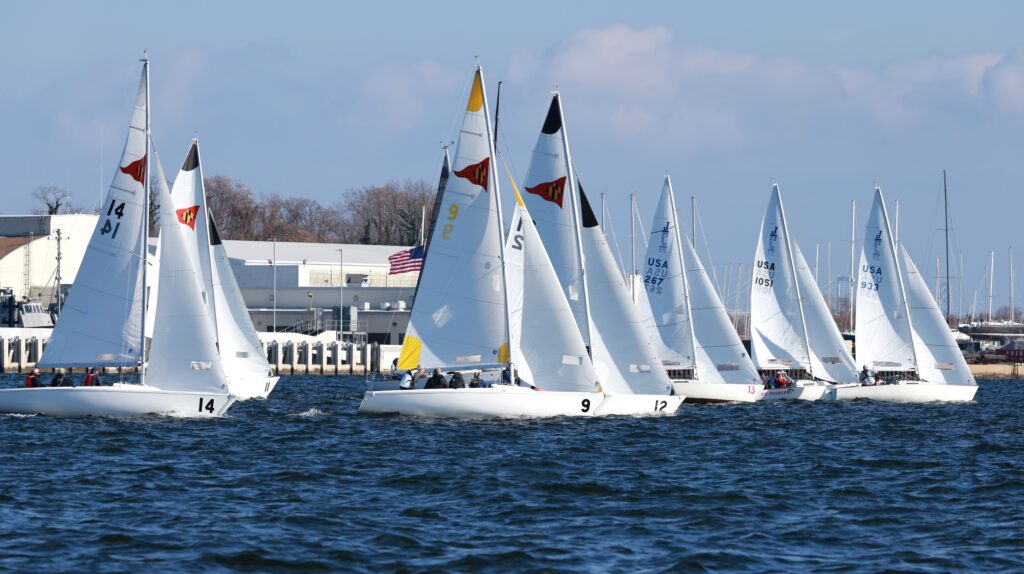
My initial goal was simple—to charter a Sonar for the Annapolis Yacht Club’s popular winter frostbite series. Second to that was a top-fleet finish, of course, and that goal proved much more challenging than the first.
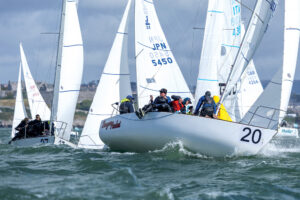
AYC’s frostbite series stretches over eight Sunday afternoons from early November to late December. The format calls for two races per day with a break between races to warm up. For the now-concluded 2025 series, a total of 118 boats entered with some classes racing in pure one-design fleets while others were lumped together. The Sonar fleet, for example, was paired with the J/22 fleet. The starting line and racecourse are the same, but fleets are scored separately. The Sailing Instructions required every boat to race with at least three crew for safety, and no spinnakers flown.
My teammates and I opened the series with a second and a fourth, and I quickly realized I could do better. I was not organized for the first day; we didn’t have a course chart, a radio, or the proper clothing.
It was embarrassing to ask competitors for the course. Worse, I did not feel confident.
After a sleepless night I resolved to improve every week. I started by making a notebook that included the Sailing Instructions, and a colored page of each of 12 optional racecourses. I also made sure to have a charged VHF radio to hear the race committee’s announcements.
The first few weeks I sailed without gloves. This wasn’t a problem in 55-degree weather, but when the temperature dropped into the 30s my hands were stinging at the end of the day. Lo and behold, I bought fleece lined gloves and sailed so much better. That was an easy fix. In cold weather it’s imperative to wear warm clothing. A thick wool hat, long underwear, good foul weather gear, feet warmers, a lifejacket and yes, gloves became our uniforms. When you’re comfortable you think more clearly. It’s as simple as that.
I learned to be patient and not get into one-on-one battles on the reach leg, which meant staying away from luffing matches. The goal was to stay as close as possible to the leader on the reach and wait for the windward leg to start working wind shifts.
— Gary Jobson
My starts on the first day were horrible. In each race, we rounded the first mark in last. It really bugged me. So, that night I reread some of my writings on starting and windward-leg tactics. I mentally thought about starting techniques every night before going to sleep and I reverted to the basics of using either a timed run or a port approach. Our starts got better.
AYC’s frostbite races often feature reaching starts, which add to the challenge. I learned to be patient and not get into one-on-one battles on the reach leg, which meant staying away from luffing matches. The goal was to stay as close as possible to the leader on the reach and wait for the windward leg to start working wind shifts. It was important to sail from puff to puff and take advantage of the shift. I noticed some of our competitors tended to pinch and sail too high when boats were close. I consciously worked on sailing straight and fast. And I avoided sparring with any other boats at all costs. As a result, in three races we were able to move from third place, or worse, and win.
The adage, “Sail your own race” does indeed work well.
In the early races I was trimming the mainsail while steering, but soon realized it was too much for me to do everything. When I handed the mainsail trimming duty to one of my crew I steered better, and big gains were made approaching or exiting a turning mark.
The essential factor of every rounding was to exit with clear wind. For example, if I was being blanketed after rounding the leeward mark, it helped to wait to tack until there was a clear lane. Doing extra tacks on short courses costs a lot of distance to the leaders. Also, we always had the sails set up for the next leg before making the rounding. With the outhaul, downhaul and halyard preset, the crew was able to concentrate on sailing fast and not making endless adjustments at the critical moment when trying to gain speed after a mark rounding.
For the past several years, I’ve sailed predominantly as a tactician, which means I am more used to studying wind patterns and the tactical actions of other boats. It had been more than a year since I steered a boat during a start. I was out of practice. At the helm, I had to relearn that it is important to have someone else look around. As I got that lesson back into my head our performance improved. My crew enjoyed watching for wind and reporting on the performance of the competition and we excelled when I verbally explained the next maneuver, so everyone was prepared.
After two days of racing, my nervousness was gone, and I looked forward to each race. We improved our starts and sailed faster each race. One day, after racing, I asked my 13-year-old teammate, Paul Turner, if he had any suggestions. His answer was succinct, “We need to sail faster.”
I interpreted that to mean not to pinch.
Another crew, Caroline Kelly, was in her first year of law school after competing on the sailing team at Tufts University. She was a skilled intercollegiate crew and was sharp on the jib trim. Our fourth teammate, Bill Jorch, sailed at Georgetown and was an excellent main trimmer. Everyone weighed in on tactics.
Looking back on the whole series, I realized that the downwind legs provided plenty of opportunity to make gains, as long as we sailed in clear wind and minimized our jibes. Three of the racing days were cancelled due to there being either no wind or winter gales, but we did get in 10 races over five Sundays. We finished second overall, just 1 point out of first, but more importantly we improved throughout the series, reaffirming the importance of identifying our weaknesses early on and turning them into our strengths.