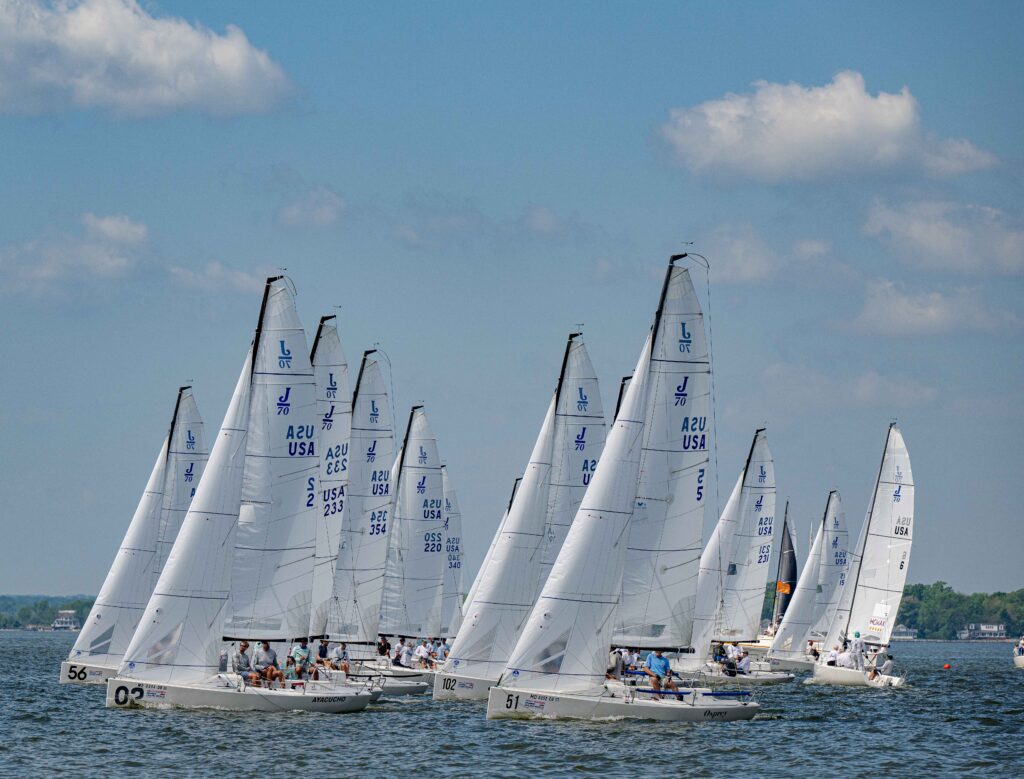
For decades I have raced sailboats by what we’ve long known as “seat-of-the-pants sailing.” This was a time when dinghies and keelboats only had a compass, telltales and a masthead fly as helpful aids, but that was about it. We have rapidly advanced to using digital compasses, speedometers and anemometers, but technology creep into the highest levels of the sport today is rapid. On board the fastest raceboats today, multiple computer screens, hand-held tablets and artificial intelligence can guide trimmers and tacticians to perfection. Let’s just say there is not a lot of seat-of-the-pants sailing happening at the highest levels, and this technology trend is weaving its way ever deeper into the sport.
Several popular one-design classes, including Etchells, J/70s, Melges 24s and many more, have embraced new technology with Global Positioning System-based instruments that provide precise distance to a starting line or turning mark. To understand how sailors use these tools toda, I reached out to Etchells and J/70 world champion (and incoming National Sailing Hall of Fame inductee) Jud Smith about the proliferation of these nifty instruments.
“They work, and they change the game,” he says. “It’s an equalizer because you don’t need a professional sailor on the bow telling you how far you are from the line. It’s helped the more amateur teams, if they learn how to use the tool. Now more boats are consistently on the front row.”
There are two major players in the industry: Vakaros with its Atlas units and Velocitek with its ProStart. These instruments are impressively accurate. The Atlas 2, Vakaros says, processes information 50 times per second to keep the compass stable, especially in choppy water. This is done using gyro stabilization. “Our (wind) shift tracking feature helps you stay on top of the phases of the wind and focus more on sailing, and less on mental math,” the company’s literature states. That’s something I can get behind.
Velocitek’s ProStart provides a clear visual of a countdown and distance to the line. The unit records position, time, course over ground, speed over ground, magnetic heading and heel angle four times per second. After sailing you can download the information to review with the crew.
There’s a lot of data and information delivered by these devices, but Smith reminds us that sailors need to use them as a guide. It’s equally important for us to keep our eyes outside the boat to stay clear of other competitors along with watching for waves and wind. In other words, they can do a lot, but they cannot see puffs moving across the racecourse. And in the starting sequence, somebody other than the helmsman should count down the time to the start, and the same should hold for the crew reading the distance to the starting line.
Setting up instruments for use takes time and study with the manufacturer’s guidebooks. It is important to practice which buttons to press so the process is second nature during a starting sequence when everything is more intense.
Because the instruments can provide time and distance to the line, first-time users tend to set up on the line early and too close, but Smith’s practice of staying back from the line to have room to accelerate has merit. Having adequate room to accelerate for speed is important. You do not want to be the boat slowing down in the final seconds before the start when you think you might be early. “I don’t have to worry too much where the line is even though I don’t sail with other professional sailors,” he says. At a recent Etchells Midwinter Championship, “everyone was too close to the line because they knew where it was. I held back more and tried to pick and choose where I wanted to break through.”
The tactic worked as Jud handily won the regatta.