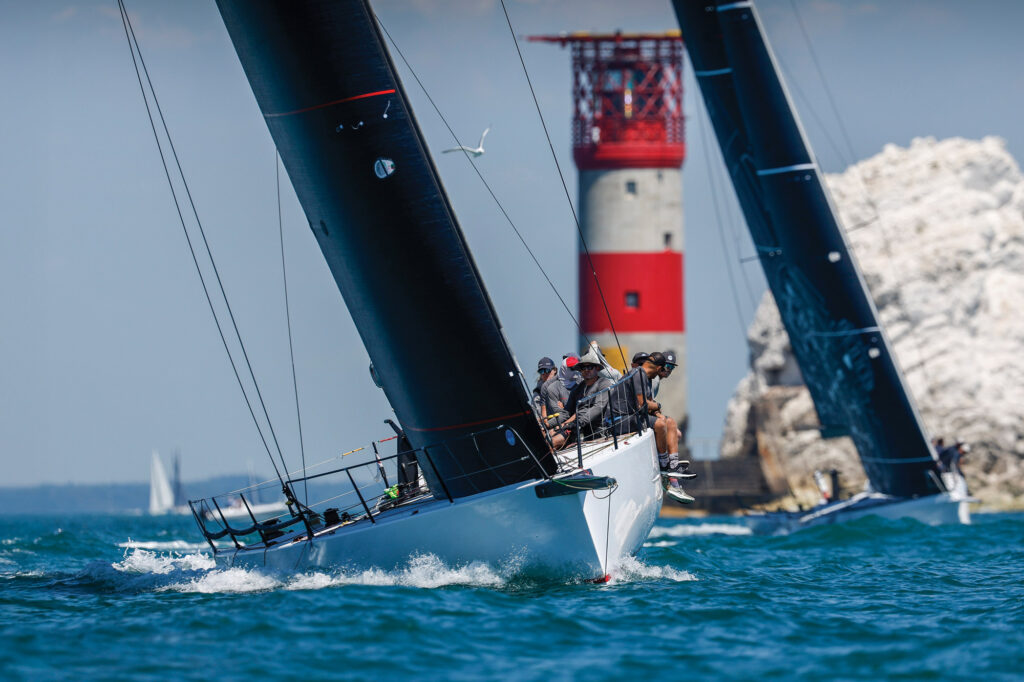
The Isle of Wight, off the south coast of England, hadn’t experienced a summer invasion of this scale or caliber in more than two decades. The arrival of 30 grand-prix race yachts, and the onslaught of owners, shore crew, grand-prix veterans and eager sailing teams, was indeed a moment to behold. Everyone was hyped for the revival of the Royal Ocean Racing Club’s iconic regatta, and here in the busy seaport of Cowes, the Admiral’s Cup—once old, was new again.
Before we turn our attention to the current affairs in the UK’s cradle of sailing, however, a brief history of the Admiral’s Cup is necessary. The RORC founded the regatta in 1957 with a simple but compelling concept: a nation-against-nation series raced by teams of offshore yachts. At the time, the offshore racing scene was booming. The Fastnet Race was increasingly drawing international entries and Cowes Week itself was the jewel in the crown of the big-boat racing landscape.
The Admiral’s Cup stitched these elements together into a cohesive narrative: three-boat national teams, typically composed of the most competitive yachts from a country, would race a series of inshore events before culminating in the legendary Fastnet Race—the 650-nautical mile epic from Cowes to the Fastnet Rock and back to Plymouth.
The format was designed to reward versatility: a winning team had to perform in the tight confines of Solent courses and not just survive, but thrive, in the offshore waters of the Irish Sea and beyond. This highly compelling formula attracted the world’s very best boats, skippers, and crews, and many countries ran trials to identify and deploy their very best assets.
The 1970s and 1980s were the Admiral’s Cup’s golden years. In those decades, the Cup was the regatta to win for any serious offshore racing nation. Big-name sailors of the era—Lawrie Smith, Harold Cudmore, Ted Turner, and Iain Macdonald-Smith, to name a few—became household names in the sport. Simultaneously, some of the most famous racing yachts of the era—Impetuous, Morning Cloud, Ragamuffin, and Container—all became part of sailing lore through their Admiral’s Cup exploits.
National rivalries ran deep and fierce. The Americans brought cutting-edge design and deep pockets. The Australians were dogged and fiercely competitive. The Germans were ruthlessly well-organized. And the British fought tooth and nail to defend the Cup on their home waters.
At its peak, as many as 20 nations fielded teams, and the Admiral’s Cup became a spectacle, drawing international media coverage and hordes of spectators to Cowes and the Fastnet finishing port of Plymouth. By the 1990s, however, changes in rating rules (the transition from IOR to IMS), rising campaign costs, and the proliferation of competing grand-prix circuits, such as the Audi MedCup for TP52s and the burgeoning Farr 40 one-design class, as well as a growing calendar of superyacht regattas, all conspired to dilute the Admiral’s Cup’s once-unassailable status.
In 2003, only seven teams competed. The RORC cancelled the 2005 edition citing a lack of entries, and with no clear path forward, The Cup quietly faded, becoming a relic of its heyday, its trophies collecting dust behind glass in the RORC’s clubhouse in Cowes. It was a disappointing loss for the offshore racing community. For many, the Admiral’s Cup wasn’t just a regatta; it was an institution, a cultural cornerstone of post-war international yacht racing.
Over the past several years, however, the regatta’s revival was carefully planned by key members of RORC. Renowned French offshore racer Eric de Turckheim—owner and skipper of a string of serial trophy-winning yachts called Teasing Machine—was the RORC Vice Commodore in 2022 and headed the club’s program and race committee.

Not surprisingly, the Frenchman fondly recalls racing in Cowes in the 1970s, still in his early 20s and dreaming of one day being part of the glitz and glamour of the Admiral’s Cup. Tasked with bringing it back after 22 years, he smartly opted to simplify the event’s rules and regulations to make it easier for teams to be formed.
“Bringing back the Admiral’s Cup was important,” de Turckheim says. “RORC offshore races have been very successful and continue to grow in participation. You just have to look at the number of entries for the Fastnet Race, which grows every year. But it was also important to bring back the international teams to Cowes and the return of the Admiral’s Cup was one way of achieving that.
“Secondly, we wanted to give back some importance to inshore racing. RORC is very active on the offshore front but not so much with inshore. But we have so much inshore racing going on with the TP52s, the Maxis and the Maxi 70 classes and that makes it an important factor.”
Choosing the size of boats was a simple decision. “In the 50- and 40-foot range, you have some top boats and crews all around the world,” de Turckheim points out. “So that’s why we limited it to those two categories, which are quite professional.”
The most intriguing change was the RORC’s decision to make the Admiral’s Cup a competition between yacht clubs rather than nations—a move that simplified the formation of teams given that coordinating things with a yacht club is infinitely more straightforward than dealing with national governing bodies. As great as it was to have the Admiral’s Cup be a nation-based competition, the appeal of the yacht club route is also compelling.
The RORC keeps good company, so it should be no surprise that the entry list ultimately featured a swath of top-tier international clubs, such as the Yacht Club de Monaco, Royal Hong Kong YC, Italy’s Yacht Club Costa Smeralda, the Royal New Zealand Yacht Squadron, the Cruising Yacht Club of Australia, the Netherlands’ Royal Maas Yacht Club, Royal Swedish Yacht Club, Yacht Club de France, New York YC, and Royal Irish YC. There were three German teams from Regatta Verein Greifswald, Bayerischer Yacht Club, Hamburger Segel Club, as well as two entries from the RORC.
The big-boat class featured six IRC-optimized TP52s, including four Botin designs. Peter Harrison’s Jolt 3 represented the Yacht Club de Monaco; Karl Kwok’s Beau Geste flagged for the Royal Hong Kong Yacht Club; Maximilian Klink’s Caro sailed for the Royal New Zealand Yacht Club; and Gordon Ketelbey’s Zen hailed from the Cruising Yacht Club of Australia.
Slightly smaller, but designed as a TP52 slayer, was Giovanni Lombardi Stronati’s WallyRocket51 Django WR51—a boat with head-turning looks that was a weapon in both the inshore and offshore races. Equally striking to look at, but less sparkling in terms of results, was Niklas Zennstrom’s Carkeek 52 Rán. Worthy of note amongst the bigger boats was the Ker 46 Rost Van Uden, a member of the Royal Maas YC team run by Dutch around-the-world racer Gerd-Jan Poortman.
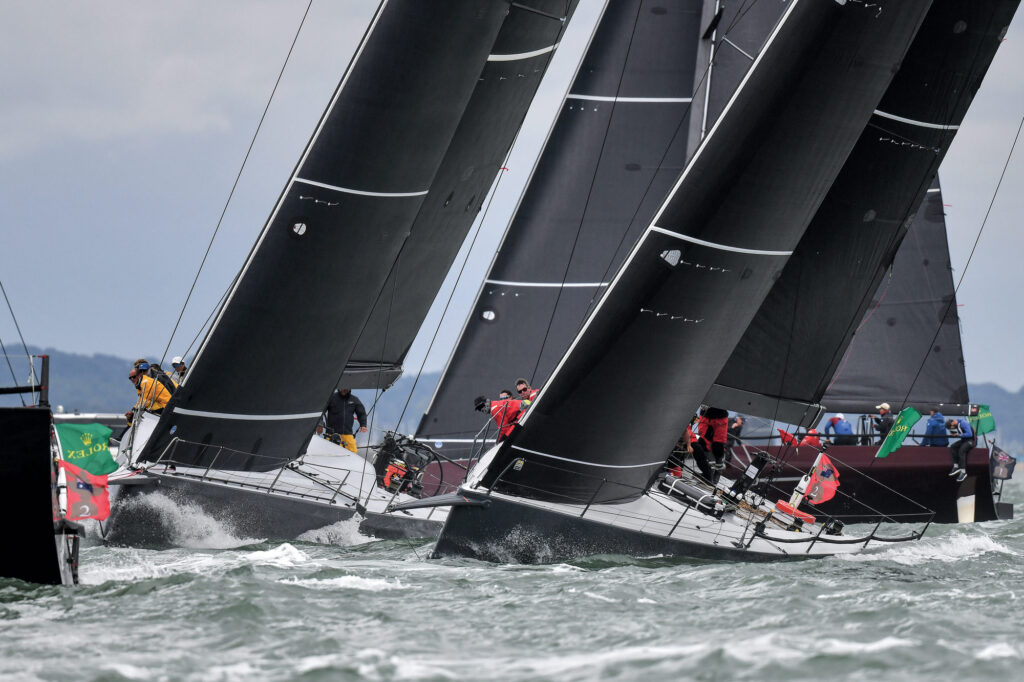
The small-boat class had Peter Harrison’s Carkeek 40 Monaco, American James Murray’s GP42 Callisto (sailing for RNZYS), Karl Kwok’s Botin 41 Beau Ideal (for Hong Kong)—a boat built specifically for the 2025 Admiral’s Cup, and Giovanni Lombardi Stronati’s JPK 11.80 Django JPK.
The format was six inshore races over three consecutive days in the highly tidal and obstacle-ridden confines of the Solent, sandwiched between two offshore races—the opening 165-nautical mile Channel Race and the final 695-nautical mile Rolex Fastnet Race, which took the fleet out to the southern tip of Ireland and back into the English Channel to the finish in Cherbourg, France.
With a double-points coefficient for the Channel Race and triple for the Fastnet Race, the challenge facing the teams was how to optimize their bigger offshore-configured boats for the inshore series, and how to make the smaller inshore boats—many of which had been set up to race in the regionally popular Fast 40 division—into potent offshore machines. It was a challenge that appeared to be welcomed by the owners and sailors alike, as a welcome change from Mediterranean-style windward/leeward racing. It also proved to be a boon for sail and systems developments across the fleets.
Rodney Ardern, a veteran of America’s Cups, Volvo Ocean Races, and Admiral’s Cups, and sailing aboard TP52 Jolt 3 for the Yacht Club de Monaco, says his team embraced the opportunity to break out from the norm of the 52 Super Series and usual offshore races. “This is a good combination of all that in a compact week,” he says. “We spent a lot of time developing the boats, and the sails in particular, with reaching sails, staysails, jib tops, and all of the kind of stuff you don’t spend a lot of time on unless you are on a pure ocean racing boat.”
Ardern says the major difference in the big boat class was between the older and newer boats. “Our 52 was an older design that dates back to when there were still reaching and coastal components to the Super Series. So, we don’t have sheeting systems that go through the deck, and that makes us relatively waterproof when we go offshore. Then, there are newer 52s like Beau Geste, as well as the specialist offshore 50s like Caro and Rán; those two are so powerful and have water ballast, so are pretty hard to keep up with offshore.”
Australian mainsheet trimmer Chris Hosking, racing on the all-new WallyRocket51 Django WR51, says the rejuvenation of the Admiral’s Cup has brought back an element of regatta racing that had been missing for a long time.
“In the Admiral’s Cup, there’s a lot of reaching and sailing at different angles and different modes. There are some skills that we are having to revive, for sure, and some that people are having to learn for the first time. Picking the sails for a day of inshore racing isn’t easy, either, when you have a windward/leeward first and then a round-the-cans course afterwards. You don’t know the course for the second race when you leave the dock, so we have to bring more sails than we would want to for weight, just in case.”
Then, there’s a great deal to think about, Hosking says, when it comes to switching a boat from offshore to inshore mode. “There’s obviously all the safety equipment that changes. The sail inventory changes. You do whatever you can to make the boat lighter: the reefing lines come out; all your bits and pieces like offshore gear bags and spares come off.”
Switching Django WR51 the other way—from inshore to offshore efficiency—means adding in an extra quota of reaching sails.

“Stuff like the Code 0, the jib top, and a big genoa staysail,” Hosking says. “Then there’s the capability to reef. We reef much earlier when we are reaching, and we might pull a reef in as low as 16 to 17 knots of breeze when we have got the Code 0 up and we need to sail a hot angle. It would be much more effective to reef the main rather than switch from a masthead zero to a jib top.
“With a boat that is this new, we are still learning and understanding every day. Even when we are racing, we are working out what the boat likes and what it doesn’t. It’s a constant process of evolution.”
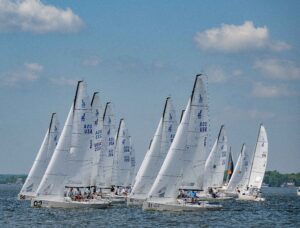
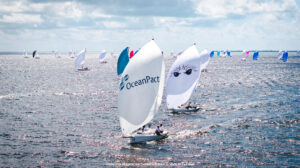
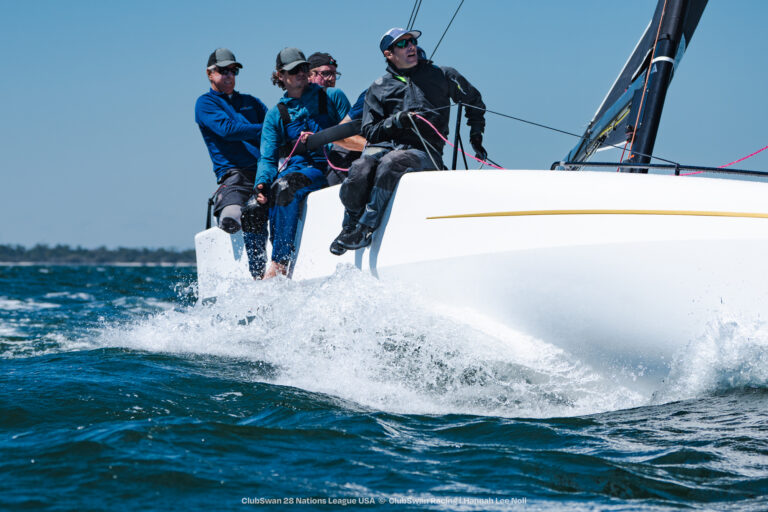
The 30-boat Admiral’s Cup fleet made for a striking sight out on the swirling waters of the Solent. Given the levels of professionalism and preparation for most teams, starts and mark roundings were plenty intense, and boathandling at the front of the fleet was top shelf. Four clubs dominated the top of the leaderboard across the eight-race series, where the team scores were tallied based on individual race points rather than their series scores. The Yacht Club de Monaco’s immaculately prepared pairing Jolt 3 and Jolt 6 both won their classes to give the principality club the overall victory. Runner-up was Royal Hong Kong YC, where Beau Geste and Beau Ideal finished fifth and third. Third overall was Italy’s Yacht Club Costa Smeralda, whose Django WR51 and Django JPK 11.50 finished third and fourth in IRC1 and IRC2 respectively.
Credit is also due to the Cruising Yacht Club of Australia’s Zen—owned and skippered by Ketelbey—which backed up an excellent inshore series with a fourth place in the Fastnet Race to finish 1 point in arrears of Jolt 3 in the IRC1 standings. Poortman’s young crew on the Ker 46 Rost-van Uden also performed well in the inshore racing, before pulling off a stunning victory in the Fastnet Race to finish fourth overall in IRC1.
There was, however, much more nip and tuck to the racing than results might suggest. The battle in IRC2 between Jolt 6, James Murray’s Royal New Zealand Yacht Squadron entry Callisto, and Beau Ideal burned fiercely throughout the regatta. The Fastnet Race was the decider, with a 1-point overall advantage going to the Monaco boat only after coming out of a jibing duel with the Kiwi yacht on the final approach to Cherbourg.
So, the Admiral’s Cup is back, and, by any reasonable measure, its return was resoundingly successful. Chatter in the pubs and restaurants of Cowes during the regatta was all about the rosy future of international team competitions like this. Moreover, it seems the British flagship event’s successful return may have triggered a wider revival of international team competitions.
On the eve of the start of racing at the 2025 Admiral’s Cup, the Yacht Club Costa Smeralda announced an Italian version of the Admiral’s Cup—the Sardinia Cup—last held in 2012, would return in 2026. There were even numerous unsubstantiated rumors of plans for Hawaii’s Kenwood Cup (formerly the Clipper Cup) to also be revived.
The next edition of the Admiral’s Cup has been provisionally scheduled for July 2027 in Cowes. No doubt there will be evolution of the format by then—perhaps a return to three boat-teams—and the inking of a title sponsor to provide the necessary funding required to fully return this gem to its glimmering state.