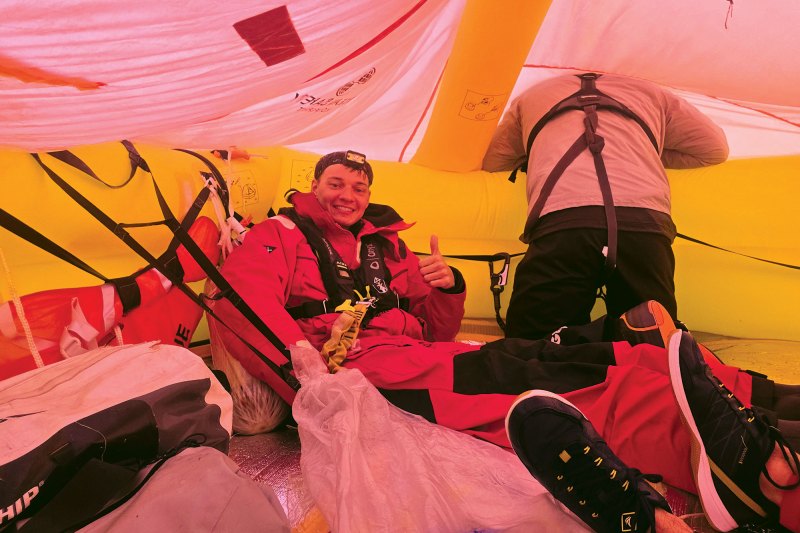
There’s beauty in steering a sinking ship. Everything becomes surreal. But here I am, on Magic Bus, my family’s beloved escape pod, sinking 280 miles off the coast of North Carolina. The helm is lifeless and both engines are dead, awash in oily seawater. Soon, I’ll be saying farewell forever to a boat that taught me to problem solve, to fix things, to be an adult.
Black is this offshore night, a void between a spotlight moon and 15-foot waves hissing and heaving on an early November night on the Atlantic. The 45-knot gale makes me think loudly to hear myself. It’s not raining, but plumes of spray pelt the deck as sloshing waves lash the hulls. The horizon disappears beneath each new roller. It’s impossible to say which heaving wave will put Magic Bus out of its misery, but by 3:30 a.m. it’s apparent to all five of us on board that a final blow is inevitable.
My crewmate, Zach Doerr, an experienced 23-year-old offshore sailor, swings open the cabin door.
“Dylan, it’s not looking good down there. We’re going to have to…ah…abandon.”
I nod. His last word is slurred, but strangely, I’m happy to hear it. For the past two agonizing hours, abandoning ship was a possibility, but now there is clarity. Now I have a purpose, even if it is just getting into a life raft. I step down from Magic Bus’s wheel one last time and dive below to search for my passport.
Exactly five years before this moment I was in the comfort of my childhood bedroom packing moving boxes with my family. When COVID came knocking a few months earlier, my dad sold our house and bought the Bus. My mother never stood a chance convincing him otherwise. We buried my childhood dog’s ashes, loaded all remaining possessions into our Ram 2500 and headed to Fort Lauderdale, eager to set eyes on our new floating home. Big she was, all 54 feet long and a staggering 28 feet wide. The 20-year-old boat was stuffed with a decade’s worth of charter captain hoarding. The four of us, and our new basset hound Boomer, spent a week scuttling rusty tools, broken parts and hundreds of feet of excess chain. We gained three inches on the waterline by the time we were done.
I’ve been holding the flashlight around the house for my dad forever, but the Bus was a different animal. The first time I looked at its circuit panel I knew electronics wasn’t my future. It was a maze of knobs, screens and switches. “Don’t flip this one,” the previous boat captain explained to us as he pointed to one labeled “firework launcher.” My dad walked me through the basics. He emphasized all the knob configurations that could “break everything.”
“If you flip X while Y is on, the generator is toast. If you switch X to Y setting while Z is happening, there goes our inverter. You see these wires, they have 220 volts running through them.”
“Is that a lot?” I remember asking.
He looked down as if he had failed me as a father and sighed. Fair enough.
After a week of dad’s instruction, I had more technical knowledge than any other kid I knew. I could replace a broken pump, change a fuel filter, and crawl around the engine with the best of them. At 5 feet 5 inches and 125 pounds I became the acne-faced Michael Jordan of bilge monkeys. The boat became infinitely more seaworthy, we acclimated to our new digs, and trained Boomer to piss on the trampoline before shoving off from Fort Lauderdale, eastbound for the Gulf Stream.
Over the next five years Magic Bus became a Staniel Cay fixture, an active winter platform for friends and family. Over the summers, the family wagon returned north to take us from Block Island to the Cape and islands. She moved with the seasons and followed the sun, one of the many boats that migrate south every Fall.
Our departure this time is like all the others. Over weeks of preparation two new engines are installed, Zach carefully inspects all 85 feet of the mast. I retrieve our 12-man life raft from the barn, check its service date, and toss it in the back of my dad’s truck. Back at the boat, we strap it to the deck above the cabin. With forecast models vetted, and professional second opinions gathered, we target our departure date for November 3.
Buster Pike, our 57-year-old delivery captain, calmly leads our pre-departure crew meeting. This isn’t his first rodeo. He’s worked as a boat captain on many boats and skippered catamarans far larger than Magic Bus. He’s got plenty of offshore miles, deliveries and races. Plus, he’s delivered the boat a few times, so he’s familiar with it. The rest of us are under 24, which makes him the adult on board.
He reviews locations of tools, medications and the emergency plan. Zach is assigned to the life raft, along with Sam Gryska, who is the greenest in both sailing and mechanical knowledge. Evan Spaulding, a naval architect from the Webb Institute, is—like Zach—a graduate of Webb’s offshore racing program. As the son of a professional sailor, I know my way around boats. I had an Opti, Darth Dylan, at four. I raced 420s alongside Evan nationally, but never loved the racing enough to shoot for a top collegiate program. My dad called me a “gentleman sailor” years ago, still an apt description.
Back to the emergency plans: the man overboard procedure, lifejackets and tether check. “If you fall overboard, don’t plan on being picked up,” Buster says. “It’s not that we won’t try our hardest. It’s just the nature of the operation.”
Sobering words.
“There is also a 12-man life raft onboard, though hopefully we won’t need it.”
Tempting as it is to start thinking about the next task, we pay attention to our raft briefing and make a solid plan. Sam and Zach are put in charge of the raft so Buster would be free to make final emergency broadcasts. Evan and myself are instructed to assist with the highest priority tasks if needed.
Lines are cast at 19:00 on Monday, as planned, the crew itching for departure. Two hours later we are embraced by the Atlantic, charging toward our destination in a fresh breeze. In the first 24 hours, we are hitting 18 knots, averaging above 10. My dad sends us a message to tell us that we were on pace to shatter the boat’s previous 24-hour record.
After a shift on the helm Tuesday afternoon, high on driving, I turn into my bunk for a power nap. While deep in a psychotic Dramamine-induced dream, I feel a gentle tap on my foot. Buster wants to know where the extra bilge pumps are. This can’t be good.
“You might want to come up on deck,” he calmly states. This is Buster’s way of saying “get your ass out of bed.”
On deck, everyone is crowded around the port engine room hatch. The compartment is flooded. Over next few hours Evan rigs the starboard raw-water intake as an emergency bilge pump while Zach and Buster wire up every spare pump available.
By the following afternoon, we accept a stalemate: the water is coming in slightly faster than it is going out. Troubleshooting continues. I offer to dive the compartment and take a peek. Buster eventually takes me up on it.
I toss on cotton thermals to protect against sharp edges, grab a snorkel, and head for the port engine room. The bilge is surprisingly clean. The water swamping the engine appears aquarium clear. Buster stands over me and calls plays. We start with the water maker. I tuck my head below the workbench and find a three-inch air pocket. My ears are submerged, my nose pressed up against the bench, my mouth just above the sloshing water. After a historic breath, I reached around the motor. I spot the strainer and follow its hose to the bilge and the brass through-hull. I grab its handle and twist. Problem one solved. I work my way out around the engine, gasp for air, and repeat the same process for the raw water intake. Buster closes the air conditioner’s valve. Three for three. Smiles all around.
As I scrub oily bilge juice from my skin with a cup of freshwater, my mates note that I’m glowing, which was probably battery acid.
Spirits are high for a few hours. There’s hope. Then disappointment. Five bilge pumps are the only things keeping us afloat. Water will not go below the waterline. What now?
Staniel Cay is out. A run west for the mainland is off the table. Virginia is only 130 miles away, but it would be a day and a half of beating into 30-knot plus winds. Both crew and the land team agree Florida is the destination. Business as usual, bearing 180 degrees. Conditions worsen but the port-engineless Bus remains in motion.
At 1:30 a.m. I’m jolted awake. My groggy eyes zero into focus, and I soon realize they are staring directly into outer space. The deck hatch has blown out, sea water is falling on me.
“All hands!” Zach calls from the wheel, his voice overpowered by the flogging half-furled jib. I hop off the settee, grab my lifejacket and harness, and stumble three times while heading for deck.
The jib whips violently in the breeze until we furl the lifeless cloth. With no jib, we are truly dead in the water. The starboard engine is now dead. The generator coughs, cranking but refusing to fire. Buster is at the nav station calmly sending messages and making calls. Evan tries to phone a Coast Guard station directly, but clearly didn’t ring the emergency number. We are greeted with a nine-prompt phone menu, followed by another four prompts, only to be told the person we were attempting to reach was not in the office.
We all contemplate one last call home. We have an hour of Starlink before communications go dark. The conversation then drifts from what could be done to what we all know needs to happen.
I zip my passport into a plastic sandwich bag and toss it into the ditch bag. I rummage through the galley and main cabin looking for water jugs, protein bars and a handheld VHF. Evan clips his JBL speaker to his lifejacket.
On deck, Zach and Sam are unlashing the life raft. I tie the most important bowline of my life and fasten the end of the inflation pull cord to the deck. We toss our one hope into the Atlantic. “It will take more line than you think,” Buster calmly calls from inside. Evan keeps taking line. No action. More line. No inflation. End of the line. We look around holding our breath. Bang! Our chariot bursts out of its case.
We work the raft into a loading position astern. My mind races through memories: Sunset dinners with family in the Exumas. Summer nights with friends. The rager that my buddies and I threw when my parents went out of town.
“Buster, it’s time to go!” I yell into the cabin. He’s still rifling off last-minute messages.
At 3:30 a.m., after loading two drybags, it’s time to make the step of faith. Sam is the first to go. The poor guy was never briefed on life raft entry and ends up laying spread eagle on top of the half-inflated raft.
“Guys, you step into the raft.” Buster shouts. Zach is next. Evan follows, landing awkwardly on his shoulder. Unclipping my harness from the Bus, I slowly rise from my knees, put my right hand to my forehead and click on my headlamp. Three. Two. One. Go.
I hit the bullseye, landing in a cold, dark wet raft. Buster follows closely behind me. I remember tying the ripcord to the deck. Not wanting to go under with the sinking ship in our oversized plastic bag, I remind Buster that we’re still attached. He reaches outside the raft and cuts us free. We’re off at the Bus’s final stop.
We each take a seat around the wet raft with our backs to the walls and feet joined in the center. Our eyes are locked. Buster takes stock and assigns jobs. While he’s working the manual air pump, a wave smashes the raft and folds it like a taco. Somehow it stays upright. Buster pumps faster.
The next two hours are dark. The look in everyone’s eyes hints at the severity of our situation. But there is no panic. Everything will work out. Evan reasons we are out of helicopter range without a refueling station. The star is the EPIRB Evan cradles in his hands. Chirp. Chirp. Chirp. Every light and noise transmitted gives us hope that our location is visible. Chirp. Chirp. Whoosh. Chirp. Whoosh. Chirp. Then silence. We hold our breath. Evan smacks the thing back to life. Chirp. Five exhales. Whoosh.
My mind drifts from things I miss, to stories I knew about survival, to God. Never religious, I figure prayer would be disingenuous. I try to keep my thoughts present. The constant whooshing is a reminder of my place in the world. I play songs in my head to pass time. I ask what everyone is looking forward to when we get home. Family, food and hot showers are common answers. Getting into another raft is not.
By 5:30 a.m. as the sun creeps over the horizon, I hear something artificial. We’re all delirious, so I give it little mind. Then I lock eyes with Evan. A mummer becomes a hum, to a buzz. Evan and Sam rip open both flaps of the entryway. Between the edges of the doorway is a perfectly framed C130.
Evan quickly makes for a flashlight and I dig for flares. He points the strobe directly into the cockpit. The plane passes overhead. We hold our breaths and wait for the noise to return.
We’re seen. During one of C130s endless loops, the crew drops a supply crate. It lands within 50 feet of our raft. The chord trailing it lands so close that Sam reaches right over and hauls it in. We open the mystery box to find blankets, rations, medical supplies, and a working VHF.
“Airplane, airplane…life raft.” Buster replies in the tone of an airline pilot giving the local time and temperature.
“Loud and clear life raft.”
The pilot informs us there is a helicopter two hours away, currently refueling on an aircraft carrier. The carrier has altered course to assist. Families have been updated, all are relieved.
The next two hours are purgatory. Rescue is on the way, but the sea isn’t done yet. Two of us are vomiting profusely. Then Sam makes a startling discovery. Off in the distance bobs Magic Bus’s beer cooler.
“Buster, we gotta get that cooler,” he suggests.
“Not the time, Sam,” Buster replies.
What feels like an hour is only 15 minutes. The raft contorts physical space and warps reality. I try to sleep, but it’s futile. Instead, I slip into a dreamlike state. Feeling nothing but water swirling around my legs. As the helicopter roars in from the west, I skip my mental playlist to Brain Stew.
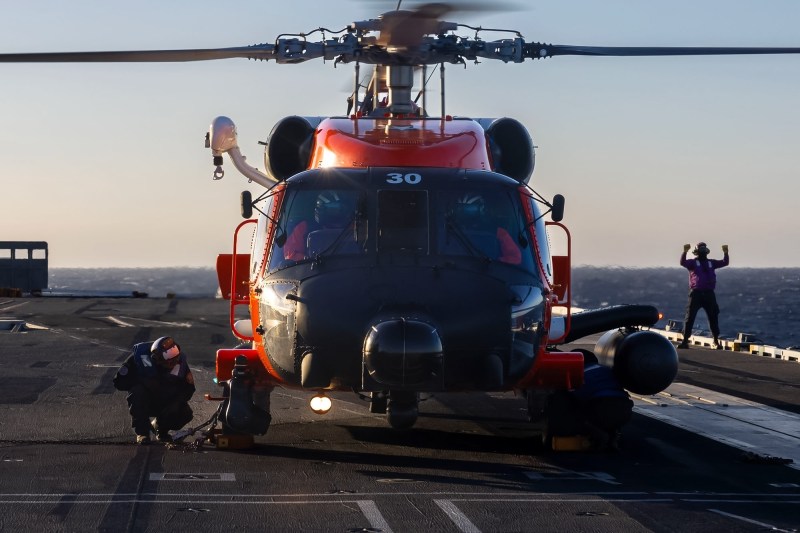
You don’t hear helicopters. You feel them. Each blade rotation sends a pulse through your flesh. “Swimmer going down.” Buster calls. Every word out of his mouth is so matter of fact, emotionless. Realistic. Every word is important. Nothing more or less.
The swimmer hits the water and makes a beeline toward our raft.
“How’s it going everybody? he asks enthusiastically.
“As good as it can be.”
“Anybody seriously hurt?”
“Negative.”
“Great, one of you at a time is going to jump over. I will then swim you to the bucket. Sit in the bucket and keep all your body inside. Who’s first?”
Our two seasick mates made the first trips, followed by Evan. After Evan exits, Buster and I share a luxurious 12-person raft, just the two of us. The diver then swings by once again. I know it’s my time to say goodbye to the raft. The water has drained my body so much that just getting up and crawling is difficult. When I hop in, I expect to swim alongside the diver, but am quickly told to “just chill out.”
Turns out rescue divers are a swimmer’s valet. He sets me in the basket, which is hovering just beneath water level. Once inside, a few waves submerge my face before the cable tensions. He gives a signal, and when I open my eyes I am 30 feet above the waves. I watch them crash on the orange raft. Moments later I’m in the cabin looking at the smiles of my three buddies.
“Wasn’t that sick?” Sam asks.
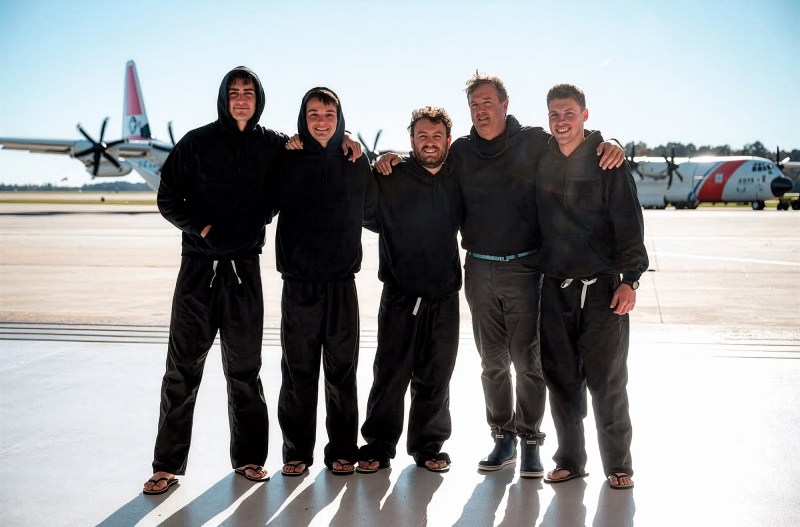
Once we’re all retrieved, the pilots exchange fist bumps and we’re off to the USS George H.W Bush. Halfway through the hour and a half flight, I realize I haven’t taken a leak in about a day. I motion to the hoist operator to bring his ear close. “You boys got a head on this thing?”
He can’t hear me, so he passes his phone and I type my question.
“We’re 45 min out, but there’s a piss tube in the back,” he replies.
“Brother, I haven’t taken a piss in 20 hours, I’ll take whatever you got,” I type.
He laughs and motions behind his seat. Turns out I am not the only one. When I turn around there’s a line as if it’s halftime at a Celtics game.
After a transfer on the deck of the aircraft carrier, we are up and away before noon headed for the mainland. The next hour passes easily in dry clothes and emergency blankets. When we land at Coast Guard Base Elizabeth City, we are greeted with handshakes and smiles. Soon we’re devouring calories at the closest Burger King.
While stuffing my face, I ask Sam if we just had the most American day of all time: boat sank, hopped in a life raft, saved by a helicopter, transported to a moving aircraft carrier, flown to a Coast Guard base where we are picked up by a former Navy SEAL and driven straight to the BK Lounge. The Magic Bus had taken us on our greatest adventures, but this final voyage gave us something better—each other, and one hell of a story.