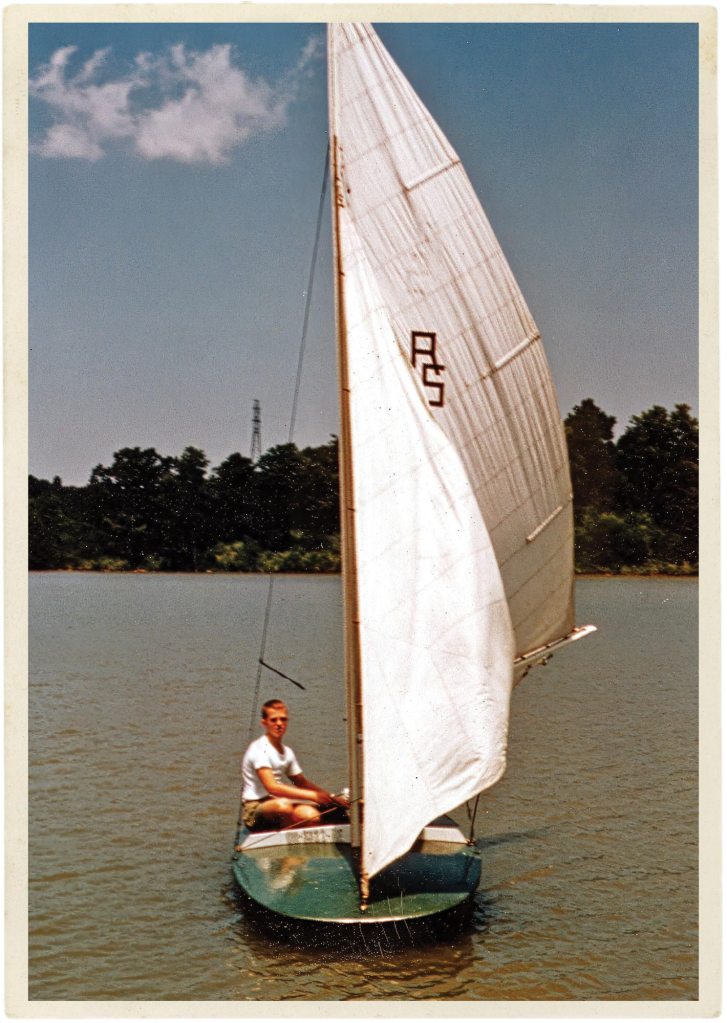
In the spring of 1960, I poked my 16-year-old head into an abandoned chicken coop on a farm near Hamilton, Ohio, and in the dim light saw a green shape under a pile of scrap lumber and years of chicken droppings. As described by the owner, it was a homemade 14-foot, sloop-rigged scow, fiberglass over plywood. It was sitting on a rusty trailer made from an old car frame. It was in rough shape, but I liked the racy lines, and it looked to be complete. The owner was willing to give it to me on long-term loan, on the condition that I make some repairs. Little did I know it would change my life.
I rigged a bolt-on trailer hitch to my father’s Buick and we dragged it home without lights or license, and I spent a good part of my high school summer vacation cleaning, painting and rigging. With a fresh coat of green housepaint and white enamel trim, it looked pretty spiffy. It had cotton sails, twisted, three-strand hemp lines, galvanized steel wire stays, and spars carved from construction grade fir 2 x 4s. There were a handful of nice Wilcox-Crittenden bronze blocks and cleats, but most of the hardware was simply hardware store galvanized steel pulleys, hinges and straps.
The owner told me that it was built from do-it-yourself plans in Popular Mechanics magazine, but I could never find the plans and never found what the design was called, so we simply dubbed it the No Name Scow. I read a few how-to-sail books and teamed up with a high school chum who had a little sailing experience. We trailed it to tiny Acton Lake near my hometown of Oxford, Ohio, rigged up and sailed away. Over the summer, our skills improved, and we entered it in the handicap division of the local sailboat racing club. I crafted a “RS” (racing scow) mainsail logo from iron-on tape so the race committee would know how to score us. While we often placed last boat-for-boat, I was hooked on racing and learned that I also enjoyed the maintenance and restoration work that went along with boat ownership. The scow fell apart at about the same rate as my skills to rebuild it evolved, and by necessity, I got handy with fiberglass repairs, marine woodworking and other basic boatwright skills.
My friends and I sailed the no name scow for two summers, but eventually I convinced my family to help me buy a 14-foot wood Rhodes Bantam class one-design racing dinghy, the start of a 30-plus-year love affair with the R-B class. I returned the now-restored scow to the same farm where we found it, and lost track of it.
The Bantam was great fun, but being a new boat, only periodic painting and varnishing was needed and I found that I missed the kind of work I did on the scow. I signed up for a wood shop class in high school and after learning the basics, our laid-back shop teacher let us pick our own projects. While most of the students were constructing end tables, shelves and turned salad bowls, I was making Sitka spruce spinnaker and whisker poles, tiller handles and always looking for similar projects. Right on cue, one of my fellow sailing club racers had a wood Penguin dinghy that needed a new centerboard and rudder, and to my delight he agreed to provide the plans and pay for the materials if I built them. As the famous naval architect, Philip Rhodes, designed both the Penguin and the Bantam, I felt a real connection to the project and forged ahead.
The rudder was to be built from one piece of solid mahogany, three-quarters inch thick with a rudimentary hydrofoil shape carved into the underwater section. I planned the rough-cut board three-quarter inch, cut out the blank on the bandsaw, smoothed the edges and then traced station lines on the underwater section as called for in the plans. Then I built shaped templates out of light gauge sheet metal that duplicated the desired shape at each station shown on the plans. Finally, the real fun began—actually carving out the specified shape of the blade.
The Stanley hand planes in the shop were dull, but the shop teacher showed me how to grind the correct angle on the plane iron on a bench grinder and then how to sharpen it by hand on a flat, oiled whetstone. When finished, it would cut an even ribbon of wood so thin you could almost see through it. I practiced on some of the scrap mahogany and then started making passes on the rudder blade blank, checking often with the templates at each of the stations. It seemed to take forever but finally the shape was complete and true to the plans. Each pass with the plane was by definition flat, so to get a uniform curve, I had to switch from the plane to sandpaper. We had vibrating electric sanders in the shop, but I decided to do the sanding by hand with a rubber sanding block. I started with 100-grit and ended up at 220. The result was beautiful, but in my zeal to get the blade absolutely smooth, I had sanded it just a little under the thickness specified in the plans. My friend didn’t mind as this blade was a huge improvement over the one it replaced, but I should have cut the blank a little thicker (“proud”) than the desired spec and then checked the thickness often during the shaping and sanding phases. Lesson learned. Five coats of varnish later, the rudder was water ready.
The centerboard construction was mostly the same drill, but with skills learned from the rudder project, it went much faster. Also, as the finished board was going to be coated with fiberglass cloth and resin, I had to make the thickness intentionally thinner than spec to allow for the thickness of the fiberglass sheathing. The only glitch was the cure rate of the fiberglass resin. I did the glass work just as school closed so as not to stink up the shop all day, but the heat got turned off overnight, the shop temperature dropped, and it took several days for the resin to cure properly. Ambient temperature affects cure rate—another lesson learned.
Somewhere about this time, I teamed up with John Bloom, a school friend and one of my Rhodes Bantam racing competitors. Like me, he had caught the sailing bug and shared my interest in boat restoration projects. In fact, he and another friend built a Bantam from a kit. We noted that reasonably priced used sailboats were a rare commodity in our area and sold like hotcakes whenever they came on the market, so Bloom and I decided to pool our resources and go into a summer vacation joint venture finding, restoring and reselling small sailboats. We figured we could do a lot better than the standard $1 per hour that we could get for lawn mowing, hay bailing etc.
Our first purchase was a wood Penguin that we found in, you guessed it, a chicken coop. It was in overall poor condition and needed a lot of work, but all the pieces were there and at $75, the price was right. We took over a vacant bay in my parent’s garage, and what followed was what automotive buffs would call a total frame-off restoration. With about $20 worth of paint and varnish remover, and a lot of sandpaper, we removed all the paint and varnish off the hull, spars, rudder/tiller assembly and centerboard. In doing so, I learned not to get Strypeeze brand paint and varnish remover on my bare skin, add that to painful lessons learned. We painted the hull a light blue with a classy red boot top and painted the interior white. The spars, rudder/tiller assembly, thwarts, gunnels and centerboard got finished clear with several coats of spar varnish. We invested another $20 for new stainless stays bringing our total investment including paint and varnish to just under $120. To our delight it sold in about a week for $350, heady stuff for a two teen age amateur boatwrights. We kept the cash as working capital for our next venture.
We took on a few minor repair and refinishing projects to fill the time between larger projects, but we finally decided that as we both raced Rhodes Bantams, our next project should be restoring a Bantam. The problem was that there were none to be found in southwest Ohio. We finally got wind of two candidates in Toledo Ohio, 200 miles away. Toledo had been a hotbed of Bantam racing for decades and when small boats race, they get damaged and often sell as-is for cheap, perfect for the Glos/Bloom business plan. My parents loaned us their Chevy II station wagon with hitch and trailer light rig, and after locating the two sellers, we threw some sleeping bags and overnight gear in the back of the station wagon and headed north. Our first business trip.
The first boat was disappointing. It looked to be a home-built affair without a measurement certificate, and the plywood was so badly checked that covering the exterior with fiberglass might have been the only way to make it seaworthy again. We passed on it.
The second boat was R-B hull number 410 and a much better candidate. The wood was in better shape than the first boat, but it had a large hole in the port side plywood topsides just forward of the mast thwart that had been crudely repaired with a large square of ½’ plywood and a couple of cans of gooey marine putty. The repair was water tight but was not up to our standards. It had newer Ulmer sails plus a roadworthy trailer and was bargain priced at $325. We bought it on the spot, spent almost two hours getting the trailer lights to work, bolted on a bogus license plate and headed home. Somewhere along the way the next day, the hubcap on one of the trailer wheels fell off and most of the wheel bearing grease drained out. We added more grease and MacGyvered a new cap from half a soda can and hose clamp and made it home without further incident.
The following day just for fun, we trailed No. 410 out to Acton Lake and raced it as-is against our usual Bantam competitors. To our surprise, we won the race. Despite the clumsy patch and other condition and rigging issues, it was clear the boat was fast. After the race, we did some research and found out that this boat, named Hussy, sailed by Toledo skipper, Stan Kelly, had won the Rhodes Bantam International Championship in 1955. We felt like we had just rescued a Kentucky Derby winning thoroughbred from the glue factory.
Restoration was straightforward. We removed the crude patch and probably lightened the hull by several pounds. With a saber saw, we cut away the damaged plywood back to solid wood and beveled the ¼” plywood about an inch or so on the inside perimeter of the hole. We then made a temporary back-up plate larger than the hole out of ¼” plywood covered with plastic wrap (so our new fiberglass patch would not stick) and screwed it temporarily to the outside of the hole. Working from the inside we layered up multiple layers of fiberglass woven roving, cloth and resin to construct the new patch. With a lot sanding and a flow coat of resin to both sides, the patch was complete. We then sanded the hull inside and out, made some hardware and rigging upgrades and replaced the heavy hardwood main thwart with a lighter spruce thwart. We applied our now trademark light blue paint on the topsides, followed by a black boot top and a white, wet sanded bottom. The 50-pound steel centerboard also got white paint to make it easier to spot weeds at weedy racing venues. The spars, thwarts gunnels and rudder were varnished. We painted the interior a light grey that covered the patch nicely. When it was done, it looked sleek and fast.
It quickly dawned on John and me that No. 410 was faster than either of the two Bantams that we were currently racing, and we both wanted to buy it. I don’t recall exactly how we resolved this conundrum, but John won out, sold his first boat, bought 410 and we split the considerable profit 50/50.
A few other projects followed, but life happened, we both went off to college and the Glos/Bloom partnership simply faded away. However, I continued solo and my interest in small-boat racing and restoration never diminished. These days, I live on a lake in Upstate New York, race Sunfish on summer weekends and restore a few boats, mostly Sunfish, per year as an enjoyable retirement side hustle. It is hard to believe that a green, no name scow buried in a chicken coop six decades ago was the beginning of a lifelong passion, but it was. Random events can change lives. Yet another lesson learned.