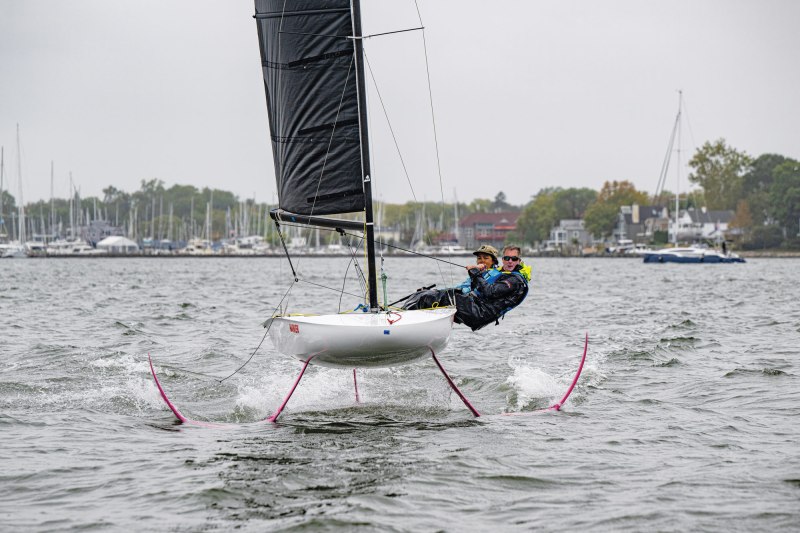
For the first day of our Boat of the Year test sailing, small-craft warning flags were whipping, and so too was the rain when we sailed off the beach at the Annapolis Sailing School with the BirdyFish S—S as in solo or single—without any clue of how to handle the scow-shaped 14-footer and its long, arcing and pointed “mustache” foils.
When it’s time to put our judge Monica Morgan into the driver’s seat, she hops in with her trademark giddy giggle. We don’t know what she knows: She’s never foiled.
She orients herself with the whereabouts of the boat’s key control lines: a 16-to-1 vang, downhaul and the 2-to-1 mainsheet. She promptly trims the reefed square-top mainsail, turns onto a reach, sails 100 feet or so away, then rises up onto both foils, streaking away as if she’s done it a million times.
“Insanely easy,” is how Morgan would later describe the experience, which is the whole point of the BirdyFish S.
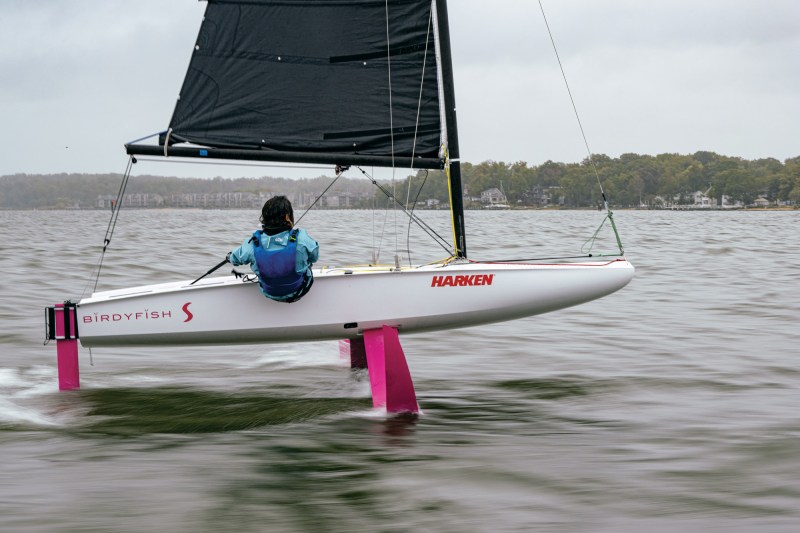
Unlike the BirdyFish Double (Race), which has symmetric J-shaped foils, the BirdyFish S has curved asymmetric foils that can’t be inverted or swapped if damaged, so launching should always be a calculated effort. Still, says Hardy Peters of East Coast Sailboats, the U.S.’ BirdyFish distributor, getting underway is a simple affair. With the foils up in their stowed position, step one is to roll the boat to the water’s edge on its custom wheels, which fit into slots in the hull. These are removed once the boat is afloat, and then stored in a bag on the boat. Wade to waist-high water (two feet or more), push down and lock the foils into their sacrificial Delrin bearing cases. Do the same with the rudder and off you go.
Like the foils themselves, the BirdyFish S’s polyester and honeycomb hull is built (in France) in halves and then glued together. A robust structural bulkhead runs the full length of the boat, giving it some serious rigidity. The scow hull shape also provides strength and, more importantly, stability. Unlike other singlehanded foilers (such as the Moth or Waszp), the BirdyFish is stable at rest and far more forgiving in crash-downs.
Most other high-tech foilers also have dynamic rudder-angle adjustment, but with the BirdyFish S, rudder angle is preset and can be adjusted on the water with a wrench. The single-piece aluminum mast and a black Dacron mainsail with two reef points also opens up the boat to sailing in a wide range of conditions. It can be sailed upwind and downwind in displacement mode, with one crew or two, with all reefs or none at all.
“You’re probably looking somewhere between 185 to 210, max is 310 (pounds),” says Peters. “I’m 250 pounds and I can get this boat up and out in 8 knots of breeze.”
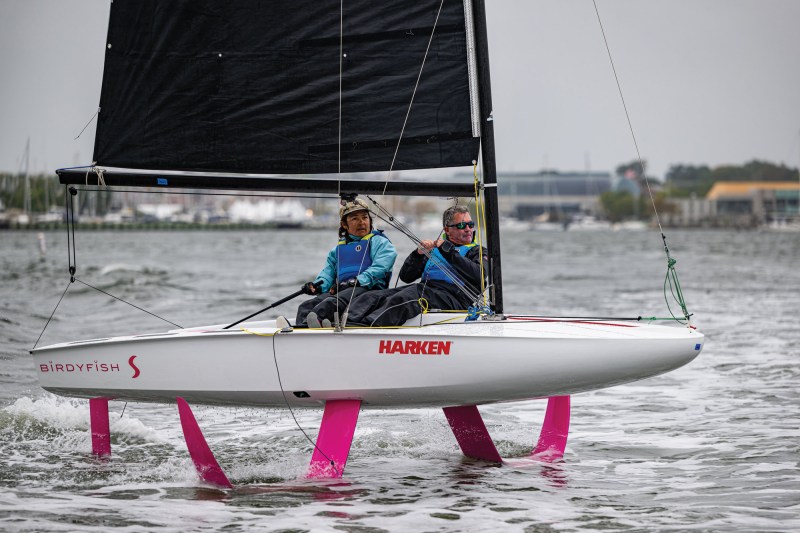
The sailing technique, Peters explains to the judges before splashing, is to shift weight aft when building speed, and once it takes off, shift forward enough to give the boat a slight bow-down attitude. Minimal rudder movement is essential, he adds, “Don’t sail it like an ILCA. Subtle tiller movements prevent spinouts.”
As for tacking, he says, “This boat will easily foil tack and jibe. Just remember that the best [exit] angle on this boat is 55 degrees. So, you have to take that 55 and go another 55 or more, so you’re looking at a 110-degree turn basically. But on a jibe, it’s a lot less.”
Both Morgan and fellow judge Mike Ingham eventually figured out the technique enough to pull off a few, albeit sketchy, foiling turns in 15 to 20 winds and flat water. And their straight-line speeds were more than impressive.
“I was a little surprised at how fast it would go,” Morgan says. “I almost wiped out once, but I never felt like I was just gonna get launched off the boat. I felt pretty locked in tacking. I was trying to figure out the right rate of turn for the tack, because you couldn’t go too slow, but if you went fast, it felt as if you were spinning out. I had that feeling a couple times, mostly tacking, but as a first-timer, it was really rewarding to go foiling so easily.”
To validate the boat’s versatility, before wrapping up our test sail, we put both Morgan and Ingham on the boat and shook out the reef. With both of them working in sync to balance the boat onto its foils, they hit their top speed of the day in one dark and streaking puff. We could hear the whooping from a good mile away, until the sleigh ride ended in a spectacular explosion of spray. Ingham slipped from his hiking strap, and Morgan casually tacked the boat back upwind and retrieved her teammate. It was easy for Ingham to get back into the boat and they soared away again.
“It was a surprisingly easy boat to foil,” Ingham says. “It was like stress-free foiling that was always just in the groove.” Morgan seconded the sentiment and says, “For never having foiled before, I was able to do it within 30 seconds, and that’s kind of crazy. But I also felt really stable on the boat, not intimidating or overwhelming at all.”