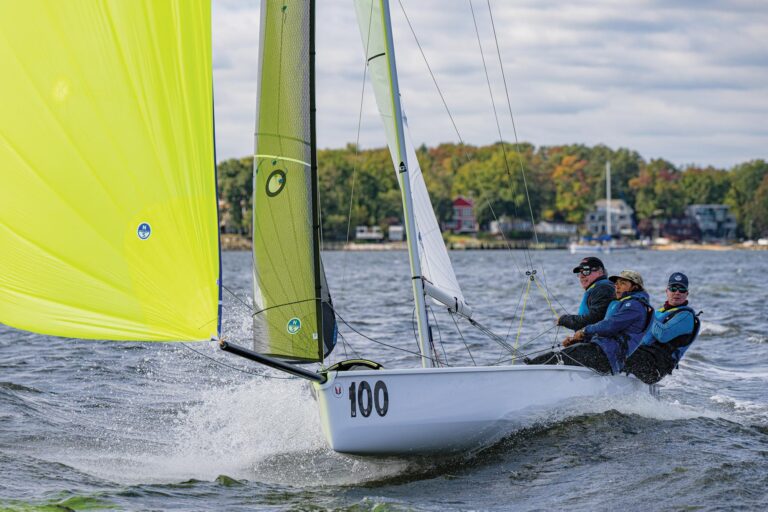
Advances in code sail furling systems have revolutionized the way racers and cruisers manage their headsails with greater ease. Facnor and Profurl have been at the forefront of this transformation—an intertwined pair of brands whose innovations have made sail handling systems that are safer, faster and more reliable. Wichard Groupe North America’s Mark Van Note, a veteran rigger and expert on these systems, says today’s refined furlers are not just about the hardware—they’re about reducing fret on the foredeck. For racers, that means better sail changes. For cruisers, it’s more miles and stress-free passages.
Innovation in Sync
Facnor and Profurl have long been operating in the same technical space, and while many attributes of the two French brands are similar, they still operate independently, Van Note says. This unique relationship between the two companies has driven both competitive innovation and mutual advancement. Facnor has a little bit more of a custom reputation, Van Note says, adding that Facnor’s flexibility helps them tailor products for serious racers and unique projects. By contrast, Profurl doesn’t necessarily have as much customization, Van Note says. They instead focus on providing robust, standardized furling systems that work right out of the box and are suited for everyday sailors and cruisers.
The Wichard Groupe represents both brands in the US, but the technical similarities and hardware integration between the two brands are striking, and there’s a point to that. “We can take components from one brand, bring it to the other, and vice versa,” Van Note says, “which helps when we’re dealing with a boat that has a diverse inventory of flying sails.”
Ratchets and Drums
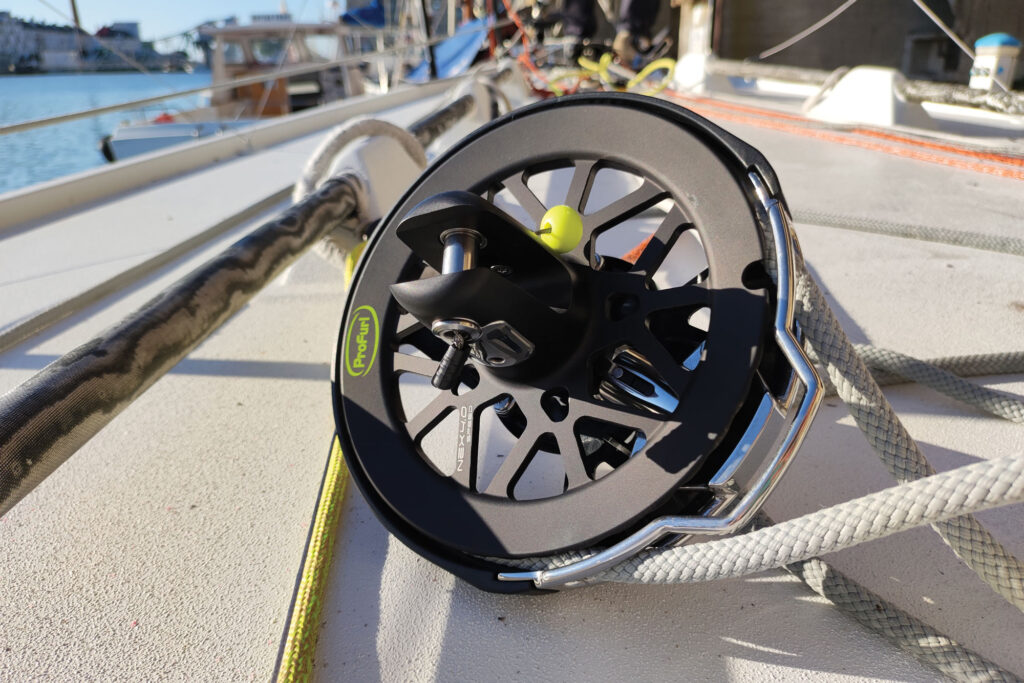
Profurl and Facnor have invested heavily in improving the user experience to ensure easy and consistent furls. Profurl redesigned its range about five years ago, Van Note says, and its drums are now slightly larger than Facnor’s drums (for a comparative-sized unit). A larger drum provides more power when furling, which makes it easier. Racers and high-performance sailors favor Facnor’s smaller drum for the speed advantage. While ease of furling is typically more important than speed for shorthanded cruisers, recreational sailors and club racers, Profurl does, however, offer smaller drum “speed versions” for high-performance applications.
Both brands have ratchet mechanisms integrated into the drum. Facnor implemented their ratchet technology quite a while ago, and Van Note admits that engaging and disengaging the ratchet remotely with the furling line does require a subtle technique. Profurl’s ratchet is simpler to use. Crucially, the ratchet mechanisms of both Profurl and Facnor ratchet units can be engaged from the cockpit using the furling line.
The Right Applications
The flexibility of having both Facnor and Profurl units for customers allows Wichard Groupe North America to accommodate customers with diverse sail inventories. Facnor’s code sail furlers, for example, can be used for either bottom-up or top-down furling. The latter is accomplished with an optional integrator fitting. To convert the unit from bottom-first to top-down furling when an anti-torsion cable is integrated into the luff of the sail Van Note explains, “You simply install an integrator in the drum, which gives you an independent tack swivel. When you drive the furling drum, it’s going to drive the cable only.”
Profurl’s top-down furling kit, the Spinex, offers one crucial advance for soft-sail applications where the cable is external to the luff of the sail. It comes with an isolation tube as part of the kit,” Van Note explains. “What happens a lot when you top-down furl is, no matter how good the cable is, you’re going to end up with a certain amount of twist in the cable. When you’re finished with the furl, the cable will tend to unwind and grab onto the first wrap or two of cloth and spin it the other direction, which can cause problems when you unfurl. The isolation tube within the Spinex system prevents that from ever happening.”