The start of the Blakely Rock Race is delayed due to fog and light wind. On our 44-foot racer/cruiser Dark Star we are milling around as the fog swirls around the Seattle-based racing fleet. Boats appear, then disappear.
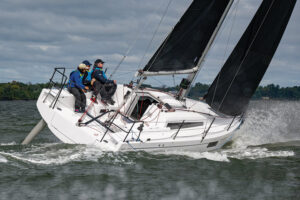
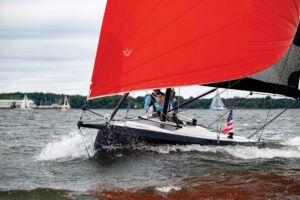
There’s Terramoto with its new taller rig, then they’re gone. There’s Pippa with its graceful curving sheer line, before it too evaporates. There’s the Riptide 41 Blue with its new owner, which vanishes into the fogbank. As we’re yacht spotting, it occurs to me that a good percentage of the fleet are Paul Bieker-designed custom boats.
How had this come to pass?
Thirty years earlier, my wife Libby and I had launched the first Riptide, a light and nimble 35- footer named Ripple (in still water). Now there were nine custom racer/cruisers in the Pacific Northwest, which makes for one extended the Riptide family.
Obviously, this development should be celebrated. These are very cool boats, each one different, each one a reflection of the owner and designer. And they all reside near Seattle or Vancouver. So, why not try to get all the boats together in one place?

I ran the idea by a few trusted associates (Libby, Paul, and a few friends). They were mildly amused at the idea, which was enough to encourage me to proceed. Then I learned that the first Riptide designed, the 55-foot cruiser Rocket Science was soon to depart for French Polynesia. This brought some urgency to the project, and I set a date for the first ever Riptide Rendezvous.
As I contacted Riptide owners, I got very positive responses, so I knew this could work. In the end, the Canadian boats could not make the trip, but all the seven Seattle area boats agreed to come. The party was on.
To begin, I arranged dockage with the Port of Seattle for slips at Shilshole, and then, with Corinthian YC for use of the adjacent clubhouse, we put on the schedule a talk by none other than Mr. Bieker himself. I didn’t really try very hard to generate attendance, but word traveled fast around the sailing community. I also invited previous owners of boats that had been sold. Then came the fun part; Riptide stickers, hats, flags. The original intention was a fairly intimate gathering of Riptide boats and owners, but it gradually morphed into a community gathering, as lots of local sailors were interested in the boats.
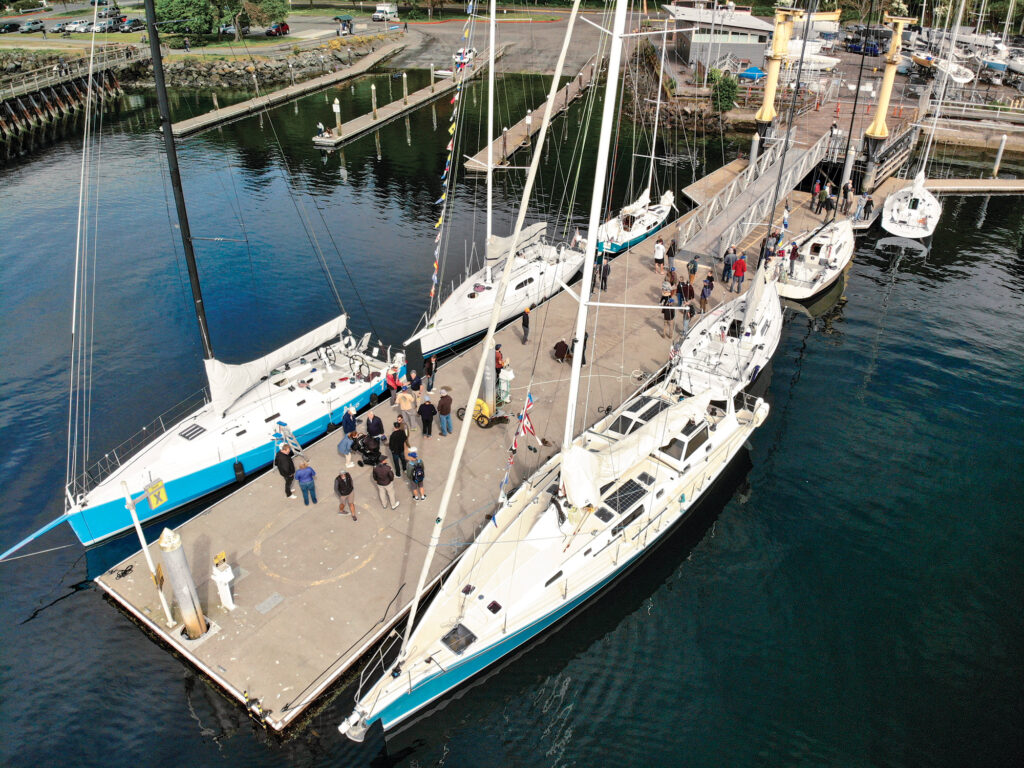
When the fateful day arrived, I was nervous. What if the boats didn’t show up? What if nobody came? I had a restless night’s sleep, but in the morning, I moved Dark Star from its slip to the public dock. Bieker’s personal boat was already there, the plywood 27-footer Orn. As I tied up, other boats started arriving, and my heart soared.
First came Rocket Science, in the final stages of preparation for its ocean passage. Next came Ripple, our first 35-footer, now owned by our friends Christine and Justin Wolfe, of Orcas Island. Then Blue, a 41-foot speedster I had successfully raced twice to Hawaii. Then the beautiful Pippa, a 30-foot day sailor. Then Terramoto, originally sistership to Ripple but since refined into the fastest 35-footer around. Finally, the elegant and sleek carbon 30-foot rocket ship Baby Blue. I was nearly in tears. This was happening.
The next two hours were magical. Lots of local sailors came and climbed around the boats. There were kids and dogs, old-timers and juniors, smiles all around. The owners were rightly proud of their boats, and it was also clear they felt part of a little club of fellow owners, people who wanted their own vision of a sailboat, and knew where to go for the design. Each boat is a kind of composition of the owner’s dreams and Paul’s vision and experience.
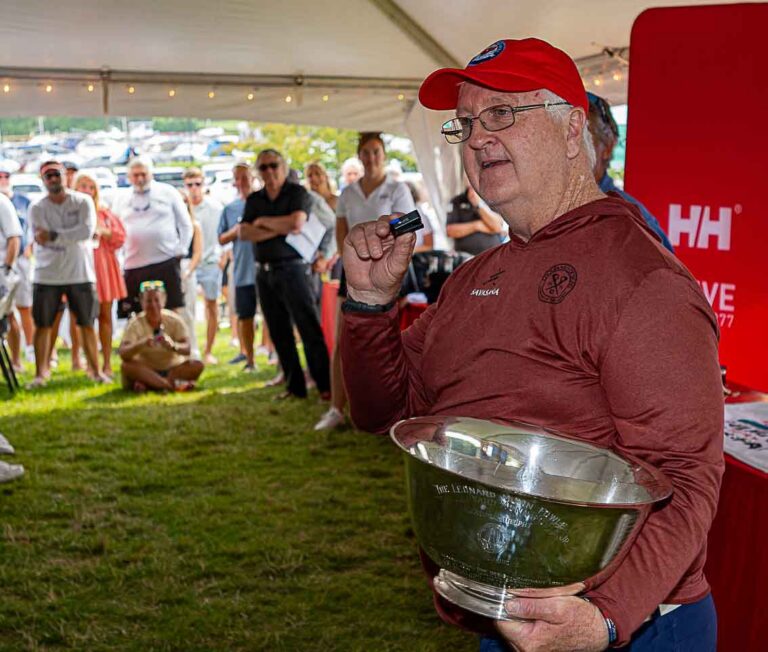
When we moved to the yacht club, Bieker give a lovely and informative lecture on the evolution of his designs, from International 14s to America’s Cup and everything in between, including the nine Riptides in the Northwest.
I got to thinking about why all the Riptides were in the Pacific Northwest. Surely these are universal designs that would be successful anywhere in the world? But maybe there is something uniquely Seattle about these boats. While each boat is completely different, they all share a few qualities; a desire for speed and simplicity, a disdain for rating rules, a sense that a racing boat should also be able to cruise, careful engineering with meticulous construction. Aesthetics that flow from function, free from preconception. A nod to the past, but something new. Boats that are fun to sail and designed to put a smile on the sailor’s face.
Surely there are other examples of boats that are closely tied to place. Think of the Beetle Cats of Buzzard’s Bay and Cape Cod, timeless and perfectly suited to New England. The nimble Lido 14 in the enclosed basins of Southern California. The ubiquitous Flying Scot, a perfect family racer/cruiser for the lakes of the southern U.S. Or the radically over-canvassed Dhows of the Middle East. Each is reflection of place, not intended for universal appeal. Maybe the Riptides are just that for the Northwest; perfect sailboats for what we do here; race and cruise in a beautiful place, where the wind can be 5 knots or 30 knots.
And perhaps there is something about the Northwest spirit that these boats reflect; independent yet traditional, technical but beautiful, unique but not precious. I don’t know, but I am eternally grateful to be a part of the Riptide family.