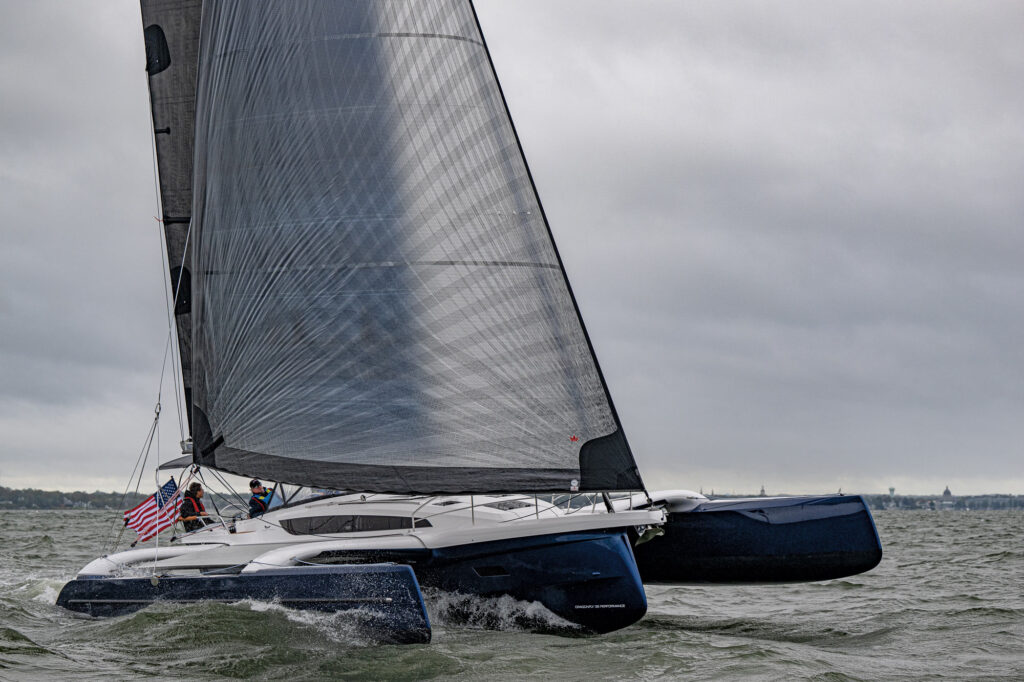
Here is a reason why Dragonfly owners are okay with waiting two years or more to get their hands on the new 36. Everyone that has tested it agrees: It’s a multihuller’s dream boat. “Exhilarating” is the one word that BOTY judge Monica Morgan came away with after a windy session on the 36.
“It was such a joy to sail,” she says. It was effortless to sail in 25 knots under a big main at full hoist. Proper winches and everything led correctly into the cockpit, tails disappear into lockers. “It was fast and stable, and felt so safe and bulletproof,” she adds. “It wasn’t hitting waves, it was just cruising through them. The helm felt amazingly light, and everything was just so simple, but it made sense, and it is so classy.”
Dragonfly’s Jens Quorning, a master of his craft, confidently says the Dragonfly 36 is the best they’ve ever done. “Up in the bows we have some new modern tricks with the wave-piercing center hull bow. We’ve got more buoyancy there, and more buoyancy forward in the floats. It is really hard to force it down.”
That also allows him to pile on the sail area and have fun. He’s especially keen about the electric Code Zero furler that “introduces more fun sailing and allows our owners to go out and do 20 knots, easily.”
The rig towers 60 feet above the deck, which Quorning says is “probably the tallest mast on any 36-foot production boat, for sure.” He adds that he and his like-minded owners like a lot of sail area. “With a more intelligent hull design, you want to push it hard, and especially downwind,” Quorning says. “With the right buoyancy right where you want it, you can push up the speedometer.”
Dobbs Davis, our panel’s big-boat guru, felt the same way: “It was blowing 30, the helm was so gentle and balanced. With the weather ama just kissing the wavetops, the sensation was amazing. It just wanted to keep going faster, slicing through the water really nicely.”
With a centerboard in the center hull, Davis adds, the boat tacked just as well as a monohull, and with electric winches available, the jib wind was easy. The code zero can go in and out all day, especially when the hydrogenator and solar panels are topping off the batteries.
The overall bigness of the boat and the beautiful composite work of the beams, the coamings and the interior give the immediate impression of a bigger boat. “I felt like I was on a 40-footer,” Davis says. “Part of that is stability, but it’s the center hull form as well. The whole thing is exceptionally engineered and the details beautifully executed, including the cabinetry. I know there was a lot of tooling that went into that, so what’s amazing to me is the amount of effort it takes to make that right.”
The judges noted the boat feeling light for its size. Quorning says that’s because he’s finally been able to shed the weight of heavy steel fittings in the folding system. All parts are now composite, all of it done in-house, vacuum-infused vinylester and carbon in the bulkheads and beams.
When folded, the beam is roughly 12 feet, great for storage and slip life. And liveaboard is definitely possible for extended fast getaways. And that’s why Quorning is also proud of what they’ve accomplished with the 36’s interior. They’ve managed to bump out the center hull enough to create space and accommodations that, he says, is on par with most modern 40-footers. All the sails, toys, bikes and gear go into the floats.
“There is tons of headroom, the head is lovely, and the aft cabin is really spacious,” Morgan says. “It was all so functional down below, everything had its place and fit really well.”
The engine is aft, under the cockpit, and the sail drive is not below the belly of the boat, Quorning says. “It gives us more freedom and more space in the main cabin. Less smell, less noise in the cabin.”
To its value and quality, Quorning is transparent about his Dragonflys being perceived as expensive. But building in Denmark is expensive, and quality comes with a price. “It’s a high-tech product with a lot of man-hours,” he says. “But we sell a lot of boats because people really admire our boats.”
Judge Mike Ingham would second that, and if he had the funds, he’d seriously consider buying one and giving the Scandinavian multihull racing circuit a go.
“It’s just such a classy boat, really well made, really functional, something you’d want to own, if you could afford it,” says Ingham. “Its stated purpose is to be a fast, safe, comfortable, offshore cruiser-racer, and it just knocks it out of the park in my mind.”
When we sailed with Quorning in October he shared that there were 35 owners in the queue already. And widely praised throughout Europe, the wait now extends well beyond 2028. It’s no surprise the Dragonfly 36 is in demand.