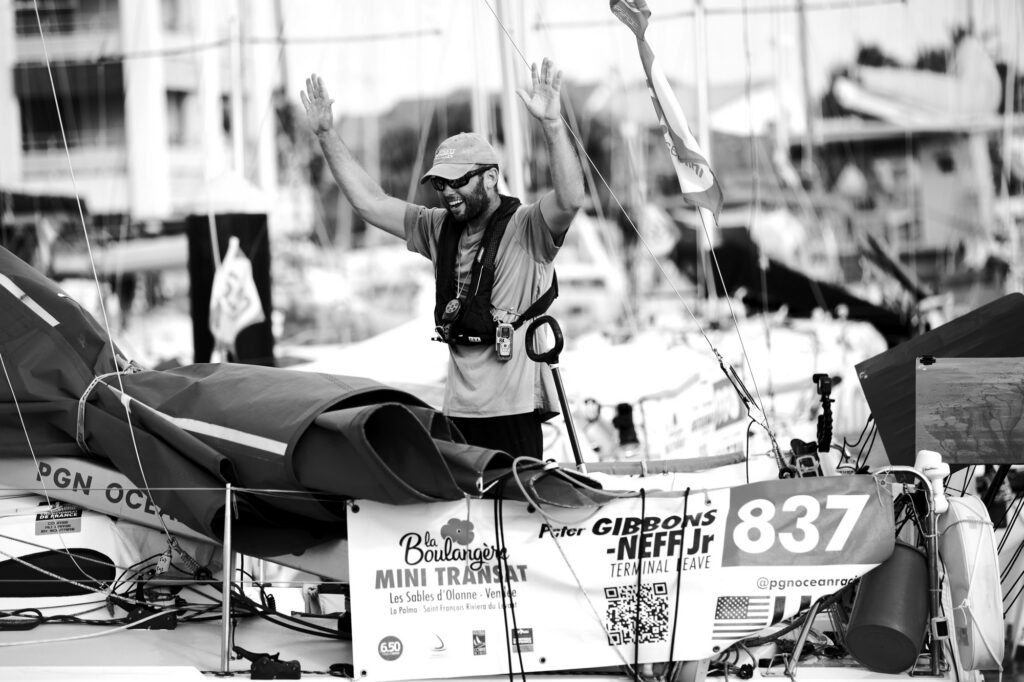
There’s one moment from the 2023 Mini Transat Race that is seared into my memory. I was six days into the Atlantic, crossing alone on my 21-footer Terminal Leave. The trade winds were cranking and the boat was surfing along. I remember it vividly—tiller in one hand, mainsheet in the other, appendages humming as the boat accelerated down each wave. Nothing but wave tops and open sea in front of me. For hours everything felt perfectly in flow.
And then, in one explosive moment one of my rudders sheared off the transom. The boat rounded up violently, and I was suddenly in survival mode. Once I discovered that there was no water coming into the boat, I focused on the repair and diverted 300 nautical miles further south to Cabo Verde for a technical stopover. Without a satellite communication link to my shore team, it was on me and my Pilot book to find a port. Fortunately, or maybe through telepathy, I arrived at the correct dock that my girlfriend coordinated to have help available on a Saturday morning.
With the rudder repaired and remounted, I got back to it. Once at sea, alone again, I was reflecting on the previous 48 hours and reminded myself that I was racing for a larger purpose. Sure, getting to the finish was the point, but I was really out there to raise awareness for U.S. Patriot Sailing, the dear-to-my-heart non-profit that supports the veteran community navigate much bigger challenges than I could ever experience in my little boat.
The three years of commitment to that race was one of the most meaningful experiences of my life. I am truly grateful I had the opportunity to race amongst the now and future legends of the French solo offshore racing scene. I am frothing, ready to take it on again. But this time, I’m attacking the race with the most advanced boat I can get my hands on. A focused mindset and a renewed sense of purpose is driving me every day.
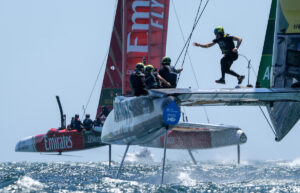
The Mini 6.50 fleet used for the race has evolved dramatically from its origin in 1977. Racing across the Atlantic every other year since has led to radical design advancements that eventually make their way to the larger IMOCA 60s of the Vendée Globe. The newest generation of foiling ocean-racing sailboats are rewriting what is known to be possible. Consider this: Nicomatic-Petit Bateau, a foiling Mini 6.50 Proto, broke a new distance record for 352.59 nautical miles in 24 hours during this year’s race. That confirms what many of us already know—the foiling Mini generation is an open invitation to blitz the course.
While I’ve been thinking a lot about what it would mean to participate in this race again from a performance perspective, rather than a mere participant, I’ve also thought about what the race represents for me. After a decade on active duty in the Marine Corps, the last Mini campaign was a bridge that helped me transition back into civilian life. Through that experience, U.S. Patriot Sailing was central to my journey. While my first campaign was about raising awareness for the organization, this next one is about expanding support so more veterans can access the same community that helped me.
When I began exploring what a second campaign might look like, one name kept surfacing: Samuel Manuard. Manuard is one of the most influential and forward-thinking French naval architects today, with a specialty in offshore shorthanded sailing. His designs range from Class40s, to the winning IMOCA in the recent Transat Café L’Or, and even the new generation of planing performance production boats for Beneteau. Simply put: His boats are fast.
In addition to his legendary designs, Manuard is approachable and responsive. Our relationship began with a simple e-mail, in English, and no introduction. From the outset, he believed in me and was transparent about the design process. In November 2024, we finally met in person, on the famous Vendée Globe pontoon next to Charal 2, just days before it was to set off on its non-stop race around the world. From that initial handshake, we were committed to working together. It was a surreal moment as I locked in this incredible yacht designer and knew I would be one day crossing the starting line on the newest generation Classe Mini 6.50.
In the Spring of 2025, my partner, Jane Millman, and I met again with Manuard in France where we spent hours talking through the design options. As he sketched what he thought the boat would look like, we talked through the pros and cons of specific features—and there are many. The campaign is now launched and construction is underway at JPS Production, in La Trinité-sur-Mer. It will be a state-of-the-art carbon flyer. This new prototype is the next evolution of Manuard’s foiling design, with a scow bow, large foils, twin T-foil rudders, a canting keel, rotating wing mast and deck sweeping mainsail.
There were certainly reservations and reflective moments as I committed to this project. A foiling Mini is an entirely different experience from my older RG 650. The learning curve will be steep. Mistakes will be obvious and costly. The speeds will be higher, the loads greater, and everything far more extreme. It’s more boat, more power, and more responsibility. But that’s also what makes this next chapter so exciting. The goal isn’t to simply complete the race; it’s to push the boundaries of design and maximize performance. Ultimately, my new mission is to win the Mini Transat.
The race starts in two years, but the race to get to the starting line began long ago. The build, testing, training, qualification races, preparation, and refinements will be wrapped into a relentless campaign. This time, I understand the process better. I know what weeks at sea alone feels like and how fatigue creeps into decision making. I am far more mature and know how to stay disciplined when the weather doesn’t cooperate or a routing choice doesn’t pan out.
My expectations are high but grounded. I know I will need to adapt to this new foiling platform, refine my boathandling and understand the complex systems on this boat. I’m ready to put in the work as I focus on this campaign full time and bring onboard with me the more than 700 U.S. Patriot Sailing participants across multiple states. With locations on both coasts, and two new teams located in Seattle and Tacoma, Washington, the impact and reach of this organization continues to expand. The organization continues to provide veterans with community and a renewed sense of purpose supporting each other, which often disappears after taking off the uniform. While solo sailing is a lonely challenge, the difficulties faced after returning from combat deployments or transitioning to civilian life are far more isolating for many veterans.
The foiling element is fitting, for this new campaign is an opportunity to give back at a higher level. It is a platform to raise awareness and to increase support. By helping the organization expand programs and create new opportunities for veterans, there is a bright future for the veteran community this team supports. If I have learned anything over the past few years, it’s that purpose is what gets me through tough miles.
The next two years will be demanding, humbling and exhilarating, but all of it will be worth it. While I’m excited for the race to come, I’m more eager to share the highs and lows, and to inspire. In two years, I will be at sea, savoring my victories and facing my failures. I will be alone in my foiler, propelled by wind and a patriot’s purpose.