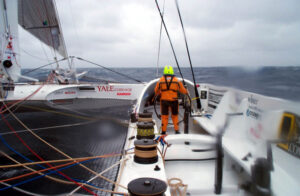
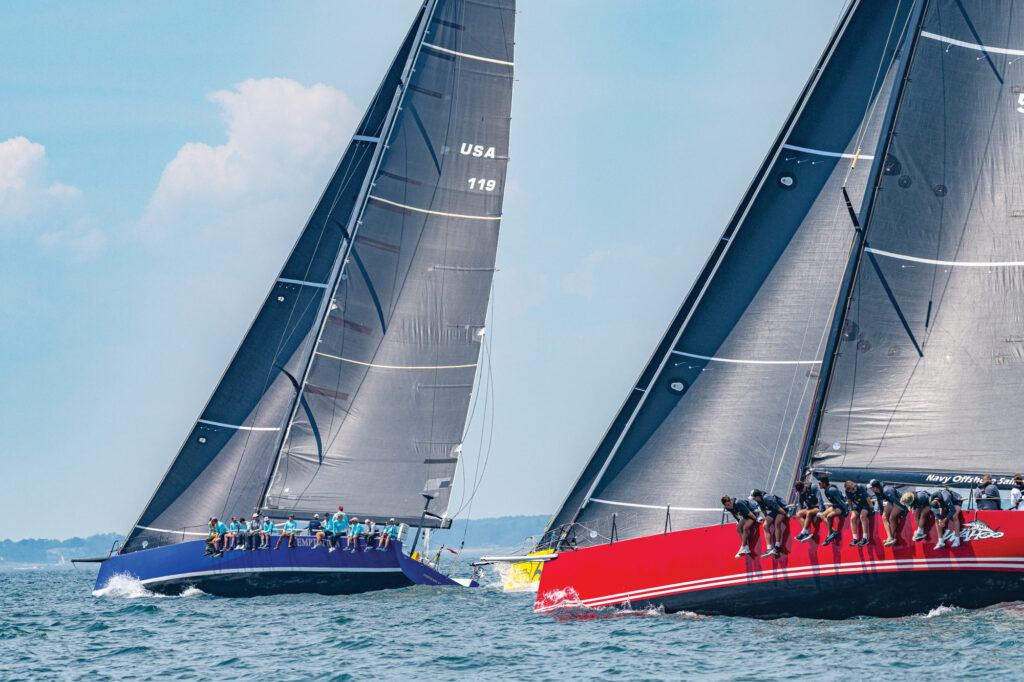
It’s a foggy spring day and I’m off the coast of Connecticut on board Art Santry’s Judel/Vrolijk 66 Temptation, bucking sharp waves kicked up by a 22-knot westerly. The boat’s bow is punching through crumbling crests as we average 10.8 knots of boatspeed. It’s not a smooth ride by any means, and to avoid hard pounding, the helmsman must turn down a few degrees to get through the big ones. Over thousands of offshore racing miles, I’d been trained to feather the bow up slightly when climbing over a wave, to minimize shock loading on the sails, sheets and rig. But modern yachts call for modern techniques, and this different approach to driving Temptation through the waves is proving to be much faster—and a lot easier on gear and bodies.
This summer of racing reinforced the notion that the more we race, the more we learn, and there was plenty of discovery for me. On board Temptation, I served as tactician and a watch captain in three venerable ocean races: The Block Island Race (186 miles), the Annapolis to Newport Race (473 miles) and the Marblehead to Halifax Race (361 miles). Each was very different, of course, and our crew continued to refine techniques and re-learn many lessons that are easy to forget in a long offseason.
The Block Island Race dates to 1946 and is raced annually over Memorial Day weekend. This year, the fleet of 70 boats started on a late Friday afternoon off Stamford, Connecticut, heading east with a light breeze filling our spinnaker. Our class started one hour and 40 minutes after the first of 11 classes, and it took exactly that amount of time to pass 69 boats. Once out front, it was our task to spot the strongest wind on Long Island Sound. The shorelines on either side of the Sound are where we often find stronger breeze, but we observed more wind in the middle, so we chased after it.
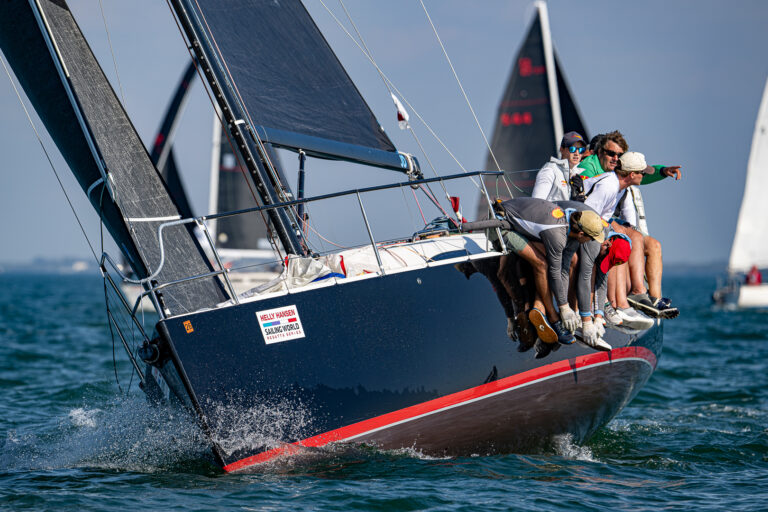
The gambit worked and we stretched away from the fleet. This particular racecourse takes us around Rhode Island’s Block Island, which we leave to starboard, and back into the Sound and its riddling currents. It was here, about 60 miles from the finish line, that the wind came in at 22 knots from the west. The short and choppy waves were making steering difficult so we experimented and learned to head down to avoid pounding. We also reefed the mainsail and did a bare-headed sail change to a No. 4. The boat was easier to control with the reduced sail area. We crossed the finish line eight hours ahead of the second-place finisher and yet, on corrected time, we won by a slim 57 seconds. It was a nice victory and an important reminder that every second counts.
One week later, Temptation was in Annapolis for the start of the race to Newport. This race originally started in 1947 with a course that ran from New London, Connecticut to Annapolis. A few years later, the course was changed to start from Annapolis so sailors could spend the summer in New England. The racecourse now includes a 115-mile scurry down the Chesapeake Bay before a 19-mile leg to an offshore sea buoy. From that turning point, it is 339 miles to the finish line off Castle Hill Lighthouse—the iconic welcome beacon to Narragansett Bay.
The wind was extremely light on the Chesapeake. It took Temptation 23 hours to reach the sea buoy. Our navigator, Hugh Doherty, analyzed many weather models and recommended we head well east of the rhumb line, reasoning that we would find consistently stronger northeasterly winds further offshore. His prediction was spot on, and we enjoyed a brisk upwind sail. The lesson, here of course, is to study every source of weather information available, and thankfully for offshore navigators today, there are many resources from which to pull. My usual strategy for a long-distance race is to sail on the rhumb line, unless there is a compelling reason to sail in another direction. In the Annapolis to Newport Race, our navigator made the case to head east, and it worked.
Unfortunately, my foul weather gear failed and leaked, and worse, my boots fell apart. It is beyond uncomfortable going on watch with wet gear when it is cold. When I got to Newport, I purchased new foul weather gear and better boots. Happily, not one of our crew was seasick on any of the three races. To avoid any chance of sickness I use a scopolamine patch, which is available with a doctor’s prescription. It is important to always stay hydrated, keep applying suncream, wear sunglasses and a hat, and of course, wear reliable foul weather gear. When you are comfortable, you are a more focused and effective sailor.
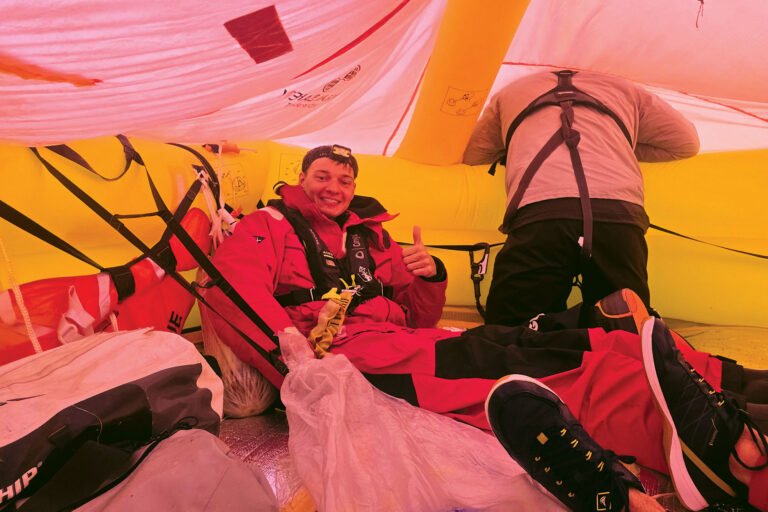
In advance of my summer of offshore racing season, I took the US Sailing and World Sailing Safety at Sea course offered by the Storm Trysail Club at the S.U.N.Y. Maritime College. The course starts with a mandatory 15-part online course that took me 13 hours to complete. At the end of each section there were 10 questions to answer. If I answered eight questions correctly I moved on (I had to take one section over when I answered only seven correctly). The most sobering part of the hands-on course was inflating and getting into a six-person life raft for 30 minutes. I found the experience uncomfortable. The fun of being in an enclosed life raft goes away quickly. The exercise reinforced my appreciation for being diligent when racing in the ocean. I encourage every sailor to take the Safety-at-Sea course, and not just once in your lifetime.
As the sun was setting on the final night of the Annapolis to Newport Race, we were just 32 miles from Castle Hill Lighthouse. The wrong hydraulic knob was turned, which eased off load on the tack of the headsail. On Temptation the headsail must be eased and the boat luffed when taking tension on the hydraulic tack. That did not happen and the hydraulic was pumped, causing the entire headstay luff feeder to fall on the foredeck and leaving us floundering without a headsail. After spending at least 30 minutes cleaning up the mess we sailed the remaining part of the race with only a staysail. The boat was 2 knots slower and tacked through 110 degrees instead of 80 degrees. The unfortunate episode probably cost about two hours. Temptation was first to finish and won our class, but we finished eighth in the fleet.
During our fast sail to Halifax, Nova Scotia, the wind built to 22 to 27 knots and headed several degrees. We elected to drop the asymmetric and set a reaching headsail with a staysail. The configuration proved to be faster, and we continued to gain on the fleet. As sunrise neared, the wind dropped a few knots and lifted. We were slow to respond and lost five miles on our closest competitors. It reminded me that the wind seems stronger at night and the waves look bigger. When twilight appeared, we set the spinnaker and spent the rest of the day making up lost ground. The lesson I relearned was to always have the next combination of sails ready to set. Often, I use a “10-minute rule” to wait to be sure the new wind strength and direction is going to stay before going through the change of sail routine.
The strong wind pushed Temptation to sail at high speeds. At times we were averaging well over 18 knots. Surfing the waves was like sailing a singlehanded dinghy. The best moments were being able to skip from one series of waves to the next. The boat would accelerate to 21 knots or higher. The problem was the boat was going as fast as the wind and the mainsail would luff and the boom would move to the center of the boat. Whenever this happened, the sail trimmers would give the helmsmen an unapproving scowl when the mainsail drifted inboard. They assumed the boat was way off course, but it was the apparent wind that dropped when the boat hit a high speed. After one exhilarating wave, the mainsail trimmer reminded me that I was an advocate for rotating people on the helm every hour. I smiled as I passed over the wheel.
There is an encyclopedia of different watch systems for long-distance passages. I have used many that range from simple (four on four off) to elaborate with different time sequences and sailors rotating on and off at short intervals. On Temptation the watch captains were on watch for four-hour periods. The rest of the crew changed watches two sailors at a time. The idea is to avoid confusion with a full crew changing watch at the same time. Temptation used the same system for all three races. The system works if every sailor keeps to their assigned time slot.
One of the most important things to do on a long race is to practice good communication. It is hard to hear when the wind is up, and boats are moving swiftly. Commands are lost when shouting from the stern to the bow. A better practice is to call the crew together and explain the next evolution, so everyone understands what is expected.
Temptation sailed over 1,000 miles during our three races. The boat was first to finish in each race, was first overall in the Block Island Race, won class in the Annapolis to Newport Race and set a new racecourse record by 46 minutes in the Marblehead to Halifax Race. We had a great season on the water and learned how to sail better—one race, one mile and one lesson at a time.