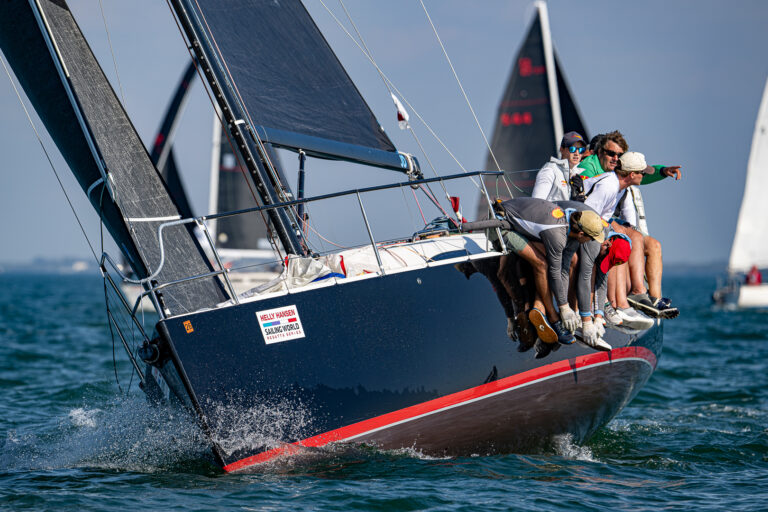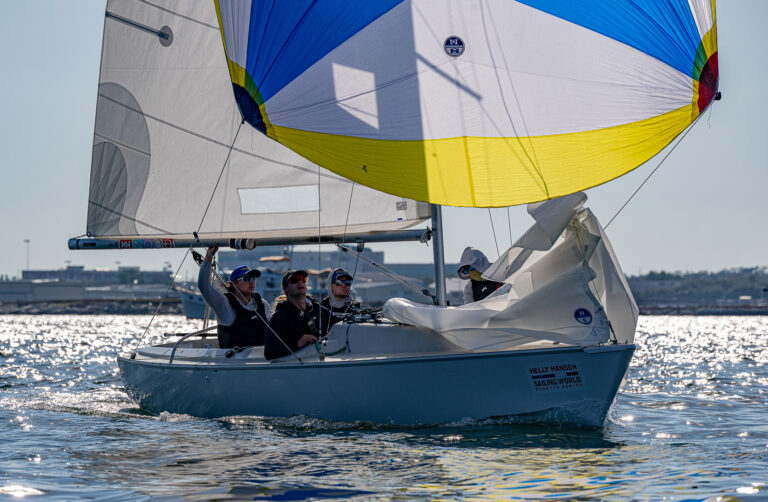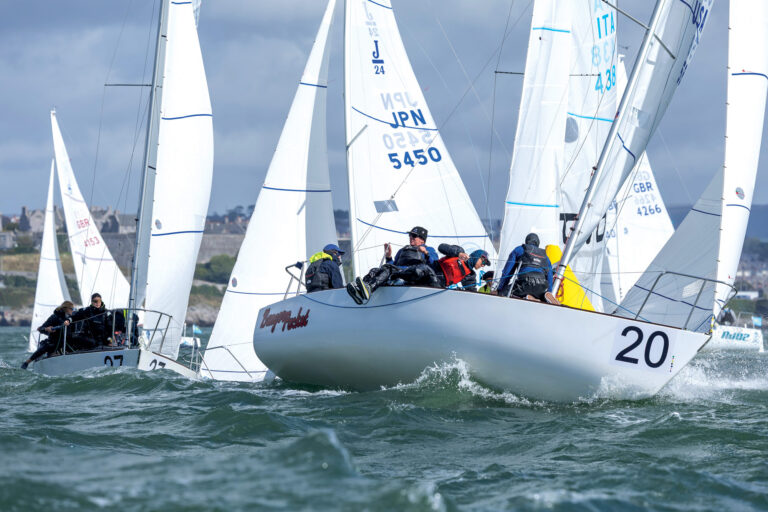
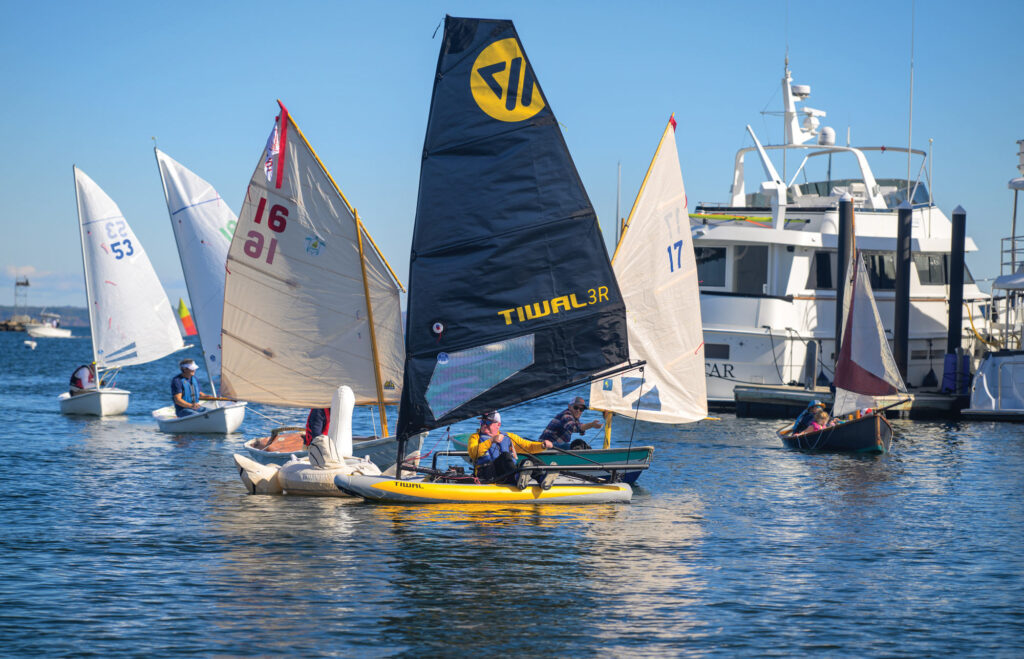
As I’ve traveled around the country over the years visiting yacht clubs and community sailing centers big and small, I’ve observed an extraordinary amount of perfectly good raceboats sitting idle on their trailers, racks and moorings. It’s easy to tell which ones don’t get used very often, their owners likely at home and thinking about the happier times when they bought the boat with aspirations of using it frequently and maybe even winning a few races.
Either life gets in the way, or in the case of many older one-designs, when new classes come on to the scene, older ones tend to fade away. Too often, remaining boats don’t have a place on the racing schedule, a spark plug to keep the fleet active or a community to rally. This sad and all too common sight of lonely crafts is often a result of too many types of boats in one area but access to the water and easy storage and launching are other barriers that I often hear about.
But there is an easy remedy to get small boats and their owners back on the water, and it’s been available to us for a long time. I am, of course, talking about Portsmouth Yardstick handicap racing. It’s a fundamental tool that can be used to rejuvenate a local fleet of small boats, and it’s an important step in helping to keep dinghy racing alive in the U.S.
Keelboats of different designs race successfully using a variety of handicap rules. Currently in the US, we have Offshore Rating Council (ORC), Performance Handicap Racing Fleet (PHRF), Offshore Rating Rule (ORR) and a few other options. These handicap rules are primarily suited for larger keelboats, but not smaller one-designs or one-offs. These empirical rules are easy to use and are based on experience and observation and handicaps are calculated by using the performance results of different boats. A yacht club or sailing association looking to get more small boats on the water should try using the empirical Portsmouth handicap system to encourage sailors to get their lonely boats back racing.
At a recent regatta, Charlie Enright, the new chief executive officer of US Sailing, witnessed the potential of Portsmouth racing and agreed more can be done to showcase and embrace it.
“At the Archipelago Rally in Rhode Island you show up with your boat and the ‘rating czar’ assigns you a rating associated with the Portsmouth Yardstick,” Enright says. “It’s a pursuit race with a staggered start that allows people with all kinds of boats to race together on the same racecourse in a fun and meaningful way.
“No one complained about their handicap because it was more about participation. You would be surprised how often it is used on lakes and in Middle America. We (US Sailing) are trying to gather data on how many people use it.”
US Sailing publishes a North American edition of the Portsmouth Yardstick Rating Rule booklet (available online) featuring the ratings of a wide variety of sailing craft and Henry Brauer, president of US Sailing, says the organization already has the tools in place. “The Portsmouth system is ready to go for most one-design boats,” he says. “We are encouraging orphan one-design boats that are no longer supported to give Portsmouth a try. We have to make it easy for sailors to participate.”
The Portsmouth Yardstick system has been in place since 1946. It was first developed in England for racing dinghies. The title “Portsmouth” refers to the Portsmouth Harbour Racing and Sailing Association, which supported the work of Stanley Milledge, the local handicapper. At the time, regatta results were tabulated by the Royal Yachting Association, giving each class a handicap based on the collective performance of boats over the course of a season. The word “yardstick” is used to define the time allowance between a designated boat compared with a variety of other classes.
In “The Centennial History of the United States Sailing Association,” published in 1997, Commodore Harry Anderson wrote, “Portsmouth Numbers were imported from Great Britain in the early 1960s. The Thistle Class was used as the yardstick to compare its performance to other classes.” In the publication Anderson also notes that a mix of one-designs can race together using the Portsmouth Numbers (PN). “Imported from the British and adapted for North American (weather) conditions the PN handicaps classes for one-of-kind boats based on the submission of race results by clubs and fleets.”
The perennial challenge for sailing administrators, however, is how to handicap sailboats without factoring in the ability of the skippers and crews. In other sports, such as golf, handicaps are determined by a golfer’s score. In golf it is the athlete that is rated, while in sailing it is the boat that is handicapped. Empirical handicapping, however, does work when you average out the results of many boats over time. The different skill levels of sailors are evened out by using a large sample.
Yacht clubs and regatta organizers can easily add a Portsmouth division to a scheduled regatta or for a weeknight or frostbite series. The result could be a starting line filled with an eclectic fleet of boats raced by enthusiastic sailors. A sailor would not have to buy the latest equipment and spend a large sum to be competitive. Just dust off the old boat and head out on to the racecourse.
In the 1960s and 1970s, Yachting magazine hosted its “One-of-a-Kind Regatta,” which compared the performance of a wide variety of boats. It was quite a scene to observe a fleet of dinghies charging off a starting line with every boat different from the others. Performance capabilities and differences were soon apparent.
The racing was fascinating, whereas every boat seemed to have strong points and often an obvious weakness. Some boats were better in light wind, others in a stiff breeze. Some boats excelled upwind while others thrived when sailing downwind. The event was intriguing because the sailors learned how their boat performed relative to other craft. After racing, discussions among the sailors comparing notes were always interesting. There was no handicap allowance. Bragging rights belonged to the boat that finished first.
While the US Sailing Portsmouth Yardstick booklet lists dozens of classes and PN numbers that have been in existence for ages, creating an equitable handicap for newer and more modern designs is difficult. Recognizing that all boats perform differently, depending on the breeze, handicap ratings are adjusted for wind strength. Each class is listed in the handbook with a Time Correction Factor. A “time-on-time” scoring system is used. In the U.S., the scale is the number 100. Corrected time is calculated by multiplying elapsed time by the scale, and that result is divided by the assigned Time Correction Factor (which is listed in the US Sailing booklet). For those who appreciate a simple formula, Portsmouth’s is simply: Corrected time equals elapsed time multiplied by the Scale/Handicap.
The desire to create fair handicap rating systems has been elusive, but since 1906 there have been many attempts to fairly handicap boats of different sizes. The perfect system may never be found, yet sailors must continue to optimize their boats and sail perfect races. This is what brings everyone to the starting line.
Handicap rules that are based on velocity prediction programs and complex formulas are difficult to administer. Consequently, owners have spent fortunes trying to gain an edge over the competition. The advantage of an empirical rating system is that the handicap is based on actual performance and this is why PHRF and Portsmouth Yardstick have remained popular over the decades. Still, while PHRF is well known, Portsmouth remains under the radar.
Two books have helped me unravel the handicap rating conundrum. One of them is “Men Against the Rule: A Century of Progress in Yacht Design” by Dr. Charles Lane Poor, The Derrydale Press. First published in 1937 as a limited edition of 950 copies that dissected the handicap rating rules of the era, Dr. Poor provides the reader with multiple stories of yacht owners commissioning naval architects to find “loopholes” in the rules to gain an advantage. It is fascinating to read about the triumphs and failures of design.
In 1997, author Peter Johnson published “Yacht Racing: 170 Years of Speed, Success and Failure Against Competitors—and the Clock.” In the book, Johnson expounds upon Dr. Poor’s narrative: “It is a story that produces classic racing winners, distorted freaks, sharp controversy and disputed results, but always fascination for the participant in, and the observer of, yacht racing.”
With the help of years of race results and data, the Portsmouth Yardstick system works well today, so sailors should embrace the opportunity to race—or simply just sail their boats with fellow like-minded small-craft sailors.
I am personally fascinated with racing boats of different sizes and shapes. I appreciate that, if my boat is slower on handicap, then my tactics revolve around finding clear air and avoiding being blanketed by larger boats. On the other hand, when I’m sailing a bigger and faster boat, I look for a clear lane and try to take advantage of puffs and wind shifts early in the race. Over the course of a season, I try to race on boats of different sizes to help me work on different strategies. I find the intellectual challenge one of the most interesting things about racing sailboats. Encourage your friends to get that neglected but back on the water.