It is true in life that timing is everything. As proof, in a recent off-season purge of old sailing equipment, I held in my hand my original metallic blue Tacktick compass that had been worked hard over 20 something years before it stopped taking a solar charge. As it landed in the electronics recycling bin with a thud, I thought to myself, “time to get myself a new one of those.”
Now, talk about timing. Two days later, I received an email from Sailteck, a company in the United Kingdom I’d never heard of, alerting us to its new electronic compass available this Spring. It looked just like the reliable Tacktick we’ve all come to love. What I always appreciated was the Tacktick’s simplicity, readability and reliability. When I mentioned my old original Tacktick in a responding email, I was happy to learn the Sailteck is also the product of the Tacktick creator and patentee Mark Johnson.
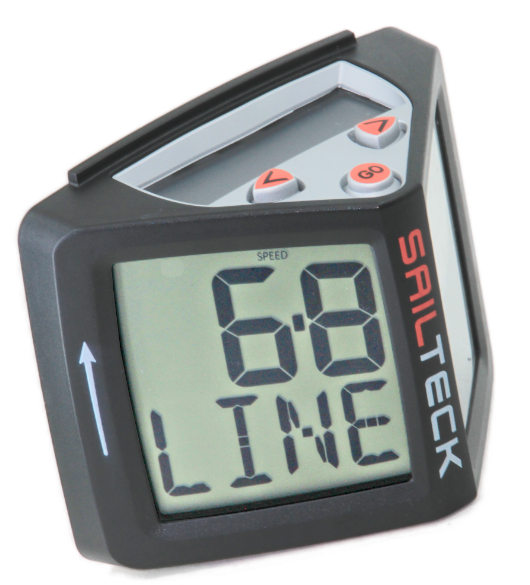
But this device was to be nothing like the old one. Jammed into the small mountable unit is so much more than a timer and digital compass. With the Sailteck GPS Compass, I would now have speed, heading, heel, trim and distance to the line. Plus, 300 hours of data storage for export and race replay with its companion web-based app. The unit is waterproof, submersible and has a stated 200 hours of solar-powered juice.
Would I like to try a demo? Yes, please.
As to its stated technical features, the GPS Compass “tracks five constellations and 30-plus satellites over two frequency bands (L1 & L5). Its dual-band ceramic patch antenna provides “accurate positioning to 40 cm,” timing to one-hundredth of a second, a display update rate of two to eight per second. Inside the 270-gram unit there’s a three-axis magnetometer, accelerometer, and gyro delivering “1-degree of heading, heel and trim accuracy.” Data logging happens at 10Hz, and they say, “no recalibration needed.” That all sounds good to me.
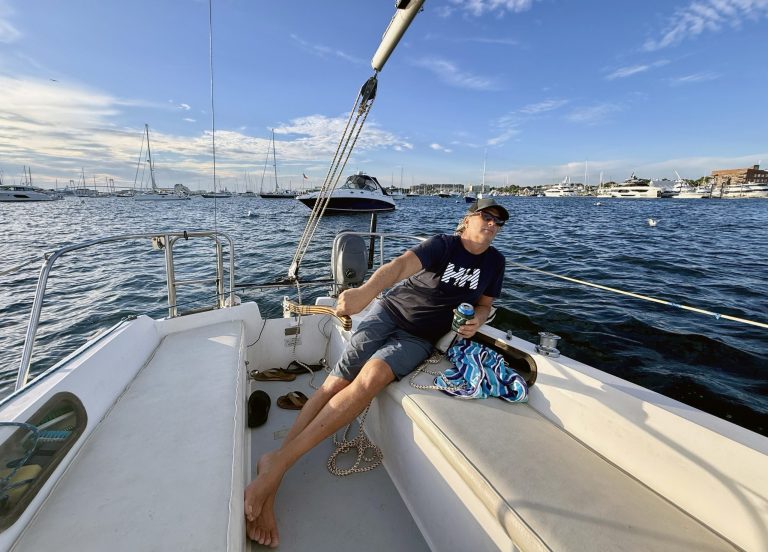
But what we want to know is what happens when we unbox it and put it to use. And that I did during a few hometown dinghy races in the Newport YC’s Turnabout fleet. Sailteck supplied numerous mounting options, but the bracket with Velcro straps worked perfectly on the spar (although I’d still add a tether). With its dual displays angled outward with large digital numbers, visibility was plenty good from the rail. At the dock, without referring to any user’s manual, I paged through the options with the right arrow button: I could see time, heel, etc. All good.
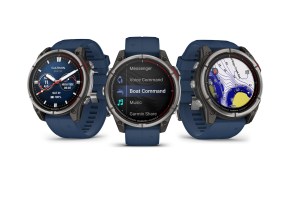
My first hope was that the timer alerts would be loud. All season long, I’d been using my Garmin Quatix 5 watch and stuffed beneath glove cuffs I could never hear anything in the final countdown. The Sailteck’s beeps, I was happy to hear, were plenty loud enough over a flapping sail.
On the way out to the course, I watched the compass and the dampening was plenty quick and seemingly accurate. All good there. Heel angle was a feature I was hoping to experiment with before the race, but with the race committee already on station, I figured that would have to wait for later. For now, I only wanted to tap into its compass, countdown timer and speed. I’d always wondered how fast the Turnabouts went upwind in less than 10 knots. I finally had my answer: 3.4—in chop.
In my haste to get to the starting line, I assumed I’d be able to easily toggle from the 5-minute default to the 3-minute sequence we use. I figured I only had to page to the timer function and hold the big red “Go” in the middle until it gave me the option to change it. No such luck. I tried again, pushing various combinations of buttons. No dice. Had I actually read the online manual before rushing to the club, I would have known to press and hold the left-arrow, which automatically switches it to 3 minutes for the day. Now I know.
So, I started the sequence at 5:00 and simply tapped the right arrow to sync it at the 2-minute horn. Messing about with the timer buttons, however, had thrown off my pre-race routine and I found myself out of position and out of sorts, but was excited to be able to hear the audible countdown at 30 seconds, then 20 and 10 and go. Had I had the time to ping ends and figure out how to use its Distance-to-Line function, at least I would have known where I stood with my second-row start.
The obvious lesson here was to not use a live race to learn how to use a new device straight out of the box.
In this particular fleet and venue, the average windward leg might be 500 feet or less, and races 15 minutes or less, so the game is more about fleet management and short-course tactics than staying on top of compass trends or boatspeed—that I can tell by nearby boats. But with the Sailteck perfectly in my line of site for the day’s first race I couldn’t help but find myself staring at it from time to time, and in doing so, not looking upwind for puffs as I should have been. That is the danger of such devices—it’s easy to be too “head in the boat.”
Guilty as charged.
This particular fleet of club charter boats doesn’t have compasses, so it was entertaining to be able to keep tabs on my tacking angles and headings in various corners of the harbor where the racecourses are set. It was also terrifying to see my boatspeed and know how slow I was going whenever I sailed myself into a lull (see head in the boat above). In the first race, comfortably deep in the fleet, I took a moment to toggle to the heel angle function, but honestly, it didn’t mean much at the time because I had no historical speed-versus-angle relatives to go. Plus, the Turnabout is a quirky hard-chine dinghy and it’s easy to feel when the heel angle is right or wrong.
Did having this powerful little device help my results that day? No at all. In fact, I’d say it was a distraction and overkill for the super short-course harbor action. Or maybe I was just “having a day” and it’s easy to blame something else. By the third race, though, I was spooked and left it ashore. That helped.
But now that I’ve experienced what is packed into this great little $800 race compass I’m eager to install it on a few different keelboats this summer and using Sailteck’s data analysis app with my teammates as we learn the nuances of a chartered J/7. And now that the J/24 class allows GPS compasses we’re going to ditch the old ProStart from the boat on which I race and tap into all of the Sailteck’s good stuff.
The device can simply be made class compliant by changing the top plate, which essentially keeps it timer and compass functions only while preserving the data for later, so if you’ve recently tossed your old digital compass, the timing is right, the Sailteck, like its predecessor, is a great and well-priced and powerful tool.