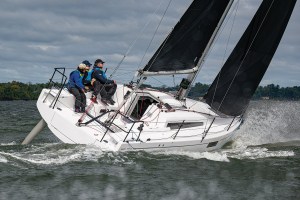
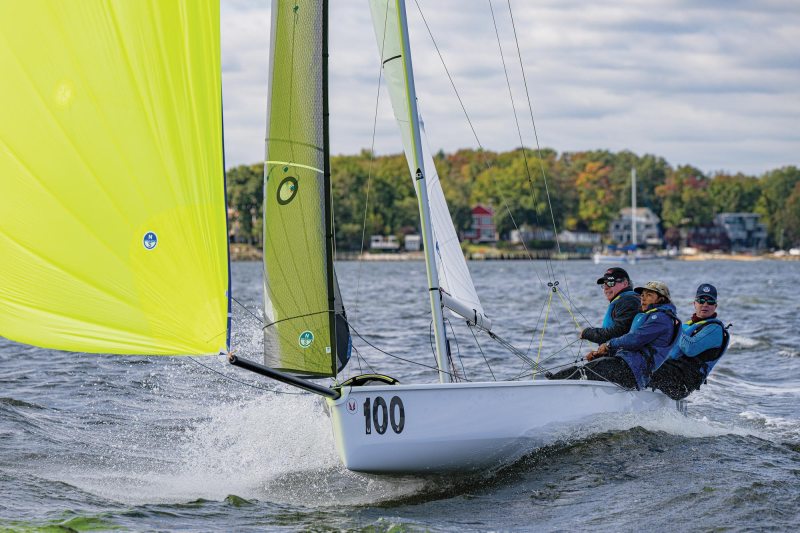
Melges is on a roll. From its humble shop in Zenda, Wisconsin, to its Watersports Center in Florida, they reignited the adult dinghy racing scene with their Melges 15, of which more than 1,200 and counting have been built. But the 15, as popular as it is, does have one limitation: it’s a double-hander. So, what’s a larger sailing family to do? Try the Melges 19, a supersized twist on the Melges 15 that delivers a supersized sailing experience for a trio.
“This is our aim at a true three-person family boat,” Eddie Cox of Melges Performance Sailboats tells our judges. “There’s a real gap in our line, and this fills it. We wanted to build something that was simple to use and affordable—under $35,000 for the boat and sails, on the water.”
“Simple,” as Cox describes the boat, does not do justice to its sophistication. It’s an immaculately infused epoxy hull that weighs in at 375 pounds, and once again they entrusted the naval architecture firm of Reichel/Pugh to deliver a hull shape that Cox says is revolutionary. “It’s so stable yet not sticky upwind,” he says, “This boat is really free upwind, and with a nicer rocker and taper into the transom, it’s a downwind sled, too.”
While cognizant of criticism about yet another one-design class with the potential to disrupt the livelihood of legacy one-designs like the Lightning and Thistle, the judges acknowledged that certain classes will continue to enjoy their followings so long as there are active builders. The Melges 19, they say, will better appeal to a newer generation of sailors who prefer a sportier asymmetric sailing experience. This one’s out of the bag, and the judges must evaluate it on what it is, not what it has the potential to do. Natural selection in the one-design world will do its thing over time, they agreed, but given their enjoyment of sailing the boat, and the commitment of Melges to support its classes, the Melges 19 is certainly the most exciting dinghy of the year.
The Melges 19 incorporates several design features that make it suitable for a family-oriented three-person racing experience over many heavier legacy classes. Lightweight construction makes it easier to launch and handle for a wider range of sailors. And the comfort and ergonomics of the cockpit, which Ingham described as considerably deep, will provide more comfortable hiking. The structural spine that runs the length of the cockpit doubles as a support during tacks, which is beneficial even for older sailors.
They appreciated such simple but modern features as the self-tacking jib and its athwartships jib tracks. But its accessibility, the judges say, is its best trait. The boat accommodates sailors of varied abilities and ages, with spacious and obstruction-free arrangements. The loads on sheets and control lines are not excessive, making it manageable for smaller or less experienced crew members.
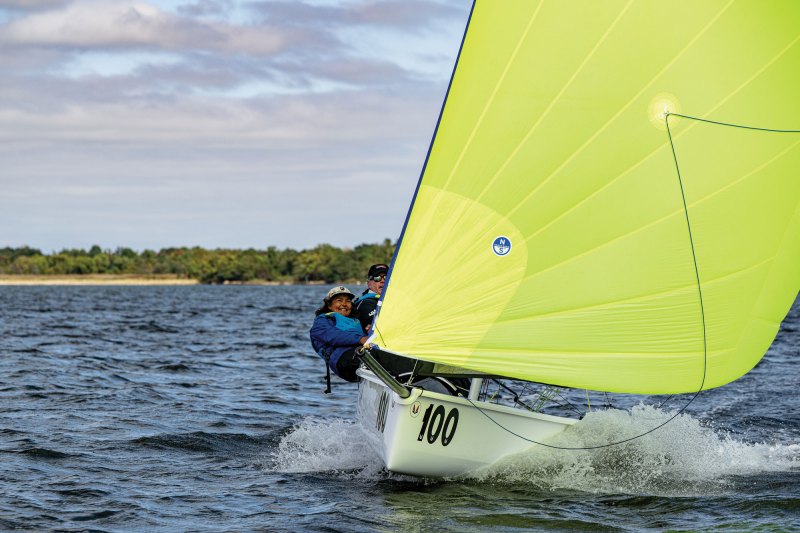
“A smaller person can definitely handle it, which is really cool,” says Morgan, a sought-after crew in a number of one-design dinghy classes, including the Lightning and Melges 15. “Nothing on this boat felt overly loaded. It’s just so easy to hike, it’s easy to crew.”
And it was definitely easy to drive—that is the Melges Midas touch. “The boat is just so easy to understand,” Morgan adds, appreciating the simplicity of the boat’s straightforward and minimalist layout, especially after her recent experience rigging a new custom 6 Metre with a cat’s cradle of control lines. “We were never sitting on any hardware, jib sheets or spinnaker gear. We weren’t tangled up in maneuvers. And for the three of us having never roll-tacked together, we did a lot of tacks and jibes with no snafus.”
Davis, Morgan’s fellow judge, who was nursing a bum knee, noted that the cockpit spine goes beyond giving the boat its structural rigidity. “They made that into an ergonomic feature rather than an impediment, so for an older guy with a bad knee, it was great because it gave me something to support coming out of the tack.”
Davis notes that high-quality epoxy construction is what makes the Melges 19 feel “really solid and robust,” but he’s also cognizant of the fact that the boat is plenty powerful, with a generous amount of sail area and a hull that will always want to get-up-and-go. This is not targeted at entry-level families learning to sail, he says—although they certainly could—but rather the families that are already experienced. “For them,” he says, “this thing would be awesome.”
Cox says one reason they chose a daggerboard rather than a keel was to have the boat be easy to trailer and launch in any way—trailer, beach dolly or hoist. And cost considerations are a major factor in the package: from the aluminum rig, to the one-design class sails to stock hardware and ropes.
The intended race-weight range, Cox says, is 475 to 550 pounds, which is right around three average adults, and ideally, one junior sailor to mentor, but Ingham says the ideal number is likely at the bottom of that range. “In this kind of boat, crew weight will matter.”
With sheets and controls spread throughout the boat, the judges agreed with Cox’s pre-sail assessment that there is a job for everybody in the boat. “You can have the driver either just driving or driving and playing the main and backstay,” he says. “You can have the middle person doing the backstay, trimming the main and trimming the kite. You can have the bow person trimming the kite, dousing the kite, setting the kite. You know, you can split up the jobs depending on the skills that you have on the boat, which makes it super conducive to families.”
Ingham ranked the Melges 19 high on his list on account of it delivering perfection. He was especially appreciative of the deep cockpit floor that gave him the feel of being in a sportboat rather than a knees-to-your-chin dinghy. “There really is nothing like it in this modern three-person dinghy category today,” he says. “So for me, it does move the dial. It’s lighter than the legacy boats, it’s asymmetric and it’s a lot more comfortable to hike on. It just moves, and in the bigger puffs it never came close to feeling like it was gonna wipe out. A puff would come, you just bear off…easy and quick.”