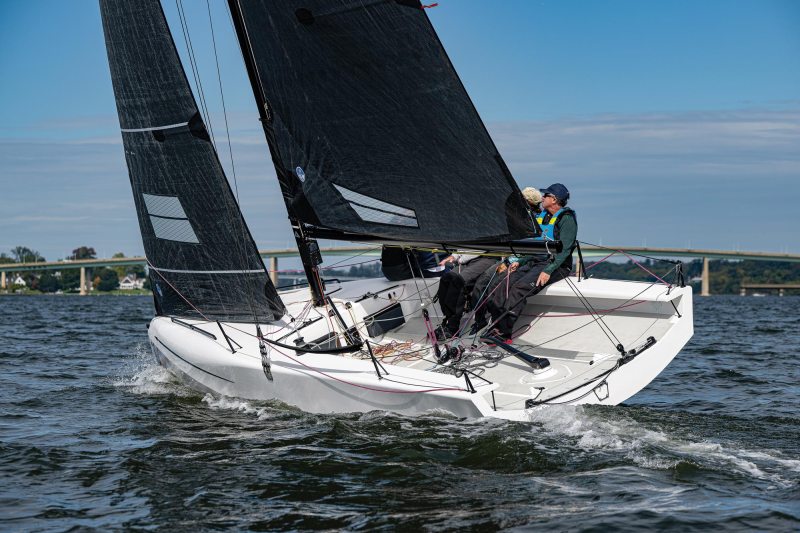
Nautor Swan’s Federico Michetti is a world-class sailor obsessed with perfection. Sail a short distance with him, and you’ll watch him make OCD-level adjustments. And when those adjustments come easy, as they do on the ClubSwan 28, he can’t help himself. Two-tenths of a knot slow? He feels it before the crash happens, and he’s already moving to the 28’s mast jack handle, the three-dimensional jib lead, the cunningham tugging the mainsail’s structured luff, or the myriad other controls that get a noticeable response from the 28-footer. Shift a gear and you feel it. Get it into a groove and it is lights-out fun, both upwind and downwind. This is Michetti’s kind of boat—a proper raceboat.
The judges agree, it’s Boat of the Year worthy.
“This thing is a pretty sexy boat,” judge Mike Ingham says. “I can definitely see the curb appeal, and we knew it was going to be sophisticated. Everything is ergonomically correct. It’s a performance boat, but it’s also a beautiful machine, and from the second we stepped on it, I was like, whoa. This is cool.”
Built in Cartagena, Spain, by the Sinergia Racing Group for Nautor Swan, the ClubSwan 28 is the smallest offering in ClubSwan one-design lineup that now stretches to 50-footers. Conceptually, Michetti explains to the judges, the boat is meant to bring new owners into the Nautor Swan stratosphere, with a no-hassle one-design boat and an organized and builder-supported regatta circuit.
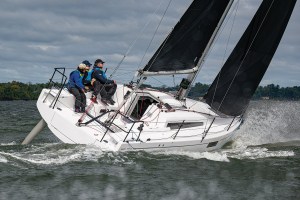
The design itself is all Juan Kouyoumdjian: It is unique, technical and loves to sail on its rail. From the chines to the reverse sheer and deck chamfer, it all adds up to a fast and forgiving platform. “The whole package is about reducing drag and windage and saving material and weight,” says Dobbs Davis, an ORC measurer with a keen eye to the behaviors of modern hulls.
Good hull design is nothing without a legitimate rig and sail package, however, and here Ingham was having fun with the boat’s easy-to-play sail controls—especially the hydraulic mast ram and the structured luff (the boat had a North Sails quiver for our test sail) for mast control in the absence of a backstay.
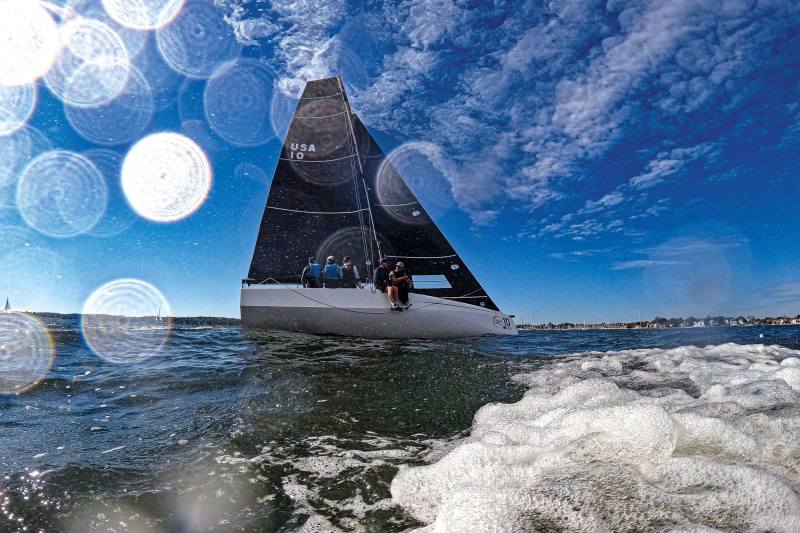
“It’s interesting because it’s got a ram that you can adjust throughout the race, but with the cunningham and the structured luff, you’re bending the mast with compression,” Ingham says. “The cunningham is led back to the main trimmer, just below the mainsheet block, and when you pull that on, mast bend is noticeable. It’s really sophisticated in that you have multiple ways to quickly depower, between the rig itself and the structured luff.”
Prepreg vinlyester construction gives the boat impressive stiffness and a solid feel underfoot, Davis says, and that was noticeable during their session in 10 to 15 knots and flat water. “When you get on a this boat, it is a completely different feeling. It really is. Things are tight as a drum and when we pulled the controls on hard, nothing flexed. It’s incredibly solid.”
Michetti, a world champion of a bunch of grand-prix one-design classes, has the experience to ensure the boat’s ergonomics were right. Access to lines, the layouts, and the overall crewing ergonomics were strong selling points for judge Monica Morgan.
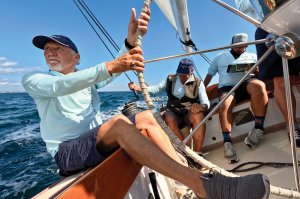
“It was really comfortable,” she says, “the cockpit had plenty of room, and even on the rail it didn’t feel as if we were all bunched up. Being a smaller person, I could do most things on the boat, and that’s pretty cool. I can see it as being manageable by a novice owner that’s new to racing. And I could see a high-level sailor being able to push its limits. There’s plenty of power in the sails, it’s really responsive, and it’s especially fun downwind.”
At 2,600 pounds, the boat is light, and with an L-shaped keel that draws 6 feet, the ClubSwan 28 can be easily trailered and raced in skinny-water venues. Michetti says an experienced team can have the boat off the trailer, tuned and sailing in four hours or less. And as to professionals, one-design class rules have no limitations aside from an owner-driver restriction and a maximum crew weight of 400 kilograms. The owner, however, can declare a weight of 85 kilograms and be exempt from any crew weigh-in requirements.
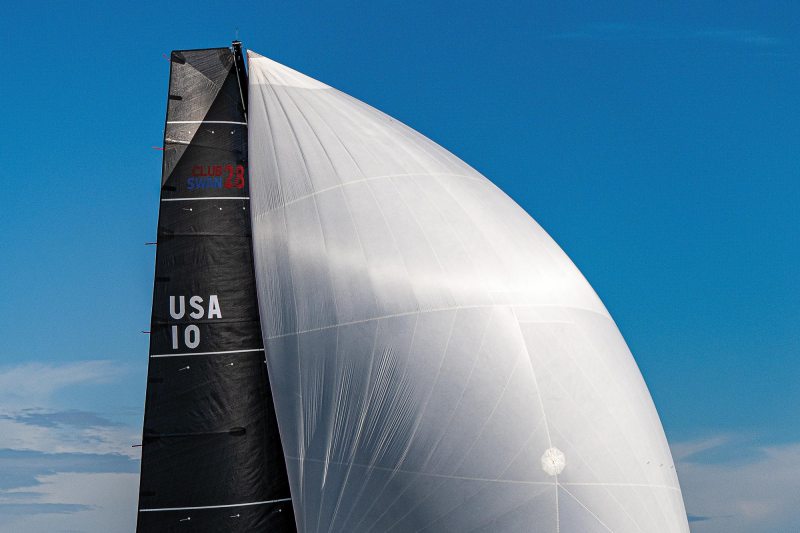
There is only one class spinnaker allowed (maximum area is 936 square feet) and only two class jibs. At ClubSwan events, the race committee determines which sail is to be used across the fleet based on the wind strength.
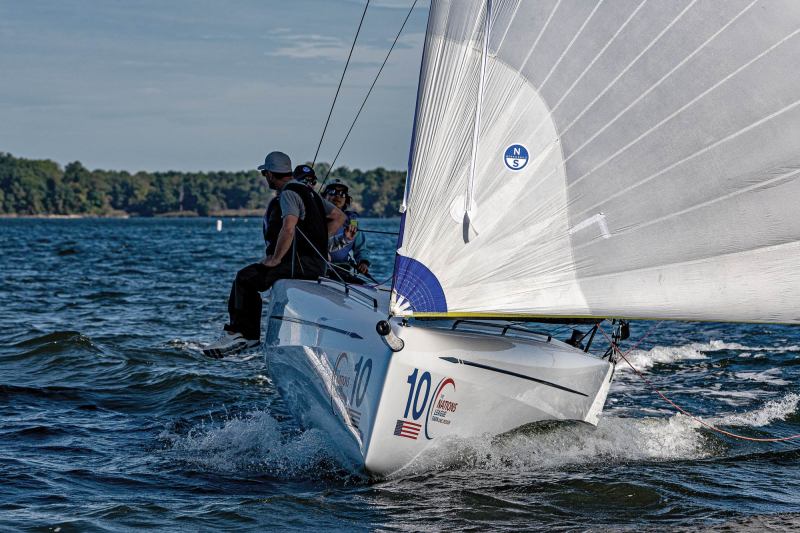
ClubSwan regattas, of which there are plenty in Europe, give owners and crew a unique environment that hints at a modest level of exclusivity. The U.S. plan for the class—as of October 2025—is to launch a series in Pensacola, Florida in the winter and Newport, R.I., in the summer. Success of the endeavor will rest upon Nautor Swan remaining committed to the class stateside. Should that happen, there’s a fun future of high-level class racing for those who seek turnkey racing.
“That is the one cool thing about the ClubSwan concept and this boat. Aside from the M32 catamaran group and the IC37s for New York YC, which is a different sort of thing, nobody has done anything like this in the U.S. for a conventional keelboat class, so this is a new deal,” Davis says. “Federico said they’re very motivated for the U.S. market because they see the potential here as untapped.”
Michetti’s stated price for the boat, in October and the midst of the U.S. tariff uncertainty, was $283,000. The judges agree that while that may seem high initially, it is a reasonable cost to experience the ClubSwan racing sphere. But for this price, they add, there’s a lot that comes with it: a sophisticated carbon build, purposeful high-quality hardware and systems and access to the club. And yes, you can club race it, day sail it and show it off all you want. It is a Swan.