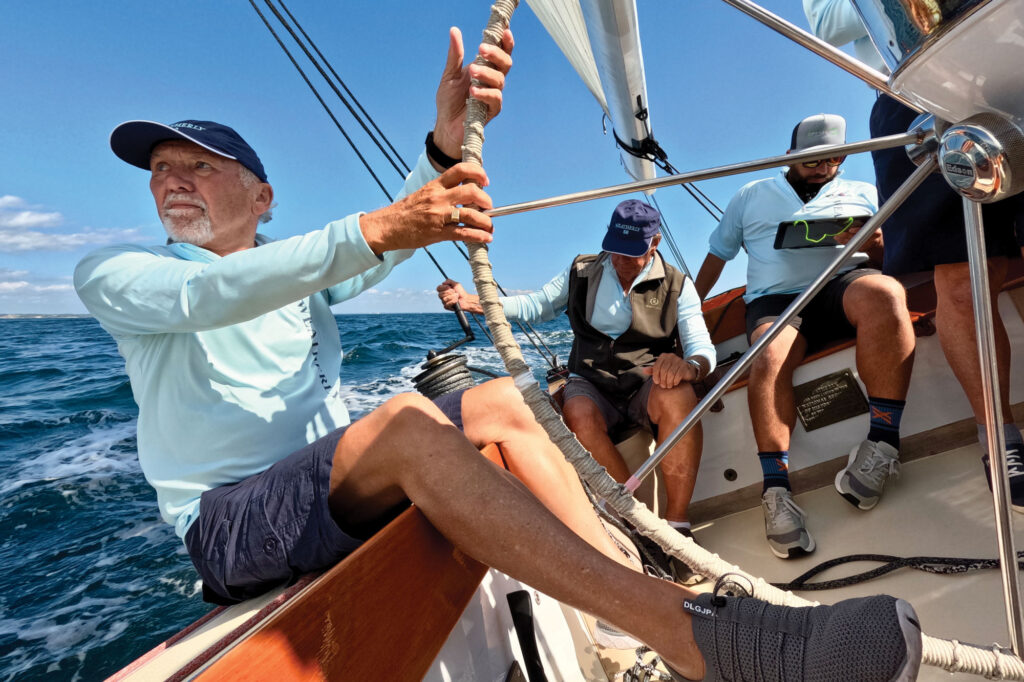
The deck is still wet with dew as the crew arrives one by one for boat call. The stillness of the sunny morning is broken by sailbags heaved onboard and dragged across the non-skid. Trimmers stroll from bow to stern leading tapered sheets and guys through and blocks. It’s the regular busy work of getting a 12-Metre off the dock and racing and it’s the first day of the 12 Meter North, Americans in Newport, Rhode Island. It’s also Weatherly’s big day.
The boat’s owner Steve Eddleston eventually arrives with the sandwiches. He’s got a cup of coffee and a big smile as he admires all the activity from the aft deck. We’ve never met, and he’s invited me aboard for the day’s races. I’ve got GoPros and microphones, and thankfully, he’s a natural on camera, an animated storyteller who effortlessly rolls from one life yarn to the next. He’s got a strong Yankee accent with a raspy Down Easter twang. But he’s a Kiwi, his wife is Mexican, and now, of all things, he owns a 12 Metre.
Eddleston’s is a wonderful success story. As a young adult he was a hardworking software engineer who traveled the world, selling, building and servicing those big old-school mainframe servers from back in the day. Work took him to Mexico, where he met his wife—another fun story of persistence. He made a name, a family and a fortune, retired, served on boards and then bought a Planet Fitness franchise—covering the entire state of Rhode Island. Somewhere in there he was a hardcore distance runner, too, which is all to safely say he’s got energy, wisdom and vision. Which brings him today to Bristol, Rhode Island, Cap’n Nat country. Somehow in his life story arc, his ownership of a classic 12 Metre makes total sense.
His path to Weatherly’s helm started in Maine, where he taught himself to sail on a Hobie Cat he found in the classifieds. No mentor, no program, no junior sailing instructor—just curiosity and stubbornness. “I can figure this out,” he said when he bought the Hobie. He did figure it out, and it wasn’t pretty, but then came years of solo hotdogging on the Hobie.
Fast forward to 2002. At a corporate planning conference in Newport, the company had chartered Weatherly for an afternoon group outing. Eddleston was the only real sailor among them, so he didn’t hesitate when offered the wheel. “It’s the most incredible feeling,” he says, closing his eyes and reliving the moment. “She’s 30 tons and when she first takes the load of the wind…it’s just incredible.”
In the early days of COVID, when he started looking seriously at classic boats, a surveyor suggested Weatherly to him. He met George Hill, its previous caretaker (Hill’s is also a long and inspiring story), and so it began. “George told me, ‘Steve, this has been my livelihood for 36 years. I’ve made my living with this boat, and I’m ready to retire and move on. I’m looking for another caretaker.’”
When he finally purchased it, he told his wife, “This may be the best thing I ever do or I’ll be trying to sell her in 12 months.”
He was no fool, however. He did calculate his decision with trepidation at first. The risk, the maintenance, the unknowns—they didn’t immediately appeal to his practical side. But the plan was simple: He would keep doing what Hill had done so well. The boat was in good shape and everything worked. He went into it thinking he wouldn’t change much, but after a few years, that philosophy changed.
He checked Weatherly into the spa for a 22-month deep-tissue treatment.
“It started with, ‘Let’s paint the deck,’” Eddleston says. Then it went deeper, all the way to a full structural review and a lot of craftsmanship to get it tight and solid. “So yeah, it became a big project.”
The deck came off and they got in under the skin of the boat, into the frames and the structure. The loads are enormous on a 12 Metre, so he and his boat captain agreed it was best to fix for the future. “The powers and the loads on these boats are phenomenal,” Eddleston says, “so it doesn’t do any harm to go in there and triple-check that everything is Bristol.”
Weatherly went into the spa as a 68-year-old and came out as an 18-year-old, he likes to say, “so she’s good for another 60 years for the next caretaker.”
His last word strikes me. We typically refer to raceboat owners as “owners.” I had never thought of caretaker as a term for classic yachties the likes of Eddleston and so many others. But it’s perfect. Weatherly is not just another pretty 12 Metre for sunset sails and the occasional race; the longer she sails, the more souls she touches. The more she sails the larger her community of admirers grows. No one forgets their first sail on Weatherly.
Over the boat’s long career, Eddleston says, “People married aboard her, renewed their vows, and celebrated milestones on her deck.” A surprising number of women in New England bear the name Weatherly, he adds matter-of-factly, because their parents were inspired by the boat’s America’s Cup victory in 1962.
At a recent regatta, Eddleston met one such woman—her mother, pregnant during that Cup summer, felt it was the natural name for her daughter after Weatherly’s win.
In Eddleston’s heart Weatherly is more than a classic racing yacht and relic of the Cup. She is a kind of floating town, with citizens, fans and more than six decades of history that took her to Seattle for the Boy Scouts, through the Panama Canal, and to the bottom of Long Island Sound. US-12 is one of a unique club of the other famous traditional 12’s still sailing in Newport: American Eagle, Intrepid and Columbia. They each have their own loyal population, and it grows with every sailor that steps on a deck or turns a coffee grinder.
The 12 Metre crew scene is a tight-knit one in Newport, and if there was one thing that worried Eddleston initially, it was finding 16 reliable mates every time he wanted to go for a sail. As a solo Hobie guy, his Rolodex was pretty thin. But it didn’t take long to string a starting team together. As soon as word got out that Weatherly had a new owner, experienced sailors began to appear, introducing themselves, offering their services as crew. Within a short time, he says, he found himself with a call list of 50 to 60 people, plenty to staff the boat for racing and events.
For several years, he personally managed the crew boss role—deciding who sailed when, where new sailors should be placed, who might need to step back for a while if they couldn’t reliably make boat-calls. Over time, he began handing that job to others as part of their own development, recognizing that building a racing program means building leaders, not just followers. Spoken like a truly successful franchise owner.
He’s also now the de-facto commodore of the Newport fleet, which itself is so iconic that the city’s manhole covers and public works vehicles now sport a logo of two 12s, hard on the wind. He helped rally enough boats and enthusiasm to stage the 12 Metre Worlds in 2023, drawing 10 boats—five classics and five moderns. It was a sight to behold and one he hopes to recreate again.
Eddleston’s racing plans for the boat include the 12 Metre World Championships in 2028, so he’s got a long way to go, with more boatwork, a better mast, new sails and mechanical upgrades to get the boat around the buoys better. Straight-line speed, perfect sets, dip-pole jibes and douses is what 12 Metre crewwork is all about.
“The power and beauty of these boats when they’re on the wind and the crew is working—it’s like an orchestra,” he says. Everybody knows what they’ve got to do at the right moment. It’s the most enchanting and powerful form of sailing I know.”
Now that Weatherly is properly marinated and the crewwork improving race by race, Eddleston’s aspirations are both pragmatic and idealistic. On the water, he is clear: under his watch, Weatherly is “first and foremost, a racing boat.” Charters still matter because he loves that the general public can experience the same sensation of sailing a 12 Metre that captured him. But the core of the program is competition. The North Americans and local regattas are not for trophies, but as check-ins for the Worlds.
And when the time comes to pass on his caretaker role, he says, he’ll be pleased to have passed on a boat that is better, stronger and faster than when he found her—just as Hill did. He happily imagines Weatherly sailing another half-century and beyond, still racing, still teaching, still thrilling people who have never stepped on a race boat before.