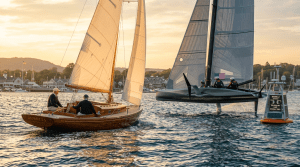
Fifty-seven years after his first ride as a $10 extra, Gary Jobson joins the 1938 Sparkman & Stephens yawl Black Watch for three days on Maine’s classic circuit — and finds the same welcome, and a very fast NY50 to beat.
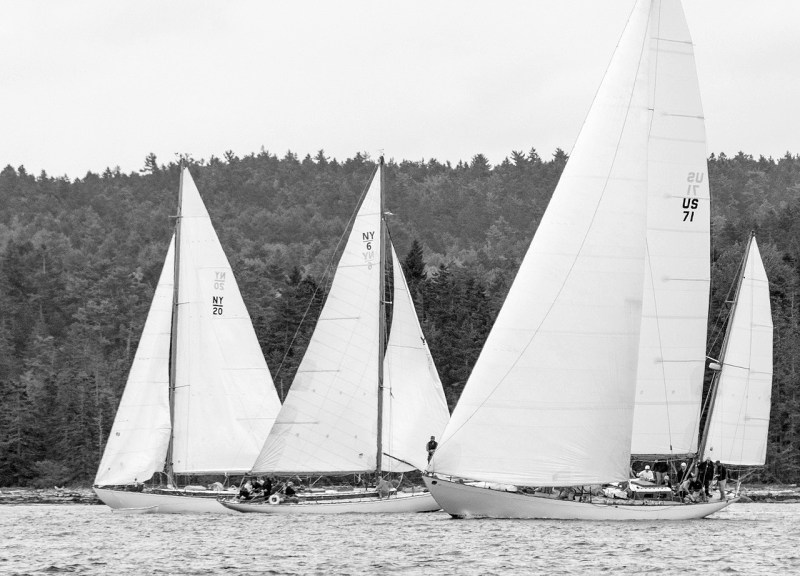
The year was 1969, and at the age of 18 I stepped aboard a 42-foot sloop in Annapolis for a race to Newport. I didn’t know anyone on the crew, all of whom had just graduated from the New York Maritime College. I was an incoming freshman. I was nervous, but I said hello, stored my leaky foul-weather gear and joined the team. The experience of that race was in my head when I stepped aboard the classic yacht Black Watch for three days of racing in Maine in August. I was the new guy again, and thrilled to be invited aboard such an icon.
But unlike my role as a $10 extra in 1969, this time I was slated as the tactician for three days of races: one from Castine to Camden, one from Camden to Brooklin and, finally, the Eggemoggin Reach Race. My trepidation receded swiftly when everyone on the crew welcomed me aboard.
“All right,” I said to myself, “This is going to be fun.”
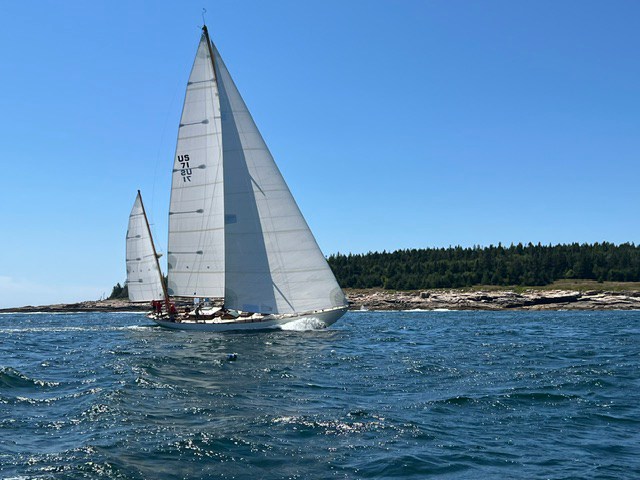
Black Watch has an inspiring legacy that started when brewer Rudolph Schaefer Jr. built the boat in 1938. When the United States entered World War II in 1941, the vessel became a coastal patrol boat looking for German U-boats. In 1954, Dr. George Brooks bought Black Watch and campaigned it until 2005. The original name of the yacht was Edlu II, named after Schaefer’s two daughters, Edmee and Lucy. The name Black Watch honors a Scottish infantry regiment tasked with keeping watch over peace. The soldiers wore dark tartan uniforms, hence the name Black Watch. Today, a syndicate of five owners takes turns sailing the yacht in classic yacht races on the East Coast. For the recent series of regattas in Maine, two of them — owners Peter Kellogg and Joe Robillard — swapped turns at the helm. Both are seasoned sailors and, happily for me, welcomed my tactical advice.
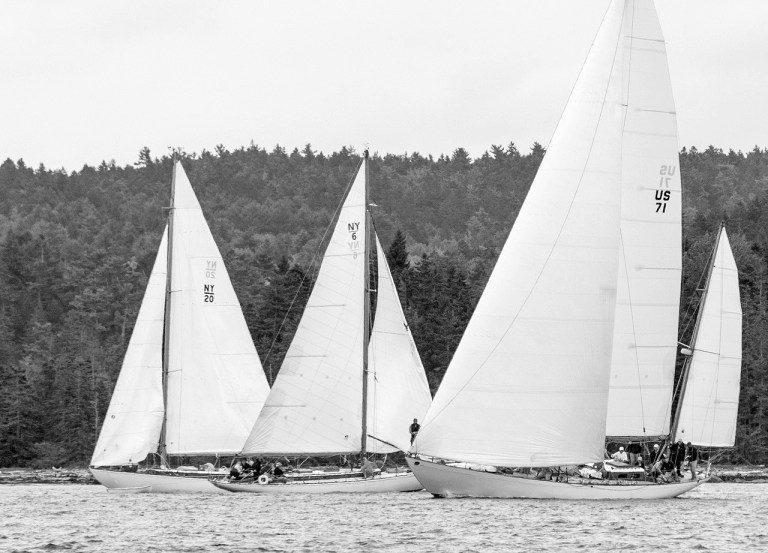
The Down East waters of Maine are a haven for classic yachts. The handicap rating rule is administered by the Classic Yacht Owners Association. The rule is formally known as the Classic Rating Formula. This year’s notable entrants included the NY50 Spartan, the L. Francis Herreshoff-designed ketch Ticonderoga, Olin Stephens’ masterpiece Dorade, and the 12-Meter Gleam, designed by the late Clinton Crane and launched in 1937. These vessels and many others have been totally restored, and they are sailed at a high level.
Black Watch captain Kyle Dufur has served the syndicate for 14 years. He has the operation down to a science and recruits a crew of strong, young sailors whom I found to be exceedingly polite and impressively efficient at every task. Spinnakers, staysails and headsails were set at a moment’s notice. When given a tactical query, the crew member asking the question was referred to the tactician — me. I appreciated the trust. Let there be no doubt that winning is important to the owners and their crews. This attitude was obvious during aggressive starting sequences, mark roundings and tactical gambits in capricious currents that weave through the rock-strewn coast.
The first race started off Castine, home to the Maine Maritime Academy. The day before the race, the academy hosted a naval architecture symposium that included principals from Artisan Boatworks, Brooklin Boat Yard, Lyman-Morse and Rockport Marine. I added a talk about the America’s Cup and the Olympic Games. The academy’s president, Craig Johnson, is a veteran racing sailor and was an enthusiastic host of the symposium. The Castine event was chaired by 93-year-old David Bicks, who has been spending summers in Maine since 1968.
The start outside Castine Harbor was a close reach to a government buoy across the bay. Spartan set a fast pace for the 22-boat fleet. As we rounded the channel marker after four miles of sailing, I thought about the U.S. Coast Guard’s initiative last year to remove many aids to navigation. Luckily for mariners, the idea was dropped. The hazardous coast of Maine is a challenging place to navigate. Aids to navigation are essential even in the age of GPS and electronic charts. The second leg was sailed to windward. The choice was whether to stay in deeper water (safer) against a foul current or sail less distance and get current relief in shallower water. On Black Watch, we stayed in deeper water.
The final leg of the 19.3-mile race was a close reach across Penobscot Bay. The wind built to 20 knots. Spartan covered the course in 2 hours and 12 minutes. The NY32 Gentian won on corrected time, with another NY32, Siren, just 6 seconds behind. Black Watch finished fifth, 28 seconds ahead of Spartan. We later learned that beating Spartan is a major accomplishment.
The following day, a colorful skippers meeting took place at 8:30 a.m. on the lawn of the Camden Yacht Club. We were cautioned about submerged rocks, lobster boats and the importance of the upcoming night’s social. A total of 59 wooden boats entered the club’s Classic Yacht Feeder Race, which gets the fleet to Brooklin for the Eggemoggin Reach Race.
The race to Brooklin included 14 turning marks on a 27-mile course. The wind was variable most of the day. Spartan, Black Watch and Gleam got off to an early lead. As the wind lightened, Siren and Viola, a newly restored gaff-rigged cutter from the Yacht Club de Monaco, were in the mix among the top boats. Our crew and helmsmen on Black Watch worked hard as we sailed around countless islands and jagged outcroppings while searching for puffs of wind. The sun was hot, and gallons upon gallons of water were consumed.
Every sail change was executed without any hesitation. The new sails seemed to work until the wind inevitably shifted again. As a tactician, I enjoy watching the strategy of competitors.
Spartan, with two-time America’s Cup-winning navigator Peter Isler calling the shots, seemed to make every maneuver at just the correct moment. We worked hard to keep up. Black Watch took 5 hours and 14 minutes to cover the course. Spartan won with a comfortable 6-minute, 44-second margin on corrected time.
Black Watch finished second in class and third in the fleet. It was a satisfying, if exhausting, day.
The next day, I was issued a new jacket with the Black Watch logo embroidered on the chest. Once again, I felt welcomed into the family. The logo is a curious red oval around the boat’s name. I had to smile because it was the F&M Schaefer Brewing Company logo. I still remember the clever Schaefer beer jingle from the 1960s, “Schaefer is the one beer to have when you’re having more than one.”
I’m not sure that phrase would work in today’s socially conscious world, but it worked at the time.
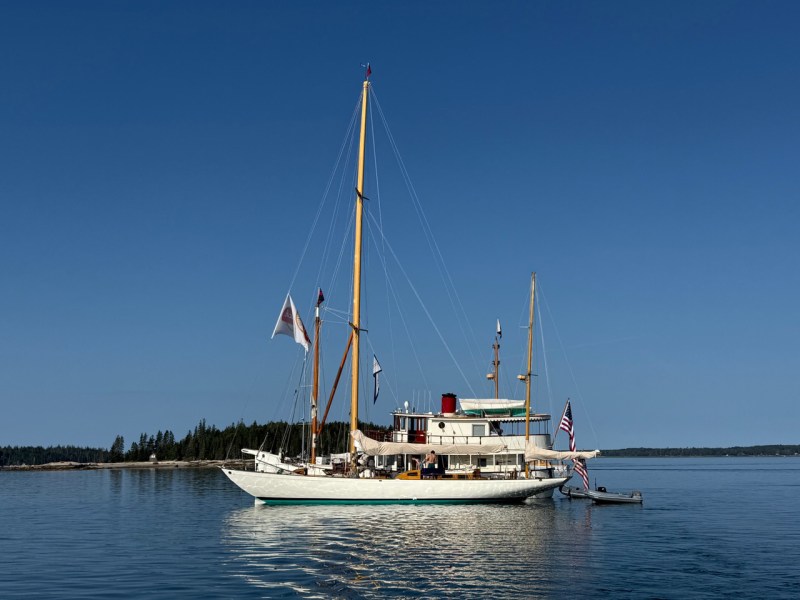
Most crews slept on their yachts each night. It is a good scene. The French-speaking crew on Viola were the most enthusiastic sailors on the waterfront and enjoyed their time far from their home waters on the Mediterranean Sea. I took a dinghy ride around Brooklin Harbor to survey the eclectic fleet of yachts. It was like a classic car rally. Every boat’s varnish glistened. Bronze winches and fittings were appropriately polished. When the sun came up, crews used squeegee cloths to wipe away the dew and shine the varnished teak. It was clear to me that classic yacht sailors are proud of their vessels. The camaraderie on shore was heartwarming in contrast to the competitiveness on the racecourse. In my mind, this is exactly the way sailing should be played.
The final race of the series is the famous Eggemoggin Reach Race. A total of 94 wooden boats entered this enduring event, which started in 1985. Once again, there was a spirited skippers meeting with many sailors crowded under a huge tent on the grounds of WoodenBoat magazine. The “Egg” race is co-hosted by Rockport Marine, Brooklin Boat Yard and WoodenBoat.
Race officials, standing on picnic tables, were colorful as they listed requirements and made suggestions. One of their notable ideas was to encourage boats to load up with lots of crew. The goal was to get many people on the water. Aboard Black Watch, we had 19 crew. Peter Kellogg invited several friends from his hometown on Barnegat Bay who were in Maine for the summer. A few were racing veterans from the area and were helpful to me as tactician.
The southwesterly breeze filled in late that morning, and the race committee sent the yachts off by class on a 15-mile course passing through islands and eventually around Halibut Rocks, where the fleet set spinnakers. As one of the bigger boats, Black Watch had to weave its way through the fleet. Spartan also found the task challenging. I quickly learned it was easier and faster to simply head off and speed through the leeward side of smaller boats whose crews were itching for a luffing match.
I know that no boat wins in a luffing match. To pass from the leeward side, just as we sailed into blanketed wind, I would call for the helmsman to reach up 10 degrees to accelerate, and we would glide right past. No harm, no foul. As tactician, I like to give the helmsman guidance to help with the strategy of the moment. For example, if a heading wind shift is anticipated, the boat needs to foot and sail fast to get to the new wind quickly. I’ve learned from racing with great helmsmen that subtle suggestions based on strategy are well received and followed.
Just as the leaders reached Halibut Rocks, the wind died and shifted about 90 degrees. It felt like the race was starting over. Black Watch’s crew kept changing sails to match the vagaries of the wind. The hard work paid off. We finished second in our class and second overall in the fleet. Spartan, no surprise, was the victor, finishing 2 minutes and 42 seconds ahead of us. Gleam was third.
As we set anchor after the race, I thought about each boat’s designer. Gleam was naval architect Clinton Crane’s personal boat. In the 1950s, he was president of the North American Yacht Racing Union, the forerunner of US Sailing. Nathanael Greene Herreshoff designed and built nine NY50s simultaneously in the winter of 1912-13. Only one remains: Spartan. The late Olin Stephens would be proud of Black Watch, a boat he designed when he was 30. For the crews of all the classic yachts, these were special days of racing on the rockbound coast. And I came away with a greater appreciation for classic yacht racing.