RulesGamble368
Max Hocutt describes himself as a casual Sunday racer who races a Flying Scot at the Tusca loosa Sailing Club. He recently described to me an incident that occurred last summer and, naturally, resulted in a lengthy debate with lots of maneuvering of spoons and a saltshaker in the club after the race.
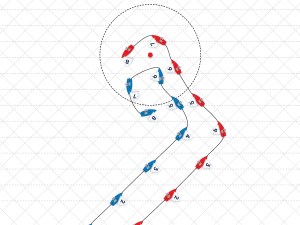
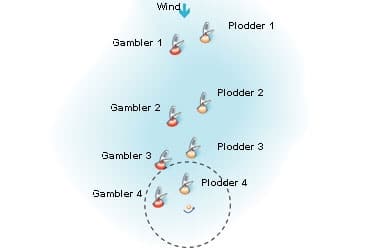
As the diagram shows, Gambler and Plodder were overlapped, running on starboard tack under spinnakers toward the leeward mark, which they were required to leave to port. The wind was light. At position 1, while they were five to 10 lengths from the mark, the boats were clearly overlapped with Plodder on the inside about a boatlength from Gambler. At position 2, as they neared the two-length zone, Gambler gained a bit, but there was still an overlap. At position 3, near the edge of the zone, Gambler luffed sharply, barely breaking the overlap for a moment, and then immediately bore off to her course to the mark.
As she bore off, Gambler established a new overlap outside Plodder. Plodder’s helmsman, believing Gambler’s luff was made to give Plodder room, continued on a course to round inside. After position 4, Gambler hailed that there had been no overlap at the moment that she reached the zone and that she would not give Plodder room. Gambler then jibed and rounded up right in the path of Plodder. There was contact but no damage. Neither boat protested, but after the post-race debate Max, who was Plodder’s tactician, sent me an e-mail asking how the rules applied to this incident.
Here’s how I would apply them. Rule 18 begins to apply when boats are “about to round” a mark. Because the winds were light, Gambler and Plodder became “about to round” at position 3 when Gambler reached the two-length zone. If you draw a line abeam from Gambler’s stern, you will see that there was no overlap at that moment, but there was an overlap just before and just after Gambler’s luff. If-and it’s a big if-the facts found by the protest committee were exactly as shown in the diagram, then Gambler was clear ahead when she reached the zone, and Rule 18.2(c)’s first sentence required Plodder to keep clear of Gambler as they rounded. In addition, since a new overlap began inside the zone when Gambler bore off between positions 3 and 4, Rule 18.2(c)’s third sentence put Plodder on notice that she was not entitled to room. If a protest committee had found precisely this set of facts, it would have been required by Rule 64.1(a) to disqualify Plodder for breaking Rule 18.2(c).
Gambler could have avoided contact by not turning into Plodder’s path. Therefore, Gambler broke Rule 14. However, she would not be penalized because she was the right-of-way boat under Rule 18.2(c) and there was no damage (see Rule 14(b)).
Gambler’s tactic was a risky one that I do not recommend. There are four ways in which the testimony at a hearing could have gone against Gambler, and I see no way that, while involved in the incident on the water, she could be confident harmful testimony would not be given.
It would be great if, just like the yellow first-down line for football television broadcasts, there were a bright yellow circle on the water marking the perimeter of the two-length zone. Realistically, there never will be one, and neither will a bell ring when a boat enters the zone. As I’m sure you know, it’s difficult to judge exactly when a boat enters the zone and it’s almost always the case that witnesses do not agree on precisely when this happens. Testimony might have suggested that both Gambler’s luff and her bear away occurred before she entered the zone, in which case Gambler would have broken and then re-established the overlap outside the zone. Or, the testimony might have suggested that she luffed after she had already entered the zone, which would imply that there had been an overlap when Gambler entered the zone. Or, the testimony might have suggested that Gambler did not luff high enough to break the overlap. If any such testimony was given, the protest committee might well have found that there was an overlap when Gambler reached the zone and that, therefore, she owed Plodder room under Rule 18.2(b).
Here’s the most likely way in which the hearing would’ve gone. When the protest committee attempted to find that single most crucial fact-whether or not an overlap existed when the first of the boats reached the zone-it was in doubt as a result of conflicting testimony. If that happens, Rule 18.2(e) applies. It states, “If there is reasonable doubt that a boat obtained or broke an overlap in time, it shall be presumed that she did not.” Because Gambler luffed solely to break an overlap that clearly existed, if the testimony left the committee in doubt it would be required by Rule 18.2(e) to resolve that doubt by presuming that Gambler did not break the overlap in time. The protest would then have been decided in favor of Plodder.
Whenever boats hit, there’s a good chance that damage will occur. Gambler got lucky when she hit Plodder. If there had been any damage to either boat or injury to any person on either boat, then both boats would’ve been disqualified-Plodder under Rule 18.2(c) and Gambler under Rule 14.
Finally, there’s a psychological factor that could influence a protest committee to decide against Gambler. The rules exist to permit boats to race in close proximity to one another without damage, and in particular Rule 18 exists to get boats around marks and obstructions in a fair and orderly way. If the tactic that Gambler used were widely used, there would likely be more damage at rounding marks and more protests, neither of which is in the interest of the sport. Therefore, judges on protest committees might well be predisposed to find against Gambler for using what is widely thought to be a “sharp” and reckless tactic. Certainly, judges are supposed to interpret testimony without bias and to interpret rules strictly as they are written. Nonetheless, if facts prove difficult to establish, such a predisposition might well tip the balance against Gambler.
There are few things that Gambler could have done to help herself both on the water and in a protest hearing. If she luffed and bore away just as shown in the diagram, she could have hailed at position 3, “No overlap! I’m just entering the zone. No room. Don’t sail between me and the mark!” Then, as she bore off, she should have watched Plodder carefully. One of two things would have occurred. Plodder might luff and let Gambler pass ahead. Then, barring a protest by Plodder, Gambler’s tactic would have worked. Alternatively, despite Gambler’s hail, Plodder might continue on a course to pass between Gambler and the mark. If that happened, Gambler should have given Plodder room and been careful to avoid contact. Then Gambler could have protested Plodder for taking room to which she was not entitled and, if Gambler were able to establish that the boats were indeed in the positions shown in the diagram, then Plodder would be disqualified. And, most important, by giving Plodder room and avoiding contact, there would be no basis for the committee to disqualify Gambler.
E-mail for Dick Rose may be sent to rules@sailingworld.com.