Steve Erickson
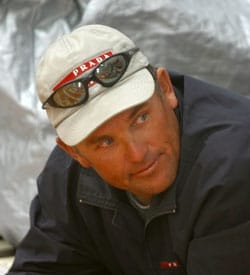
He’s a pioneer of the professional sailor movement. But Steve Erickson says he had no idea where he was headed after he won the 1984 Star class gold medal at the tender age of 23. “I had the opportunity to make a little bit of money and do what I love doing,” says the five-time America’s Cup veteran and two-time Star world champion. “I didn’t think it was what I’d be doing in my early 40s.” Since he concluded his second tour of duty with the Prada syndicate last winter, he’s been enjoying free agency. He sailed the Rolex Sydney Hobart Race on Skip Sheldon’s Zaraffa and has been coaching U.S. Olympic hopeful Meg Gaillard and Mark Ewing’s Farr 40 Riot. He’s also returned to the Star after a decade-long hiatus and joined forces with three-time Olympic medalist Mark Reynolds in pursuit of the 2004 U.S. Olympic Star berth. The U.S. Star Trials start March 20 on Biscayne Bay, Fla. What brought you back to the Star? The initial part of the answer is the opportunity that presented itself. Without that I wouldn’t have been that interested. It’s a project that can win, and it’s a return to my roots, which is a bit of a cliche these days. But I like playing on different boats. What puts a smile on my face is sailing small boats. Before you signed on with Mark, when was your last Star regatta? I think the last regatta I sailed was in 1994. I sailed with Jim Brady at the Olympic Classes Regatta, which we won. What’s been difficult about getting back into the Star? The one thing I miss is my flexibility. The crew gets taken out of the tactical picture somewhat and I feel like when I was younger I was more aware of other boats. If there’s a struggle right now, it’s, “What’s going on behind me and why wasn’t that a problem 15 years ago?” Essentially I’m stiffer; it’s harder to rotate my body around. What separates a great Star crew from the guys just hanging over the side? You try not to be a detriment. I acknowledge there are times where you’re kind of taken out of the play tactically. But I look for the times when you can stand out. Whether it’s giving input 3 minutes before the start or it’s on the run. Mark and I just throw ideas back and forth a little bit and see what sticks. We won the Pacific Coast Championships in 1983 and we haven’t sailed together since. We know each other well, but we’re still trying to figure out our sailing style. Do you remember you’re first paying gig? It would be something like driving a Star boat from the West Coast to the East Coast and making $1,000 or $2,000 and sailing the regatta. That was a way to make ends meet. The true professionalism of it started with my ’87 Cup with Tom Blackaller, which started in ’86. I think we were offered $500 every two weeks and room and board. We thought that was a pretty good deal. Any memories of that campaign? I learned more about sailing, the physics and dynamics of why a boat sails, why a boat needs to be balanced, how to sail in a lot of wind, and what seamanship is all about. We knew we were on a shoestring budget and it was all going to come together in the end, which it almost did. What was it about Blackaller that created such lasting impressions on so many sailors of your generation? Passion. He was passionate about his sailing and he was really loyal to the group around him. Did your generation have an advantage in being the first true group of professional sailors? I’ve got a theory. Essentially, there’s a group of us 40-year-olds?say from Paul Cayard, who’s 45, on down to John Kostecki, who’s 39?that came out of the ’80s and was able to make a living and occupied the space. The universe of pro sailors that solely race boats is 200 to 300 people, maybe more. But it’s not 3,000. It’s a small group. We’ve occupied that space all through our 30s and I have a strong feeling that’s why there isn’t a lot of 30- to 38-year-old pro sailors. But you’re seeing a lot of 22- to 30-year-olds making a push at it now. Will you pursue another America’s Cup job when this Star campaign ends? I’ve done five America’s Cups; it’s what I do. Starting in 1996, I did the Whitbread for two years and the last two Prada campaigns for five years. So for seven years I’ve been flat out. I came out of this last Cup thinking it would be nice to get back to what I used to love, sailing with different people, sailing on different boats. My travel schedule’s a little hectic, and I’m not in lovely Hood River (Ore.) as much as I’d like. But it’s nice to be heading off to a new project with different people and different smiles to put on your face. Did you enjoy your time with Prada? I really did. The two campaigns were very different. The first one we were the new guy on the block, the big spender, the guy with all the cool stuff. Two years later, we had the smallest tender, one of the smaller compounds. The second campaign had more of an international flavor. At the end of the day, the result wasn’t as good as the first time, but that’s sport. It isn’t all about smiles. Would you prefer to take a more primary role in a future campaign? In the last campaign I was the operations manager, so I definitely had a leadership role. But I’ve always felt content to be in a supporting role. If you ask people who know me, I’m not the guy standing next to the trophy in the picture. You coached a Farr 40 team at Key West. How does that circuit compare to the 50-foot circuit of the late ’80s and early ’90s? I went to the most recent St. Francis YC’s Big Boat Series. I probably hadn’t done it in seven years. What really jumped out at me there was the number of boats, the number of owners satisfied in steering their boats, and all the boats having a combination of pro and amateur guys. For me that’s just growth. It’s a good thing. Reflecting back to the 50-footers, you always wondered how long that circuit was going to sustain itself. Winning an America’s Cup is obviously still a goal of yours. Anything else you’d like to accomplish in the sport? I want to go catamaran or trimaran sailing around the world. The Whitbread gave me a taste of that. I don’t know if I have a lot of those laps in me, and I don’t know if I have a lot of years left, but that’s something I’d really like to do. Have you had trouble landing a ride? I wouldn’t say I’ve had trouble, because I haven’t looked that hard. These races that are coming up in a couple of years?there may be opportunities there?and I’m putting my nose in that direction and seeing where it leads. I really like the Southern Ocean and the fact that you can send it for 60 days and be done with it.