Fisher Rounding
One Thursday evening, surrounded by a clutter of dishes at Nacho Mamas, Thistle class veteran Tom Hubbell started quizzing class champion Greg Fisher. Hubbell’s questions weren’t about the contents of the soft-shell taco; they were about how to polish the coaching program for the Thistle Midwinters in St. Petersburg, Fla. He was creating a course focusing on the most important skills in racing, and Fisher was there to provide the expertise. They continued to meet regularly and what emerged from those taco sessions was a book manuscript by Hubbell entitled On the Water with Greg Fisher, Racing Sailboats. Sailing World got a sneak peek at what Fisher had to say about faster mark roundings.
Tom: We recently gave up a lead at the weather mark by bearing away to the rhumb line too soon on a right-triangle reach. I was too preoccupied with getting down the course and getting the chute up to defend against two faster jib-reaching boats. How would you prevent that from happening?
Greg: You can gain a lot of distance with efficient mark roundings, so what you have to do is set up the turn. There are tactical as well as speed issues, but first, let’s talk about how to accomplish the turn while keeping the boat at top speed. In other words, how to come into the mark ready to make a speedy, controlled turn.
Tom: By controlled you mean not sharp, right?
Greg: Right. You want a smooth turn. Remember that a sharp turn requires a lot of rudder action, and using the rudder to turn the boat is like using the brakes. And, when you turn sharply, the boat will tend to heel more, and that’s slow, too. Boat balance and sail trim, and by that I mean easing at the weather mark or sheeting in at the leeward mark, are the best tools to turn the boat.
Tom: Besides avoiding aggressive steering, what are some other boathandling techniques for the weather-mark turn?
Greg: As I come abreast of the mark, I like to ease the mainsheet about 2 feet and have the centerboard immediately hoisted to the halfway point. This greatly reduces weather helm and helps the boat bear off. We also work hard to keep the boat flat, or even slightly heeled to weather, at the beginning of the turn. Allowing the boat to heel to leeward makes it a lot harder to get the boat to bear off. Easing the main helps keep the boat flat, or slightly heeled to weather. In a good breeze, you can ease the main to the point of luffing. This will create a slight roll to weather and allow the boat to bear away with very little rudder action. We don’t ease the jib much, if at all, because we want it to help pull the bow down.
Tom: People are always talking about how to play the weather-mark layline. What do you say?
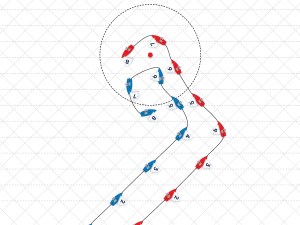
Greg: What you want to do is make your final approach to the weather mark about one boatlength above the starboard-tack layline.
Tom: Isn’t that a waste of distance?
Greg: What you’re trying to do is position the boat on the approach so that you pass close to the far side of the mark as you gradually turn downwind and ease the sails. If you approach right on the layline, then you have to keep the sails trimmed in and continue steering on the beat until the end of the boom is past the mark before you can drive off downwind. That approach forces you to make a sharp turn.
Tom: When do you start thinking about where you’re going to steer after rounding the weather mark?
Greg: Ideally, you figure out where the jibe or leeward mark is before the start. I always have that heading written down on the seat. A few boatlengths before I get to the weather mark, I’ll look down and remind myself what that heading is, so that I know just how much to bear away. Initially, you may need to hold a higher course to avoid being rolled by boats close astern, but it really helps to know where the mark is so you don’t waste time or distance sailing too high or too low immediately after rounding the weather mark. Plus, if the next leg is a run, knowing the compass heading to the leeward mark will help you recognize which jibe is better. As I head downwind, I try to position myself so I’m inside at the leeward mark.
Tom: So you want to be inside, get there in better wind, and get there by sailing a shorter course as long as it’s fast?
Greg: Absolutely. Just as at the weather mark, you want to sail a smooth, gradual turn so that you end up close to the far side of the leeward mark. You want to go from the higher downwind speed to the slower closehauled speed without slowing more than necessary. The thing to remember is that no sailboat turns like the Batmobile. You can’t cruise up to the turn at full speed and turn 90 degrees without stopping the boat. It helps to drop the board well before the turn. Of course, you also need to get the chute down early, too. It seems like a lot of sailors hold the chute too long and then just park when they turn the boat. I also keep the boat flat-as in not heeling. Some people feel that heeling the boat to help it turn is fast. A couple of degrees of heel is OK, but in my book, excessive heel results in excessive helm, more rudder drag, and more difficulty controlling the turn.
Tom: What about sail trim?
Greg: I like to create a slight helm by trimming the main. How quickly you trim the main sets how rapid the turn will be. Obviously a little practice in the mechanics of trimming the mainsheet goes a long way toward helping you execute a smoother turn. The jib trimmer plays an important role here, too. Overtrimming the jib too early pulls the bow to leeward and the boat tracks lower as you pass the mark. Keeping the jib eased until the boat is on the closehauled course helps the boat come up to the highest track closest to the mark. In fact, on our boat, the jib is completely luffing until we’re on a closehauled course, then the crew snaps it in.
Tom: How do you deal with congested mark roundings?
Greg: Fouls are slow, so it’s better to lose a boat or two instead of committing a foul, doing turns, or worse, causing damage. That’s another reason why it’s important to anticipate and plan every mark rounding. You have to figure out how to accomplish a fast, clean rounding well before you get into the fray.