atlantic class 368
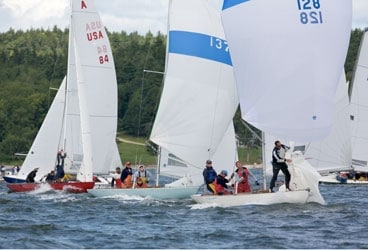
At the start of the final race of the 2008 Atlantic Class National Championship, four teams representing four yacht clubs were within two points of one another, and several others in the fleet of 34 boats still had reason to hope. An hour later, when Ian Evans and his crew in Try Again turned the final leeward mark with a healthy lead and began working their way upwind to the finish, any onlooker who resisted the distraction provided by the panorama of scenic Blue Hill Bay, Maine, would have been convinced that Evans’ home team had the series securely trapped in his personal lobster pot. But Evans was in no position to relax. Just behind him, a handful of previous champions were making that last leg very tense indeed.
Two were old-timers from Connecticut. Between them, defending champion Norm Peck Jr., of Niantic Bay YC, and George Reichhelm, of Cedar Point YC, had been racing Atlantics for almost 100 years and had won a total of 25 Nationals. Also in the hunt were two younger former class champions. Norman Peck III-universally known as “Norm III”-has been racing Atlantics for most of his life out of Niantic, first with his father and then on his own. In Cassidy, representing the New York YC, was the new boy as Atlantic sailors go-Adam Walsh, who had raced these 30-footers for only three years. With co-owner Steve Benjamin of North Sails trimming mainsheet, Cassidy was the closest thing to a factory team at Blue Hill. Also in this pack nipping at the heels of Try Again was Henry Brauer’s Scamp, from nearby Northeast Harbor.
As they rounded, Cassidy went hard right; Reichhelm’s Schucks and the others went left. Evans cautiously worked the middle, keeping an eye on both sides of the smooth, picturesque, and maddeningly shifty waters of nearly landlocked Blue Hill Bay.
They have been sailing Atlantics at Blue Hill since the 1930s at the Kollegewidgwok YC, pronounced “College-eh-wigee-wak” by the locals and a few brave visitors. KYC suffices for most people. The name means “fresh salt falls”-a reference to the violent reversing falls stirred up by the change of the extreme local tides at the mouth of a nearby fresh-water inlet. KYC is one of those clubs where the same handsome boats have been sailed forever by generations of the same families and are identified by the names on their transoms, not the numbers on their sails. They take sailing seriously at KYC, with 280 kids in Optis and an active racing program. The sailors, most of them summer people from points south, love their Atlantics, equip them well, and race them hard.
That blend of tradition and modern can also be seen in the Atlantic itself. Reichhelm has been racing Atlantics for over half of his 75 years. “I like the people,” he says, “and almost everybody has a family crew-and the boat’s so pretty and exciting.” Four of the boats fighting for the lead in that last race had at least two relatives in the crew. As did many more further down the standings.
From a distance the Atlantic has the breathtakingly graceful appearance of the Star and other over-rigged boats designed before 1930, with the low freeboard, snubbed bow, and big mainsail. Come closer and take a peek at the center console, tapered spinnaker sheets, and other gadgets, and you see that this boat’s not stuck in the 1920s. Take a ride in a good breeze, and the excitement is vital.
The boat was designed by one of the most original minds of his generation, W. Starling Burgess. A sailor and also a pioneering airplane pilot and builder, Burgess was far ahead of his contemporaries in his understanding of aerodynamics and the power of the new Marconi rig. His innovative Marconi-rigged staysail schooner Niña was still winning races 40 years after she was launched in 1928. In the 1930s he produced the designs for three America’s Cup winners. Co-designer Olin Stephens credited Burgess for the lion’s share of the shape of the nearly invincible Ranger.
Working with the German boatyard Abeking & Rasmussen in the 1920s, Burgess produced numerous racing boats that were shipped to America. First came one-design 12-, 10-, and 8-Meters and Universal Rule M-boats. Then, in 1928, he designed a new 30-foot one-design keelboat to meet the growing demand for day racers. Burgess spent that summer sailing a prototype around from yacht club to yacht club promoting a class he called the Atlantic Coast One-Design (the name was changed to a simpler Atlantic, probably because there was interest on the West Coast).
Burgess’ aggressive marketing worked, and 99 Atlantics were shipped across in 1929 and 1930. Until then, the biggest one-design classes that size had 30 boats. There were that many Atlantics on the starting line at Larchmont Race Week. Soon the Atlantic was the standard boat on Long Island Sound for sailors in their teens. My father had one over in Cold Spring Harbor, on Long Island, and sailed it to regattas all over the Sound, where he raced against Bus and Bob Mosbacher, Victor Romagna, Bob Bavier, George Hinman, and other sailors who went on to the America’s Cup.
The boat has many appeals. The long, low open cockpit makes it easy to handle. While normally raced with four, Atlantics can be raced competently by three. My Dad and I used to doublehand ours on occasion as well. The cockpit layout is comfortable for day sails and also for moonlit sailing dates.
They were designed for speed, with almost 400 square feet of working sail area, overhangs to cut wetted surface in light air (LOA is 30’7”, LWL 21’6”), a full, scow-type bow that quickly stretches the sailing length when the boat heels, a long, flat run aft, and lightish (for its day) displacement of 4,500 pounds-the slightly longer International One Design weighs 2,600 pounds more. “They’re just about the fastest small craft down the wind in a good breeze that have been developed in recent years,” remarked Sam Wetherill, a columnist for Yachting, in 1928. Upwind, they can be a little wet, but that’s part of the fun, assuming you have a good pump. Everybody who has steered an Atlantic has remarked on the well-balanced, almost neutral helm.
Like many classes of wooden boats, popularity waned as the boats began to age. Norm Peck Jr. learned about the structural issues the first time he sailed an Atlantic in 1945. He was 16 and helping to sail one from Western Long Island Sound 100 miles east to Niantic Bay, near New London. “That boat was a wicker basket,” he recalls. By 1950 Niantic’s fleet had five boats and was growing until a spate of hurricanes hammered the East Coast. Boats were lost, “But we started all over again,” he says, with a grin.
As the class was celebrating its 25th birthday in 1953, its leaders decided that it would not survive unless the boats did. The solution was the new miracle boatbuilding material, fiberglass. One of those leaders was Hoyt O. “Hop” Perry Jr., of Pequot YC, the brother of the class’s 1944 National Champion, Charlotte Perry Barringer, and the father of Soling star and rules expert Dave Perry. Another was Briggs S. Cunningham, who later would win the America’s Cup. Cunningham donated funds to have a fiberglass hull built by the Cape Cod Shipbuilding Co. using hull No. 27, Rumour, as the plug. Once the old keel and rigging were reattached to the new glass hull, the transformed Rumour had little or no noticeable advantage over wooden boats except, of course, that its crew’s socks stayed dry. By the mid-1960s, as more boats were converted and a few new ones were built, 50 boats were regularly racing on Long Island Sound and Blue Hill Bay. Thanks to an effort led by Reichhelm to have Cape Cod Shipbuilding build boats on spec, the sail numbers are now up to 150. One woodie raced in the 2008 Nationals, Silverfish. Steve White found the Perry family’s old Carolina on the Hudson River with a $900 price tag, the value of the lead in her keel, and restored it at his Brooklin Boat Yard, near Blue Hill.
The class has updated the boat’s sails and technology. In the 1960s came a 20-percent larger spinnaker. The old wooden spars gave way to aluminum, and a deck-sweeper jib and a mainsail with a bigger roach were introduced, along with a traveler and fine-tune controls, plus an adjustable permanent backstay. More recently, mainsail battens were lengthened. In the 1960s the boat was introduced at Cedar Point YC in Westport, Conn., where a number of aging Thistle sailors were suffering the aches and pains of years of hiking. They found a home in the keelboats, although John Foster, a former Thistle National champion, made his loyalty clear when he named his Atlantic Thistle. He proceeded to win three Nationals in eight years. “They’re huge fun, the racing is close, and the boats are spectacularly beautiful,” he has said of the Atlantic.
The other powerhouse was and remains Niantic Bay YC. Sailors from Cedar Point and Niantic have won every Nationals since 1963. “The only problem at Niantic,” one sailor said, “is sailing against Norm Peck.” That makes two problems because there are two Norm Pecks. Norm III was a boy when he started sailing with his Dad. “I went off and raced 505s for a while,” he says, “and then I came back and bought my own boat. He’s won the National 15 times, me only once.”
The pattern of repeat champions suggests that you can’t jump into an Atlantic and immediately make it perform. “Sail ’em more” is the typical answer when you ask how to sail it fast. “Like any boat, it takes time on the water,” says Norm III, “I’ve seen some pretty good sailors come into the class and have trouble. It just takes time to get used to the boat.” The big mainsail, the neutral helm, and the flat bow all pose special challenges when shifting gears. Ask former 470 silver medalist Steve Benjamin how to win races in an Atlantic, and he’ll run through a tuning guide, rat-a-tat-tat, all from memory. My notes say: “Rake 40’9” to the center of transom. Adjust the diagonals and headstay in changing air. When it blows hard, sail on the main’s leech. Mark the traveler lines for every screw. Mark your mainsheet. Everything’s got to be marked.”
Benjamin’s skipper, Adam Walsh, did his first sailing at Niantic with Norm Peck Jr., liked the class, and bought a boat with a good record. He and Benjamin won the 2005 Nationals, tied for first in 2006-losing the tiebreaker to Norm Jr.-and were second in 2007. “It’s the crew who buy boats,” says Norm III, who acknowledges the challenge of competing for sailors against the Etchells, the IOD, and other classes. “The people who are attracted to Atlantics tend to be crews who have an appreciation of a classic-people who put more importance on the boat, not sailing in large fleets and going to big cocktail parties. You appreciate this boat. It’s a beautiful boat. It attracts families.” With boats available for around $10,000, the entry cost is attractive.
All of that helps explain why almost two dozen teams were trekked from Long Island and Connecticut over 400 miles to the coast of central Maine for the Atlantic Class’s 80th annual National Championship last August. Kollegewidgwok YC’s first Nationals turned out to be the largest since 1981 and the third largest in class history.
As every great championship should, this one came down to the final beat of the final race. When we left it a while ago, Evans in Try Again was doing his best to hold off five boats nipping at his transom, playing the middle to keep his eye on Walsh in Cassidy, over on the right, and on Reichhelm’s Shucks and the others who had gone left. Had Evans known that Cassidy was OCS, he surely would have glued his wind shadow onto Schucks, which, in a finish too close to even be called “bang-bang,” beat him literally by a nose-the length of its stem fitting. This left them in a tie, and since they both had a first and Reichhelm had two second-place finishes to none for Evans, the tiebreaker went to Cassidy.
And so George Reichhelm won his 10th Atlantic championship since 1971. The old guard won, but the new boys were gaining.