College sailing
College sailors are incredibly deft in short-course racing, but they lack the skills for a wider range of disciplines available to them after college, which makes me wonder whether college sailing does enough to prepare them for a lifetime of sailing.
The Inter-Collegiate Sailing’s Association’s longtime president, and Old Dominion University coach, Mitch Brindley says college sailing fosters a passion for the sport. His peers also tout the benefits of the collegiate experience. Russ O’Reilly, the coach of New York Maritime, says that no other discipline exists outside of college sailing where sailors are provided with the amount of starts, races, and tactical decisions. The simplicity of the boats, he says, ensures that results are based on the sailor, not on the equipment. College of Charleston Sailing’s Greg Fisher agrees that the sailors are highly technical and tactically sharp.
Georgetown’s Mike Callahan notes, “It teaches the value of practice, fitness, and teamwork—that there are no shortcuts.”
Within this narrow discipline of sailing, the collegiate system is clearly efficient, but it is deficient in several important areas. There is no real tuning knowledge developed during the collegiate life span, says O’Reilly, a sentiment shared by Callahan.
“College sailing doesn’t prepare sailors for rig tuning and advanced sail trim, spinnakers, long-distance racing, or boat preparation,” says Callahan.
These are fundamental areas for most sailors, and the sport as a whole, which is why college sailing must be a broader sailing experience. Other than military academies, most colleges are not equipped to own and operate big boats. Certain organizations have stepped up to broaden the average collegiate sailor’s skillset. The Storm Trysail Club, for example, hosts an annual collegiate regatta on large keelboats and Safety-at-Sea Seminars. College teams should get involved with these kinds of events. Every full-time coach I’ve talked to is adamantly against altering the college sailing experience as it is today, but I encourage them to meet up with sailors of varying ages to review their collegiate experience. I think they’ll see that we can do more to better shape our lifelong sailors.
There is one additional issue that I believe college sailing should address. I notice that most teams consist of sailors weighing less than 160 pounds. During a regatta, some teams rotate in three different crews of varying weights, depending on the strength of the wind. This presents two problems: Modestly funded teams are unable to afford travel for a large squad, and heavier sailors rarely get to compete.
Ed Adams, who was an All-American sailor at the University of Rhode Island and is a two-time Rolex Yachtsman of the Year, suggests that a weight limit would make sailing more inclusive. Smaller skippers could sail with bigger crews, and the bigger skippers could sail with smaller crews. Everyone can play, he reasons, proposing a combined weight limit that every serious collegiate and post-collegiate sailor is familiar with—290 pounds, dressed.
Yale University coach, Zach Leonard says the issue is more complicated than a simple weight limit proposal. “Title IX is a really big deal for sailing,” he says. “Most of our programs owe their existence to Title IX. If you need a bigger all-up crew weight and don’t have at least one woman in every boat, you’re going to have Title IX problems.”
According to Brindley, about 5,500 sailors compete on a college team each year. Looking at the Record of Participation forms used at the 2012 Collegiate Nationals, nearly half of the participants were women, so the sport seems to be in compliance with Title IX. I also notice that, each year, more women are steering in either A or B division at nationals.
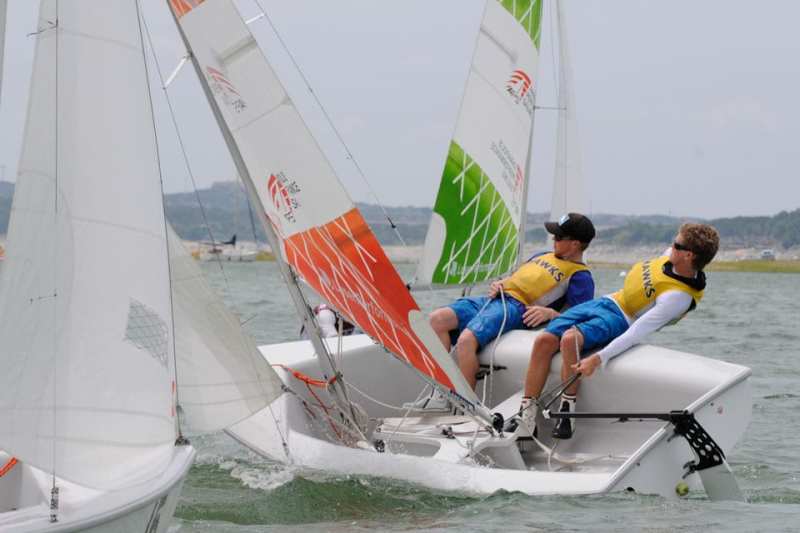
One solution to help get heavier sailors on the water is to use bigger boats. Currently, most co-ed college sailing takes place in fleets of 420s or Club Juniors. A combined weight of less than 250 pounds seems to be normal for many teams in all but the heaviest wind conditions. Adams remembers when bigger boats were sailed in college: “Boats like Tech Dinghies and Interclubs are not so weight-sensitive, but now there is a push to make the 420s and CJs even lighter, which will emphasize the importance of having a lightweight sailing team.”
To which Callahan says that the use of 420s and CJs is simply pragmatic. “We end up with boats like the CJ and 420 because they’re cheap, easy to fix, and easy to teach in,” he says. “I can teach a total novice how to roll tack, roll jibe, and properly trim sails in eight weeks.”
Using larger boats with trapezes and spinnakers doesn’t fit with the collegiate model, but a boat that favors a heavier combined crew weight would likely expand the number and types of sailors who would get to compete. Leonard argues that heavier college sailors tend to race in singlehanded regattas: “In 10 of the last 15 years, the College Sailor of the Year has been a singlehanded sailor.”
To which Adams counters that the average weight of a college sailor hasn’t changed over the years because the singlehanded championship is usually in full-rig Lasers. “The number of 170-pound plus helmsmen has certainly declined, and that is bad for sailing in general,” he says, pointing out that the sloop nationals had a maximum weight limit of 513 pounds for a 3 or 4 person crew, one of which was required to be female. This makes it very difficult to include a heavier sailor on the team; Adams thinks there should be a better balance.
“It’s OK to have a weight limit for Sloops, which makes it difficult for a big guy to sail,” says Adams of the current atmosphere, “but it’s not OK to have a weight limit for dinghies that makes it easier for a big guy to sail.”
While the weight issue will continue to be debated, there’s no arguing that today’s college sailors are highly skilled athletes. Brindley notes that physical training is a high priority, and many structured sailing teams serve as sailor-athlete incubators. “I look at college sailing as the old dirt track of auto racing,” he says. “From here, competitors can work their way to NASCAR or Formula 1.”
Read more about college sailing in the Rolling Start blog.
Read more from ISAF Vice President Gary Jobson here.