Buckingham
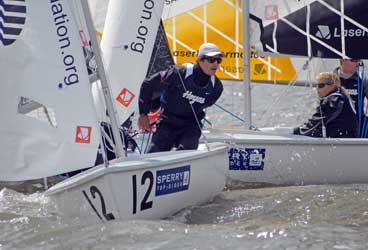
Georgetown senior Charlie Buckingham won a slew of major regattas and awards throughout the 2010-‘11 college sailing season. A two-time College Sailor of the Year and four-time All-American, Buckingham credits his overwhelming success to a conservative approach that took years to master. Now, he hopes to bring this maturity and focus to an Olympic campaign.
You won the Morris Trophy for College Sailor of the Year in 2009. What was different about getting the award this year?
Two more years of experience helped me a lot as a competitor. After winning the award in 2009, the 2010 season came with more expectations and pressure than I had ever dealt with before. As a result, I ended up not performing as well. However, I learned how to deal with the many pressures associated with competing at a high level. Those lessons helped me perform better this year, and I don’t think I could have won the award without them.
**What type of pressure did you feel in 2010? **
Most people experience pressure when they think about results and expectations rather than the task at hand. After winning the award in 2009, I felt this pressure during the 2010 season. I was trying too hard to achieve results and live up to expectations rather than just focusing on sailing and competing well. That year, I learned that blocking out excess noise and focusing on the process rather than the results took a lot of pressure off me and usually resulted in better performance.
There were five finalists this year for the Morris Trophy, and the competition was close all season. Did you think much about getting this award?
Several people asked me about the award at various times throughout the year, and talking to them definitely got me thinking about it. Other than that, I tried not to think about it because there were other, more important things during the year that I was more focused on.
Was there a common attitude you tried to bring to each regatta?
I tried hard to take a more conservative approach to every event this year. I was lucky to have another senior and All-American, Ashley Phillips, as a crew all year. Our combined experience helped us work well in the boat together. We knew that we had good boatspeed and boathandling in our back pocket, so as long as we didn’t take huge risks, we had the potential to be in good positions every race. In the case that things didn’t go our way, our conservative strategy made it so that we were never out of the race and could rely on our speed and mechanics to make a comeback.
Having that conservative attitude at every event must have been difficult.
The decision to take a more conservative approach came with experience. Having 18 races with no throwouts gives you little room for error. Throughout my college sailing career, I learned that being conservative is the best way to avoid bad scores.
What was the high point of the year for you?
Winning the Singlehanded National Championship was definitely the high point for me. Going into the last day, it was really close between me and Cy Thompson, and I sailed well enough to come out on top in the end. It was a huge accomplishment for me because there was a lot of pressure on the last day. To overcome that and win the Championship felt very good. I also respect Cy very much as a sailor and competitor, and being close to him throughout the event meant I was doing my job well.
In addition to winning the Singlehanded National Championship, you also placed fifth at the Team Race National Championship and won your division at the Coed Dinghy National Championship. What did you take away from each of these different styles of racing?
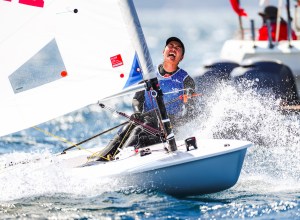
I was very fortunate to have sailed all three because I took away different lessons from each of them that made me a stronger sailor overall. Fleet racing and team racing sharpened my abilities at starting, fleet management, and forming a general race strategy. Sailing Lasers contributed greatly to my sailing feel and fitness.
The Gorge was a tough venue for the Team Race and Coed Nationals with extreme current and a wide wind range. How did you prepare for these conditions?
Going into the event, I wanted to use the same conservative approach that I had been using all year. When we got to the venue and saw the extreme upwind current, I had to adjust my strategy a bit, but it was still pretty conservative. The current made every race reset at the windward mark, and the downwind legs became the longest, most important part of the racing. Keeping that in mind, I made sure I got off the line clean and tried not to make huge mistakes or foul upwind so I could get to the windward mark in a decent position. After the windward mark, I concentrated on setting the boat up well for the downwind, picking clear lanes, and being patient.
What did you do after Nationals?
After Nationals, I flew straight to England to compete in Lasers at the Skandia Sail for Gold regatta in Weymouth, England. When I returned home, I took a week off to take some much-needed rest and then started training in my Laser at home for the North Americans, Laser US Nationals, and World University Games, which are the major regattas I am doing this summer. Beside training and competing in the Laser this summer, I’m doing the NYYC team race with Tyler Sinks and Cy Thompson and am staying as active as possible through off the water training in the gym and doing fun cross-training activities outdoors, most of which involve the ocean or water.
How does your experience in college sailing transfer over to your current sailing goals?
I’m planning on campaigning for the 2016 Olympics in the Laser. A full-time commitment to training and competing is required to ensure a position and do well at the Olympics. The most important things I learned through college sailing that will help me during my campaign were the benefits of spending a ton of time on the water, the value of doing different types of sailing, and the importance of making good friends along the way.