FTE: Winning an End
A few months back, we talked about the importance of establishing a set routine for starts—something that will help ensure you’re in a predictable place at a predictable time (January/February 2010). A natural extension of the routine is to use that system to help win either the pin end or the boat end of the start—and determine when to bail if things start to unravel. Let’s take a look at each situation.
Win the pin
The problem with trying to win the pin is that, if you’ve decided the pin is the best place to start, five other people have probably reached the same conclusion. This usually results in a string of boats coming in on port tack with most headstrong people trying to be at the tail end of the line. That group is like a magnet—teams fighting for the pin generally fight to be the last boat in the port train and arrive too late to have a good start.
When I’m trying for a pin-end start, my whole plan is based on the idea that I don’t want to be part of the magnetic pack fighting to be the last boat in. Let the other boats congest that area and leave yourself in a position where, with around 2 minutes left, you still have the option of deciding whether it’s worth the risk or whether you should go for a more conservative start further up the line from the pin.
Here’s how it’s done: From the start routine described in my previous article, start by shortening the time you’re passing by the pin, on port tack, to around 2m:30s rather than 3 minutes. Instead of slowly diverging from the line, as you would if you were planning to start further up the line, sail more parallel to the line, perhaps two to three boatlengths to leeward of it. By sailing more parallel to the line and not getting into the parade, you can make your final decision at less than 2m:00s. If there’s a pack 30 seconds from the pin when there’s 1m:30s remaining, you can say, it’s just not worth it—let’s go behind them; there’s plenty of time to get up the line a little bit and create a hole.
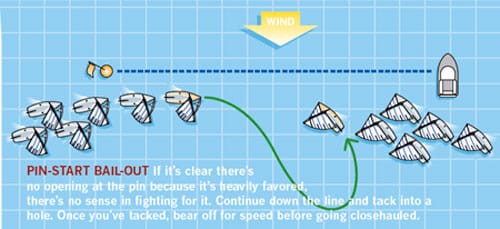
This does two things: First, from the perspective of the other boats, there’s no real indication you’re going to be going after the pin end. Secondly, if we look back and see a huge clump of boats at the pin, suggesting the odds of winning it are really slim, we are still in good shape for a mid-line start. If we stay at the pin and it becomes congested with teams more concerned with being the last boat in the train than having a good start, the only way out is to leave on port, go up the line early, looking for a hole to tack into. If this happens, you’re guaranteed there will be 10 other boats right behind you, doing the same thing—you’re in the wrong spot, in front of a big pack of boats rather than behind them, where you have more control over your destiny.
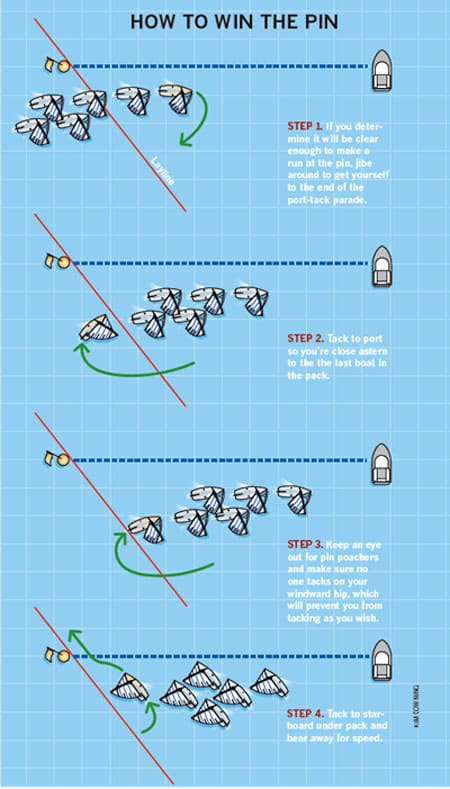
If you decide it looks clear at the pin, you can see everyone is on port following you, and you decide to go for it, the next move is a jibe. Turn down, jibe, and sail back toward the pin on starboard. Now, you want to be the last boat in line, unless there’s an outlier that’s just being an idiot. Then, trim up to close-hauled and tack as close to the last boat’s transom as possible. Now you can attack. Depending on the wind, the boat you tacked behind can’t tack because of your position, and you’ll be able to tack into his hole. If there’s a starboard-tacker coming in that will force him to tack, you do need to give him room to do that, however. The goal is to be close behind so you are in control of the decision about when to tack. If you’re coming in a little late, position yourself just to windward of that boat; if you’re early, position yourself slightly below him or right on his line. Then, using your knowledge of the time and distance required to get to the pin, it’s a standard tack into his hole and accelerate to the pin.
One situation where this system breaks down is in light air, especially in boats that are slow to accelerate, such as keelboats. The jibe and subsequent tack can require more acceleration time than you’d ever have. On the other hand, in dinghies, which can easily keep their speed up through tacks and jibes, it still provides a good weapon for winning the pin.
Win the boat
The difference between trying to win the pin and trying to win the boat is that you need to go by the pin end earlier on port tack when you’re trying to start at the boat. You don’t want to arrive at the committee boat so early that you end up out past the committee boat layline, tack, and still have to kill speed back to the boat.
As with the pin-end starting routine, the key is to keep your options open for as long as possible—sometimes down to as little as 1m:30s remaining. At that point, if you look in front of you, toward the committee boat, and you see a huge pack of boats, you can concede that end, sail a little deeper, away from the line and tack underneath that pack of boats. Then, you’ll at least be in the right-hand third of the line. Or, if that pack of boats appears to be further down the line, and with the time remaining it’s apparent that it’s going to clear out to windward of them (maybe there’s current pushing them down the line), you can trim up on port, weave your way through the pack and tack over on the committee-boat layline.
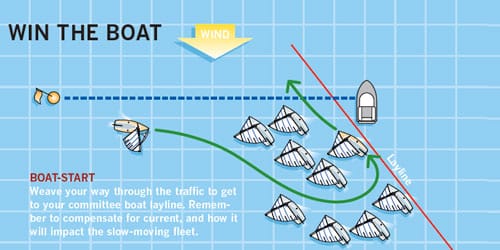
If you have to sail through the pack of starboard-tack boats to get to the committee boat layline, don’t be afraid of trimming on and sailing above those boats, or crossing them. A lot of people are hesitant to do this: Sometimes, I even sail right through the middle of them, as they usually end up in rows that make navigating through the gaps easier than you might think. The problem with dipping below them is that there are always boats that will be late to the line. Once you start dipping everyone, you’ll be late, too.
The idea is to try to get in a spot where you’re coming in on port tack at around 1m:15s to the start and on the committee-boat layline. You might be early, but you’ll still have room to kill speed. Just make sure you don’t set up on the committee-boat layline too early—doing so severely limits your options.
Keep it legal
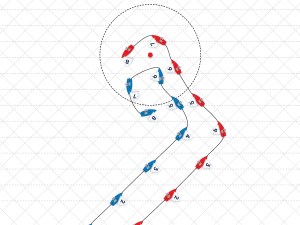
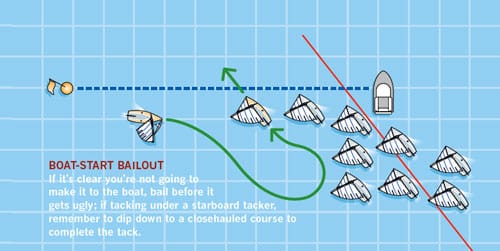
One mistake often made by port-approaching boats that attempt to “claim” a spot to leeward of a group of starboard-tack boats is never actually gaining the rights they need. As far as the rules are concerned, when you complete your tack to starboard, you need to first turn your boat down to a closehauled course before you can luff the starboard tack boats.
Notice in drawings that whenever the port-tack boat has tacked over to starboard, its course includes a slight dip to leeward. That dip takes the boat down to a close-hauled course on starboard tack, establishing right-of-way as a leeward boat on the same tack, enabling it to luff the windward, starboard-tack boats. If the boat approaching on port tack does not establish a close-hauled course on the opposite tack, two things can happen.
First, if the port-tacker only goes up to head-to-wind, it is technically still on port tack. In that case, it’s a simple starboard-port situation (Rule 10). Second, once the port-approach boat goes just beyond head-to-wind and never actually gets down to a close-hauled course, it’s “tacking” (Rule 13) and, again, has no rights over the starboard tackers. The tack is only complete when that boat is on a close-hauled, starboard-tack course; only then can that boat luff.
Pro Tip: Pin Starts, Make No Mistakes
›› When you jibe, give yourself enough time to get back to the line
›› Identify an opening at the pin
›› Your last tack onto starboard must be on or above the pin layline
›› Know how much time and distance you need to get up to speed
and be at the pin when the gun sounds