Overlap rules
Back in 1962, when the first issue of One Design Yachtsman hit newsstands, the U.S. rulebook was a 34-page pamphlet issued by the North American Yacht Racing Union. The size of the pages has not changed, but now there are 154 pages. However, 104 of today’s pages are devoted to special-purpose appendices and the introduction, index, and protest form, whereas in 1962, just one page was devoted to a single appendix.
So, over the last 50 years, the number of pages devoted to the rules for a fleet race has grown from 33 to 40. That’s not so bad—especially if you compare it to the increased complexity of the laws and regulations we confront in everyday life. Not surprisingly, half of those seven added pages contain rules recommended by lawyers (see Rules 3, 68, and 69).
Throughout those 50 years, the basic right-of-way rules, as developed by Harold S. Vanderbilt between 1936 and 1947, have not changed. However, eight important game changes have been made since 1962. I’ll discuss each in turn. In my opinion, six were steps forward, and two were not.
1 Common Rules Worldwide
In 1965, the first big step was taken toward a single set of racing rules for use wherever a sailboat race is held. That process was completed in 1977, when responsibility for all the rules was turned over to the International Yacht Racing Union (later renamed the International Sailing Federation). This has enhanced international competition.
2 On-the-Water Penalties
Before 1964, if you broke a rule you were expected to retire from the race. In 1961, Tom Ehman Sr. had the idea that a 1080-degree turn penalty should be a sufficient penalty for a violation of right-of-way rule (only a 360-degree turn was required if you broke a rule while your spinnaker was set). Ehman’s goals were to make the penalty fit the crime and to keep boats racing. Three years later, he convinced his club, the Portage YC in Michigan, to try his idea. It was a success. He lobbied the rules committees in the United States and the United Kingdom to include his penalty turn in the rulebook as an alternative to retiring, and in 1973, an appendix was added allowing the sailing instructions to specify either a 720-degrees turn penalty or a 20-percent scoring penalty as an alternative to retiring. In 1997, the 720-degrees turn penalty became the default penalty. It has been slightly changed today to a Two-Turns Penalty.
3 The Zone at a Mark
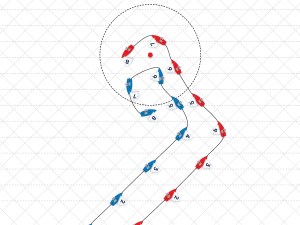
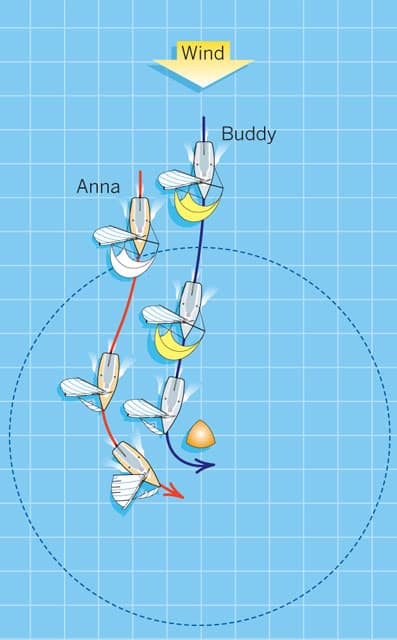
One rule has probably saved lots of repair costs. It’s the rule that establishes the perimeter of a zone around a mark as the cutoff point for establishing or breaking an overlap. It was added at the urging of Paul Elvström in 1965. Today it is in Rules 18.2(b) and (c). Initially the zone was a two-length zone; in 2009, it became a three-length zone. The diagram shows a common application of the rule. In position 1, Anna reaches the zone when her bow enters it. At that moment, Buddy has a small inside overlap, which entitles him to mark-room even if the overlap is broken later. Before 1965, the overlap cutoff did not occur until later— when the lead boat “reached the mark”—but even experts couldn’t agree on when a mark was “reached.” As shown in the diagram, by just bearing off a few degrees at position 2, Anna breaks the overlap—arguably before she has “reached the mark.” But then when she turns towards the mark, the overlap is reestablished. Current Rule 18.2 freezes the overlap status at the perimeter of the three-length zone. At that time, the boats are usually sailing a steady course and have not begun to maneuver to round the mark, and they still have time to hail each other before they start to round.
4 The Propulsion Rule
The arrival in the 1960s and ’70s of popular classes of lightweight planing boats led to the discovery of many kinetic techniques for muscling boats around the course. For a while, it looked as if dinghy races would degenerate into frenzies of pumping, rocking, and ooching. This was averted by the development of what is today Rule 42, Propulsion, along with interpretations and procedures for enforcement by on-the-water judges. A great deal of time and effort was spent devising a rule that prohibited mechanistic, boring, and repetitive kinetic movements, but permitted skillful weaving around and over waves, and well-timed moves to initiate surfing or planing.
5 Simplification
In 1997, all the rules were completely rewritten with six goals in mind: (1) Allow maneuvering in close quarters with a minimum of anxiety; (2) Encourage sailing fast and discourage impeding others; (3) Make minimal changes in the existing “game”; (4) Discourage contact between boats; (5) Minimize exceptions within rules and eliminate rules for unusual situations; (6) Use simple, direct, familiar language. The rewritten rules were two-thirds the length of the previous set of rules. Many exceptions and rarely-used rules were eliminated, but the basic “game” was little changed. Acceptance of the rewritten rules was high—one club that had eliminated its racing program because of difficulty with the old rules restarted its program successfully.
6 Avoiding Contact
One rule introduced as part of the 1997 revision deserves special mention. It is Rule 14, Avoiding Contact. The old rules permitted a leeward boat that had been overtaken to windward to luff the windward boat “as she pleased.” An aggressive, rapid luff was permitted even if it caused damage. In addition, those rules permitted a right-of-way boat to collide with another boat just to prove that the other boat had broken a rule. These intentional collisions were permitted provided that they did not cause “serious damage.” This “bumper car” aspect of the pre-1997 rules put off many novice racers and raised the cost of racing for many others because of the frequent need for repairs. Repair costs were particularly high for youth programs in which young sailors raced boats owned by the club or sailing center offering the program. Rule 14 has restored sanity by requiring that “A boat shall avoid contact with another boat if reasonably possible.”
Two changes made in 1997 are not, in my opinion, fair to competitors who make the error of crossing the line early. Competitors who are over the line at the start do not deserve a severe penalty. They have not broken any rule (unless the start is a made under Rule 30.3, the Black Flag Rule). Instead, they have made an error of judgment that the rules allow them to correct by sailing back to the pre-start side of the line and then starting in accordance with the definition Start.
7 Elimination of Recall Signals that Identify OCS Boats
Way back in the 1960s, a placard displaying a boat’s sail number was used to signal that she was over early. In the 1980s, a hail of the boat’s sail number was used if the sailing instructions so stated. However, since 1997, Rule 29.1 no longer requires, or even mentions, the use of hails to notify boats that are over early. To their credit, many race committees now write a sailing instruction allowing them to make such hails (either with a public address system or over a VHF channel).
8 The Black Flag Rule
Since 1997, when a black flag is used as the preparatory signal, a boat that is in the triangle formed by the starting line and the first mark during the last minute before her starting signal is disqualified without a hearing. Some race officers defend this onerous rule on the basis that without it they simply could not start certain fleets of “aggressive starters.” I am firmly convinced that black flag starts are unnecessary overkill. If the starting line is of adequate length and set at the appropriate angle to the wind, use of the Z flag or, better yet, flags Z and I together, is always sufficient to start even the most unruly fleet.