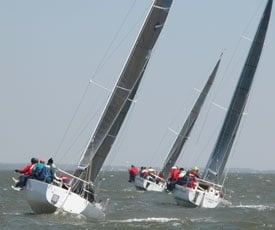
Shift Gears 1
Subtle gear changing is what truly separates those with just adequate boatspeed from those who always seem to be a click quicker and higher. While most of the fleet starts the race with a similar setup, created with the help of a tuning guide or by following standard principles, the fast boats are constantly making additional adjustments. When conditions suddenly change—a puff hits, or powerboat waves arrive—these sailors shift gears smoothly. Before we dive into the subtleties of their sail adjustments, let’s take a look at how you might create a basic pre-race setup.
Step 1: Set the depth
Try to memorize the depth that feels about right in 10 knots of breeze. Then set your mast bend and headstay sag to replicate that shape, using it as your starting point in other velocities. Another method is to increase mast bend until you just begin to see slight wrinkles (called inversion wrinkles) running from the clew of the mainsail to the lower quarter of the mast. For the jib, decrease headstay sag until you are just able to make the telltales on both sides of the sail fly easily. Any tighter, and the steering groove will become too narrow.
Step 2: Set the draft position
For most boats, the main draft should be positioned nearly halfway back. Pulling the cunningham tighter pulls the draft forward, while easing it allows the draft to move aft. Use the jib halyard or jib cunningham to position the fullness in the jib. The draft should be slightly farther forward than in the main, usually about 35 percent, or roughly one-third, of the way back.
Step 3: Set the twist
To set the leech tension for the main, sight from under the boom and set the sheet so that the chord of the top batten is parallel to the boom. For the jib leech, set the sheet so that the last 6 inches of the middle of the leech (a mid-leech batten helps here) are parallel to the centerline of the boat. Easing the sheets allows the outboard end of the battens to fall away, increasing twist. Trimming the sheets does the opposite, decreasing twist.
Step 4: Set the angle of attack
If you drop the tiller, the boat should continue to track straight, or slowly head up into the wind. Any more helm than that means excessive rudder drag. If the boat has excessive windward helm, ease the traveler to until the helm is balanced. This four-step process for setting your sails is only a starting point. It’s still a great idea to line up with someone you know is fast before the race to see if you are “on the money.” If you’re faster, great! If you’re off the pace, just ask your crew, “Are we lacking speed or pointing ability?”
Solving Pointing Problems
An inability to hold a lane or position close to other boats can really destroy a tactical game plan. Pointing problems are not so much indicated by the angle that the boat seems to be sailing relative to the boats around us, but more by the fact that the boat is actually sliding to leeward.
Trying to pinch to maintain height can be the crux of the problem. The old adage, “foot, then point,” says a lot. A boat needs to go fast before the underwater foils can develop enough lift to hold their position in the water. To regain pointing ability, ease the sails out, bear off slightly, and get back up to speed. Once up to top speed, re-trim to your starting point trim and reevaluate your pointing problem. If the problem persists, check your sail trim.
When sail trim is the cause of the problem, it’s usually the main, not the jib. The upper leech of the main provides most of your pointing ability. Be sure to trim the main so the upper batten is at least parallel to the boom. If you need more pointing ability, try trimming the main tighter. You can hook the upper batten as much as 15 degrees to weather for short periods. Avoid the temptation to overtrim the jib to help pointing ability. Hooking the jib leech will choke the slot between the main and jib, stalling the entire sailplan. The jib should never have less twist than described in the “basic setup.”
Only after you’ve decided to trim the main harder should you try to pinch the boat. In this mode, the weather telltales on the jib will be stalled. In big puffs, the luff of the jib can break as much as 8 inches back. This “super pinch” mode can only be held for short bursts and in flat water. Once the boat starts to slow down, be sure to ease the sails out, regain your speed, then start the process again.
While it may seem natural to let the boat heel more when trying to point, fight the urge. Keeping the boat flat will help maintain a balanced helm and maximize the efficiency of your underwater foils. Still not pointing? Either your rig is too loose, resulting in too much headstay sag (i.e., the jib is too full) and sometimes too much mast bend, which makes the leech too open, or the luff tension on either sail is too tight (the draft is too far forward).
Solving Footing Problems
What if your pointing is fine, but your straight-line speed is lacking? The simplest fix is easing the sails. More open leeches on both sails will help the boat sail lower and faster in a straight line. Sometimes, however, this results in a pointing problem. If so, first check your helm balance. Weather helm can seriousIy hinder the boat’s ability to go fast. Instead of easing sheets, it’s often better to find a way to ease helm. First, try to sail the boat more level. If you can’t keep the boat flat, induce more mast bend to flatten the main. The next step is to ease the traveler until the helm is balanced. Finally, tighten the outhaul, tension the cunningham/jib halyard to pull the draft forward and open the leeches of both sails.
**Gear Shifting: Puff On! **
We’ve got you going with good speed and good height. Then what happens? The wind velocity changes and it’s time to shift gears. First, let’s look at some of the automatic trimming change that should happen as soon as a puff hits. 1. Ease the main, and sometimes the jib 2. Steer up to “feather” the boat 3. Re-trim sails.
Since a puff typically lifts you, due to a change in the apparent windspeed, you need to ease sheets and head up as it hits. Be sure to let the boat climb up into the wind and steer toward the upper end of your groove with the jib luff actually breaking. In flat water, all that may be required is a quick ease of the mainsheet. But in chop, it may be necessary to ease the jib as well.
If the puff packs some real velocity, more adjustment may be necessary. If you can’t hold the boat down, and there’s still too much helm, try the following, one at a time, until the helm is balanced. 1. Ease the traveler 2. Bend the mast (vang tension, backstay tension, etc.) 3. Tension the cunningham on both main and jib.
Gear Shift: Into a Lull
For the same reason that puffs are lifts, lulls usually appear as headers. In a lull, it’s important that you bear off as smoothly as possible. Make sure the boat remains flat and resist the temptation to add heel to maintain “feel” in the helm.
Ease the main so the top batten angles outboard from parallel to the boom. Leave the jib trimmed initially until the bow is pulled down to the lower end of your groove with both telltales streaming aft. At that point, the jib should be eased so the leeward telltale doesn’t stall.
Here’s how to maintain speed in a lull. 1. Ease the main 2. Allow the boat to heel to weather, creating lee helm, to steer the boat down 3. Ease the jib 4. Level the boat 5. Pull the traveler up (if the boom is below centerline).
If the lull is long-lived, you may need to take additional steps to maintain speed. 1. Straighten the mast and induce luff sag in the jib 2.) Ease main and jib cunninghams to maintain correct draft position. The smoother you shift gears the faster you’ll be, so practice until it’s automatic. Heck, manual transmissions went out years ago!