CallPuffs368
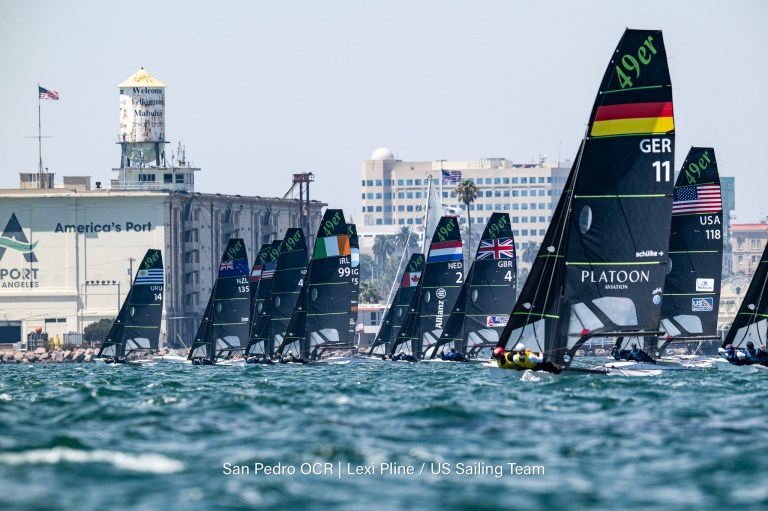
On a windy day, especially as you fight your way off the starting line in close quarters, you can hear the calls from the talking heads of your nearest competitors: “Puff in 3 . . . 2 . . . 1 . . . followed by a lull and two steep waves.” Getting this kind of input back to the helmsman is critical, not just at the start, but all around the racecourse, because as you know, huge gains can be made by taking advantage of puffs and lulls, both large and small.
It’s important as a crew to communicate what’s happening with the wind, and do so with confidence. To call a puff effectively, you need to recognize one, determine its size, estimate how strong it is, and figure out what direction it’s moving. But before I go any further, let me stress that it’s just as important to call the lulls preceding or following a puff.
Remember, a puff is simply an increase in breeze-big or small. When I’m calling puffs to the helmsman, I refer to them as fan puffs or directional puffs. A fan puff is the leading edge of a gust, a mass of air dropping from aloft and fanning out from its center of impact as more air piles on top of it. A directional puff is essentially the remnants of the fan puff, overcoming the initial surface contact and moving in the direction of the upper air mass from which it came.
The initial puff is always a fan puff. Its appearance is generally darker and more solid than a directional puff, and it will appear on the water as an expanding oval. After a short period, the puff stops spreading as the air overcomes the initial surface resistance and moves in the same general direction-now it’s a directional puff. Puffs will come from the prevailing wind direction, so figuring out where they’re coming from is a matter of scanning the area to weather to see where they originate. Watch to see if a puff is expanding to the sides: if it’s still expanding, it’s still fanning. If it’s just moving straight, it’s a directional.
You’ll commonly hear people refer to “lifting puffs” and “heading puffs,” which is simply a matter of which side of the puff you’re engaging. You can determine this by the direction from which the puff approaches. If it’s coming from aft of about 60 degrees to your course it’s a lift, forward of that to 45 degrees it’s the median, and forward of 45 degrees it’s a header.
Determining how soon it will hit, and thus the countdown, is a matter of figuring out how fast it’s moving over the water. You can count down aloud by how fast you see it coming. If you start counting faster, the helmsman knows it’s coming faster with more pressure; if you slow your count it’s coming slower with less pressure.
What about the lulls? The lulls will appear ahead of and behind the puffs, and it’s important to let the driver know whether a lull is less or more than the pre-puff velocity. Their shapes and lengths are difficult to determine, so I don’t really try. I look for the next change on the water and try to guess how long it will take to get to it. Simply calling out the lull gives the helm and trimmers the opportunity to change gears. The lulls are going to last until the next puff hits, so the best thing to do is start looking for the next puff.
Upwind, keep calling ’em
With this background, it’s time to learn how to relay the information to the helmsman. Picture the following situation, sailing upwind: What I might see and tell myself is, “A large area of breeze is coming from directly abeam, but not very quickly.” What I should tell the helm is, “Small lifting puff, lasting 20 seconds, hitting in 3 . . . 2 . . . 1, breeze on.” Note that even though the puff is big, its slow movement indicates there isn’t necessarily a lot of breeze in it. Armed with this information, the helm can make changes in sheet tension and adjust the backstay for what he knows will be a long period. Knowing that it’s a lifting puff allows him to ease as the puff hits in order to let the boat accelerate. He then turns up as he re-trims the sheet.
I occasionally give the helmsman extra information if I think he can deal with it and break it down fast enough. For example, what I might see and say to myself is, “Lots of breeze (really dark water), in a very small patch, same direction as current breeze, coming fast.” What I tell the helmsman is, “5 knots more breeze, this direction, lasting 7 to 10 seconds, followed by a lull, and then the same breeze we’ve had, in 3 . . . 2 . . . 1.” This allows the helmsman to make a drastic adjustment for the puff, knowing how long he has to stay depowered, when he can start to power up again, and to what degree.
The other important ingredient in the above example is information about the lull. Doing this allows the boat to be properly powered up when it needs to be. As the wind fills after the lull, the call will be much the same as calling a puff. What I say to myself is, “Flat water, no ripples for a while, darker line about 200 yards away, coming slowly, with about the same pressure we had before, same direction as before.” What I tell the helm is, “Lull for 15, slowly building breeze for 20, back to what we had, initial velocity lift, steadying out to the median. Small increase in 5 . . . 4 . . . 3 . . . 2 . . . 1.”
The helm knows he has to live with this breeze for a short time and trim for it. He knows how he was set up before the lull and when to return to the pre-lull trim settings. He also knows the boat’s heading so he can let the boat climb to its previous heading as the puff hits. Giving an accurate countdown with a gap gives the helm time to consider when to start making fine-tune adjustments.
Downwind: Look behind
The best part of calling puffs downwind, especially on a keelboat, is that it’s usually possible to stand and see them from a higher vantage point, which allows you to track the direction of the puff more accurately and gives you a better idea how much wind there is in the puff.
When calling puffs, scan everywhere behind and determine whether a dark patch is easy to get to. If you can, you generally want to head for a nearby puff or to at least place yourself in front of it. As you reach a puff, you’ll usually get an initial header. As the puff begins to fade, and you enter its center, you’ll slowly be lifted. If there’s still pressure in the puff, you can jibe onto the headed tack and stay with it until the breeze returns to the median pressure. Then start looking for another puff.
Puffs that are abeam will probably be gone before you can reach up to get there so don’t bother. It’s better to look directly up the course to watch for puff development. If a puff isn’t really catching up, then it’s important not to chase it around trying to get in front of it, often it’s better to sail less distance and let a puff go by.
A few more things to remember downwind: If the puff approaches from the left (looking upwind), it’s a “lefty,” from the right it’s a “righty.” If it’s filling from astern, track its direction and figure where you are in relation to its inside edge-that’s where you want to place yourself. Boats behind are perfect clues as to what the puffs are doing. Generally, the boats toward the edges will jibe toward the middle of the puff so they sail the headed tack, or they will try to sail low toward the center in more pressure.
The most important part of calling puffs downwind is to make sure you maximize the time you’re in the increased breeze. With this in mind, I’ll often tell the helm to steer low because the breeze is going from windward to leeward. My advice to the helm as I do this is to “maintain pressure, stay low until the chute starts to de-pressure, then slowly head up for speed build.” This allows maximum leeward separation from weather boats or allows you to get down into a different lane for tactical or clear-air considerations. Staying artificially low will also allow you to re-align for the next puff without having to jibe for it.
There’s generally less talk about the characteristics of the puffs downwind since they come to you slower and you stay in them longer. As a tactician, you tell the helm whether to sail a VMG course or a course that will keep them in the puff the longest-there isn’t much more you can say. A typical conversation when seeing a puff coming from astern is “building breeze going right to left, build speed and take it down when you’re at max pressure.” The important conversation deals with telling the driver when to shift gears from sailing in the current puff and setting himself up for the next one. The biggest mistake people make is not recognizing when they’re in a dying directional puff; you’ll have to step up to the next puff because the directional puff won’t fan to you. Don’t be afraid to make a quick but drastic course change to get to a lot more breeze, the pressure will allow you to extend and roll down later.
The hardest part of talking to the helm downwind is trying to figure how long the puff will last. Upwind you’re sailing toward the puff so you’ll usually see some increase, even if the puff is dying, and it will increase as you get toward the middle. Downwind it’s possible to outrun the puff and it’s very important to let the driver know that the breeze is dissipating. I’ll often see a puff with a small increase and relay that, but in these situations, it’s critical for the spinnaker trimmer to let the driver know when they feel the breeze in the chute-you can’t turn down until the chute is loaded. When you have the pressure, you have to recognize where in the puff you want to be. The air inside a puff is semi-turbulent and may be a little unstable, on the edges it tends to be more defined and solid. However, the breeze on the edges is usually less so pick your poison.