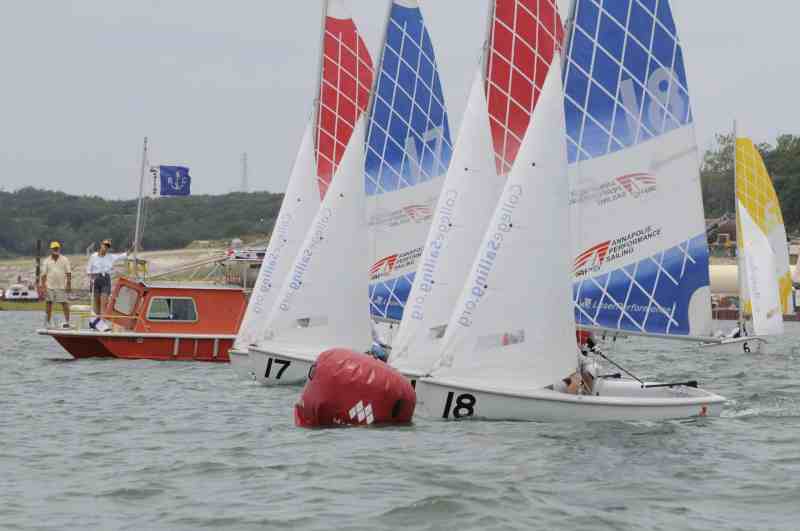
Team Race Start
The fall college sailing season has come to a close, and as the spring approaches so does the exciting challenge of team racing. For college crews, there are varying levels of understanding of what exactly is happening during a team race; a freshman crew is a lot less likely to recognize the patterns and plays than a seasoned upperclassman crew. A huge responsibility for every crew, however, is to keep in mind the fleet-racing aspect of team racing.
In the words of Ken Legler: “It’s a fleet race first, and a team race second.” By this, he means that without proper boathandling and boatspeed, your team doesn’t have a chance at winning the race. Since the skipper will likely be almost entirely focused on the other boats on the course, it’s the crew’s responsibility to make sure that the boat is moving at the right speed at the right time, and that the two of you can pull off tight maneuvers without having to talk it through. In team racing, if you’ve already verbalized it, it’s probably too late.
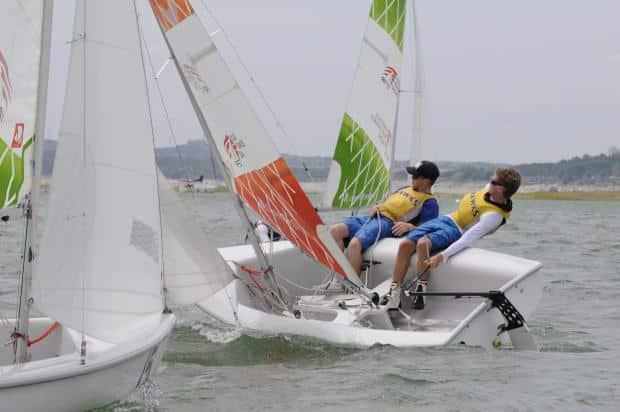
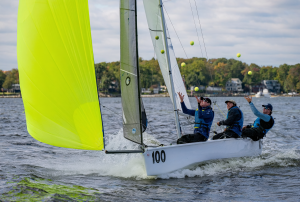
Fleet race first to win a team race: focus on boathandling and boatspeed. Photo: Bill Records
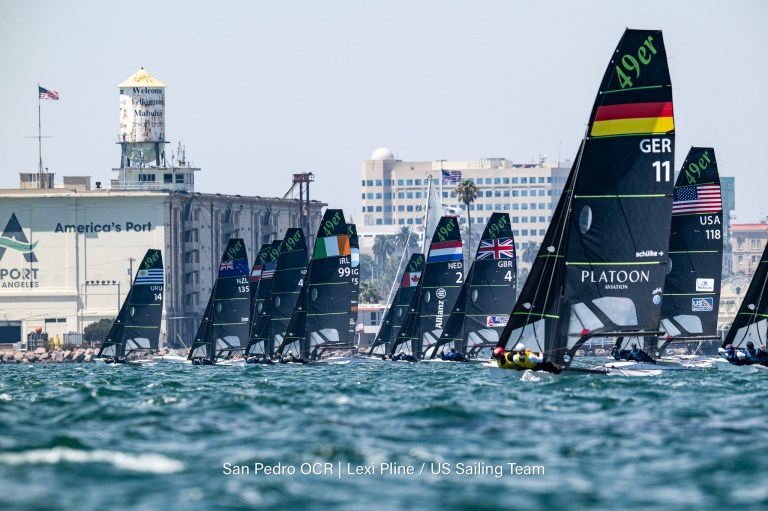
Pre-start, you should remind your skipper about many of the same things as during a fleet race. Make sure you both know where the marks are and what the current is like, and talk about breeze on the course. Know which end of the line is favored, and if it’s light air, prepare yourselves to lead in instead of push. After the two-minute warning, you should be rolling at about 50% to keep up momentum and enable steering, and once you engage with another boat you should be in full racing mode.
Even while you’re engaging with another boat, keep an eye on the line; let your skipper know the time, and if you think you’re getting close to missing the start, tell him or her. While beating your guy on the start is important, ideally you want to not only beat your guy but also have a good start yourself. Don’t ever lose awareness of the breeze, and if there are any huge shifts before GO make sure to verbalize them. Be prepared for anything; if you’re pushed over early, recognize it immediately and clear yourself as quickly as possible. Then get moving.
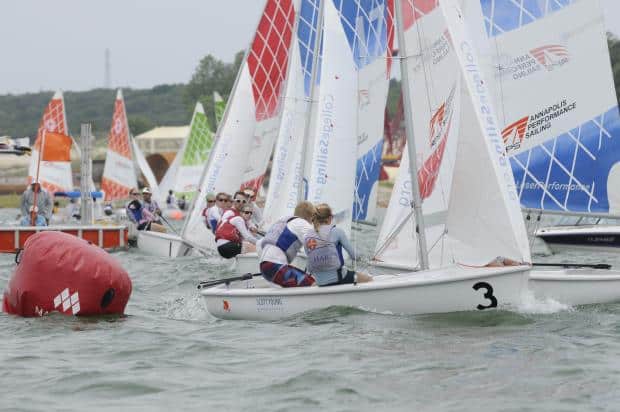
If you’re over early at the start, clear yourself as quickly as possible and get moving again. Photo: Bill Records
I would argue that the first leg of a team race is primarily a fleet race, at least for the first two-thirds or so. Make sure that your boat is tuned correctly, and that while you feed information about your combo and other pairs on the course, you’re not forgetting to keep your boat flat and fast; you can’t make any plays from the back of the fleet.
The windward mark is likely going to be a place where boats meet, so make sure that you have complete control of your boat when you reach it. If you’re on starboard, pinning out another boat, you need to be able to hold them there without ever making contact. In addition, your jib trim largely controls fore and aft movement of the boat relative to the leeward boat, so trim and ease according to their speed. You want to keep their bow roughly at the leeward shroud, while always keeping enough flow to get moving if they start to accelerate. Then, when your teammates have rounded successfully, you need to be able to get back up to speed with a huge roll tack.
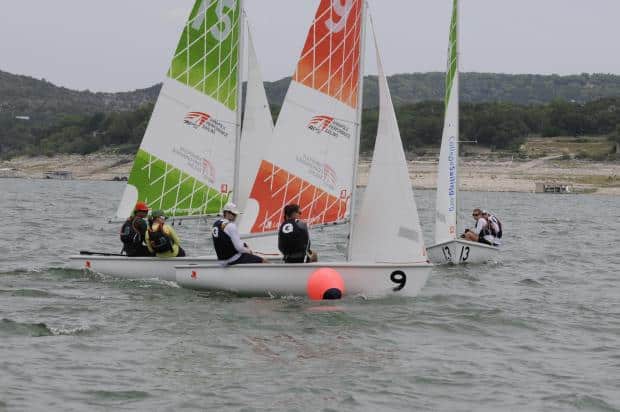
Jib trim is a key component of holding a pin at the windward mark. Photo: Bill Records
Anytime your boat is down-speed, you’re going to need to get back up to speed quickly, or you’ll stall out and watch the race go by you. This includes the aforementioned roll tack, which will likely be necessary at the end of just about every pin. Especially in Larks with their enormous sail area, rolling near other boats must always be calculated correctly, though; make sure that your mast doesn’t touch tips while you roll or flatten, especially during a leebow. While rolling is important, avoiding fouling is more important in close quarters.
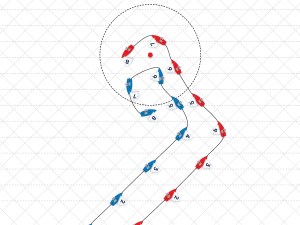
The windward offset is a tricky and exciting little leg. Especially if it’s windy, there’s always the opportunity for sailing high and reaching over the top of all the action. Be on the lookout for this: Let your skipper know when you think you can do it, and commit to going high and fast—or, if you’re the boat ahead, setting a trap, always keep up enough momentum to be able to accelerate and hook that boat. Setting mark traps is another delicate balance of stop and go; your boat should be all but stopped at the beginning of the two-boat length circle if you’re setting a trap, but if you stall out, you will lose the ability to actually screw over any of your opponents. Be ready to steer the boat drastically with your weight, which also legally allows for a rock to facilitate steering.
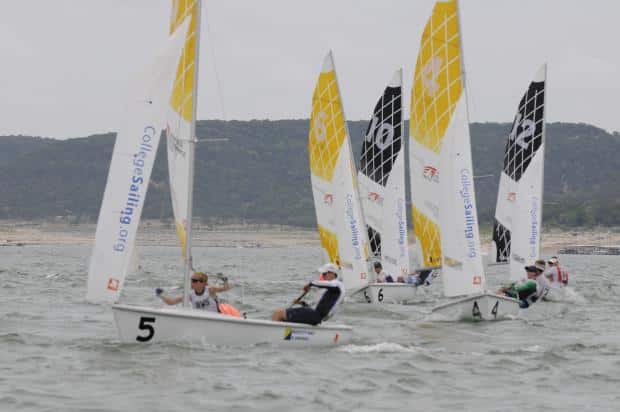
Know whether you should commit to going high and fast or slowing on the windward offset leg. Photo: Bill Records
Downwind, your body movements and boatspeed are perhaps even more vital. If you’re in a winning combination when you round the windward offset, the run is likely going to be a nerve-wracking leg where all that you’ve worked for can easily be lost if you’re not careful. On top of being on the lookout for puffs and nailing down the location of the leeward mark, the crew also needs to be able to transition between fast-forward mode and playing back. If you’re going fast, you should be doing everything the same as in a fleet race: board up, controls eased, arms outstretched jib reaching or perfect heel while winging. The skipper will likely be focusing on things besides jib trim, so he or she should be able to just point the boat downwind after the offset ,and you should be able to manage the necessary transitions.
If you’re about to engage another boat, or need to play back, put down the board and keep your head up so you know what to expect. Especially when it’s windy, be ready to punch up hard by trimming in the jib and jumping to windward to hike, whether you’re the leeward boat trying to hard luff a boat or the windward boat trying to break overlap. Even in lighter air, your body movements are key in heading the boat up, and your jib trim is crucial to maintaining or breaking overlap.
The crew must initiate the gybe, so if you know what’s happening you can start rolling before your skipper has to say anything. If you’re not confident enough to do that, then be completely prepared to roll at any second when other boats are nearby: vang on, slack out of the opposite jib sheet. No team race is complete without a gybing duel, so be prepared to gybe over and over again. This is a tough skill; without time for the sails to load up between gybes, it’s easy for your boat to stall out. By making sure that your rolls are big enough and your flattens quick enough, you can keep up momentum. Someone is going to get tired; don’t let it be you.
The leeward mark is another big moment on the course. If you have a shot at getting the inside as you approach the zone, focus all your efforts on going fast-forward. Inside overlap here can make or break the race. Once at the zone, again be prepared to bring your boat to a stop; a big heel to windward will slow you down, as will your skipper’s repeated tiller movements. As soon as it’s time to accelerate, throw in a large gybe if you’re trying to go quickly; or, if you have room on one of your opponents and you’re trying to slow him down, make sure that your rounding is seamanlike but not rushed.

Don’t let your guard down on the last beat. Photo: Bill Records
The last beat is not a time to let your guard down if you round in a winning combo, or to give up hope if you’re losing. Especially at shifty venues, a winning combination can vanish in a matter of a puff if you’re not careful, and by the same token your team can turn a losing race around if your opponents don’t balance carefully. Therefore, be on the lookout for shifts and puffs, and make sure to remind your skipper to be disciplined if you’re ahead and covering.
If you need to free a teammate in a speed passback, you need to know how to position your boat relative to your opponent’s in order to do the most damage as quickly as possible. Your skipper will probably overtrim the main to create a windshadow, so a large part of your responsibility is trimming and ragging the jib to keep your opponent’s bow right at your leeward shroud. If it’s windy, you need to be hiking and luffing—even though it feels strange to hike off of only the straps. If it’s light air, you need to make sure that you keep up your momentum—not to beat a dead horse, but there are few things as frustrating as watching your opponent sail right by you while you’re dead in the water.
If you’re the boat that is being passed back, chances are that you’re going to want to make it take as long as possible. If, and only if, it’s windy enough to warrant it, you can really extend your body as you hike out to windward to force that boat to give you some breathing room. However, don’t focus on the boat to windward; instead, focus on sailing fast and keeping the leeward boat pinned without fouling them. As soon as they tack out, make sure you’re clear and then tack on them, re-pinning them.

Winning a tacking duel can mean winning the race. Photo: Bill Records
Tacking duels are incredibly important in team racing, especially on the last beat. If your tacks are better than your opponent’s, and you have the stamina to out-tack them, then your chances of holding them if you’re winning the pair, or getting free if you’re losing it just skyrocketed. Make each tack perfect—you can catch your breath after the race. If it’s medium to light air, do huge tacks; if it’s breezy, snap the bow across and then have a huge flatten so you’re ready to go again immediately. Don’t wait for your skipper to say ‘tack’; as soon as your boat is ready to go again, you should also be ready to roll again–if the other boat tacks again, assume you’re going to tack on them.
So many team races come down to half a boat length, which is part of what makes them both so thrilling and so painful to lose. Clearly, there are more factors in play than just boathandling and speed, but they’re the foundation that the rest of the race is built on. If a crew doesn’t understand what’s going on in a team race, then he or she won’t intuitively know what to do at any given moment, and the skipper will have to spend valuable brain power directing them. Skippers and crews should debrief with each other after every race, talking through tricky situations until they both understand exactly what happened and what they could have done differently. Whenever possible, crews should try to skipper during team races, even if it’s just piggy-in-the-middle drills or 2 v. 2s.
On the flip side, especially when skippers fully immerse themselves in the team-racing aspect of the competition, crews need to be in tune with the conditions and the boat. If you’re both thinking about the pair in the 5-6, then you might both miss the huge righty that loses you the race. If you’re staring at the boat you’re covering and forget about your own heel angle and jib trim, you might stall out and lose them. Keep your head out of the boat, but never lose touch with it.
_ Amelia Quinn is a senior at Tufts University, studying a little bit of Arts and Sciences and a lot of sailing. Find more of her blogs here._