BPV960
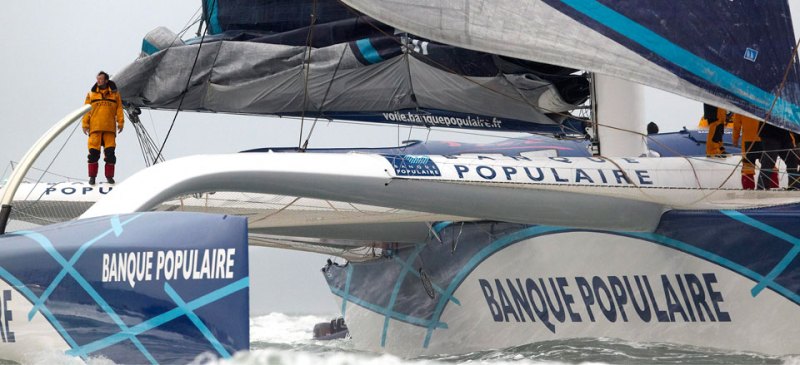
Earlier this month, Loick Peyron and his 13-member crew completed a 45-day, round-the-world sprint aboard the 130-foot trimaran Banque Populaire V to earn the Jules Verne trophy. Since then, Peyron and crew have been the center of media attention in France. Primetime newscasts here show BPV arriving in Brest, where more than 1,000 spectators braved the winter weather just to catch a glimpse of Peyron and company. It was as if the crowd was gathered at the Cannes Film Festival, trying to steal a peak at Johnny Depp or Penelope Cruz.
A few days later, Peyron appeared on the French equivalent of the David Letterman show, Le Petit Journal. During the show, he wowed the audience by commenting on a video shot while BPV was sailing past icebergs, which made the massive multihull seem like a dinghy in comparison.
But despite his celebrity status in France during the past few days, Peyron remains level headed during his interviews. His message to the public—that is, when he is asked about sailing instead of silly, Oprah Winfrey-like subjects—is that Banque Populaire‘s Jules Verne record will likely be short-lived. French multihull designs will only continue to get better and faster during the years to come, he says.
Peyron shared his perspective when he spoke to me by satellite phone a few days before arriving in Brest. At the time, BPV was heading north from the Azores, doing about 25 knots. Breaking the record is not so much about seamanship skills as it is about technology, he said. The next team will break the record when French multihull knowhow is applied to build a bigger and faster giant than BPV, which Pascal Bidégorry designed and the late Hubert Desjoyeaux, father of Michel Desjoyeaux, built. Peyron says it’s the fastest long-distance boat in the world.
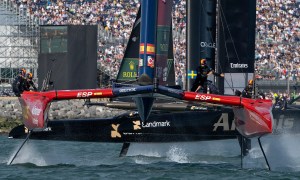
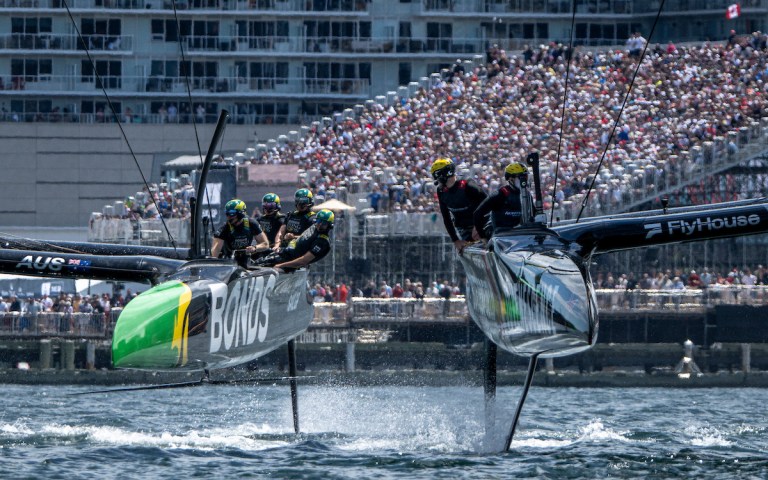
What is really exiting in multihull long-distance sailing is what is yet to come, Peyron said, as more recent advances like hydrofoil boats and rigid wings find their way into massive multihull designs in the future. “It almost goes without saying that our Jules Verne time will be bested again,” he said, speaking over the noise that a 23-metric-ton multihull with a mast as high as the Statue of Liberty makes when it’s plunging through the Atlantic at 25 knots. “Huge advances have been made [in offshore sailing technology] during the past thirty years, and multihull technology will certainly continue to evolve. In fact, we are at the beginning of a new era in multihulls.”
We could also be at the start of a new era in offshore racing, as sailors begin to push these fast-yet-fragile boats much harder than Peyron would be willing to do. With the same caliber of boat, another skipper and crew will be tempted to push the envelope more than Banque Populaire‘s mostly French team did. “I would even go as far to say that an Anglo-Saxon team can be more radical and aggressive than French teams are when sailing this type of boat,” Peyron said.
A more radical crew could have taken more risks and pushed the boat faster, but according to Peyron, there’s a price to pay. “Speed, of course, is a variable that is associated with risks, which means that breaking these records will involve more safety concerns and [off-shore sailing] will become that much more hazardous.”