Asym Trim
Ask a group of sailmakers how to toast a piece of white bread and you’ll get as many different answers as there are sailmakers in the room. Invariably, they’ll tell you that it depends on the kind of bread, the toaster, and its heating elements. The same is true when breaching the topic of asymmetric spinnaker trim. However, while their trimming tips have lots of subtle variations, they ultimately boil down a few fundamental rules. We put the topic before a handful of asymmetric trim experts-Jay Lutz, of North; Kerry Klingler, of UK, Dave Ullman, of Ullman Sails, Richard Bouzaid, of Doyle, and Scott Nixon, of Quantum-who tell us that asymmetric trim is not much different than it was five years ago, the one exception, of course, is that the sails are better designed to do what they’re supposed to do-get you down the run faster.
**Commandment No. 1. Thou shall rotate your asymmetric to weather. **
Lutz: “A well-designed running spinnaker can rotate around and away from the blanket effect of the mainsail, which allows you to sail low without collapsing the sail. The keys to getting it to rotate are crew weight and the shape of the sail. Both work in conjunction. If you can get the boat to heel to weather, gravity naturally helps rotate the sail. Today’s runner asymmetric-if it has enough luff round [the shape of the curve designed into the luff of the sail] designed in-naturally wants to rotate when it fills. It’s more genoa-like, with the draft far forward.
Klingler: “We’re designing so much positive luff round that the dynamics of the sail pull the draft forward dramatically. As a result they rotate better, and as they do, that puts the draft even more forward in the sail, which is where you want it to be. But you still need to pack the crew on the weather rail to get it to rotate well.
**Commandment No. 2. Thou shall keep the tack line in mind. **
Bouzaid: One of the problems with the centerline sprit-flown asymmetric sails is that as you start sailing deeper the sail wants to rotate and the luff effectively becomes shorter. Unless you ease the tack up it won’t float away from the front of the boat. When the spinnaker naturally starts rotating to windward it’s a good time to ease the tack line.
Ullman: How high you fly the tack is a matter of wind velocity and angle. If you’re sailing relatively tight angles-trying to go fast forward-you want the tack all the way down and the luff as straight as possible. If you’re trying to go deep, you want the spinnaker to rock (rotate) to weather. How much to ease is gut feeling and eyesight. The rule we use is that anytime you ease the tack line and it’s angled to weather, that’s good. If it goes to leeward at all, you’re losing projected area. The whole goal is to get the spinnaker to go in front of the boat farther. If you ease too much, the head gets too parallel to the water and you start losing area (basically making the sail smaller and not spreading it out.) In J/105s, we recommend no more than 2.5 feet of ease (with our sail), but every spinnaker will be different. There’s not a lot of science to trimming them. If you’re at 90 to 110 degrees apparent wind angle, then you want the tack down and trim as loose as possible. As you go deeper than that, start easing the tack as it starts rotating to weather and ease the sheet as far as possible.
Klingler: If you have the boat heeled properly, and you have the right pressure in the sail, easing the tack line opens up the shoulders and gives you more projected area. It also flattens out the luff a little and moves the draft to the middle of the sail a little bit. The thing you’re looking at is the upper luff; when it’s trimmed right, the luff is coming around, sort of cupped and hinging in slightly. Fly it like a normal symmetric spinnaker where the shoulders open up and out, like it does when you raise the pole on a regular spinnaker. If the luff gets too bouncy, bring the tack line down. If it’s too easy to fly, ease it up. The deeper you try to sail the more you can ease it, but trim it again as you change your angle to sail higher. In other words, adjust it often.
Lutz: Everyone’s letting off tack lines. The reason you’re really doing it is to increase the luff length on the sail, and with a longer luff length, you can rotate the sail farther to weather. That’s absolutely true, but there’s more to it. In the J/105 class, the 77-square-meter spinnaker had a luff length that was really short, so if you pulled the tack all the away down to the pole it would tighten the luff too much and the spinnaker wouldn’t rotate (the new 89-square-meter chute is better with a longer luff). On the J/80, the luff length is much longer relatively, so it’s not as necessary to ease the tack to get rotation. When you first raise the J/80 chute, you set the tack line all the way down. The only time you would ease it off is if your particular sail design is a little short in the luff. In really flat water and medium air, where you’re trying to sail low for tactical reasons, you can ease the tack line as much as 5 inches. On the J/105, it’s a couple of feet. Here’s a rule of thumb: if you let the tack line off and the line angles off to leeward, the tack needs to come back down. If you let it off and it goes straight up or moves to weather, you have good rotation. The vertical angle of the tack line is the visual key of whether or not you have it right.
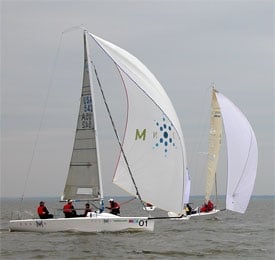
Nixon: The Melges 24 gets up on a plane so quick that we don’t spend much time adjusting the tack line, but there are a couple of conditions when you start soaking deep enough in the 6- to 10-knot range where you might-as long as the tack is straight up or to weather. We keep the tack line firm because in boats like the Melges you end up steering the boat a lot to either get up on a surf or soak down; with the tack down it’s easier to steer the boat to the kite. Having it down makes the luff of the sail more stable, too. In the light stuff we keep it down as well because we’re sailing tight angles-if you let it off, the sail will fall behind the main.
**
Commandment No. 3: Thou shall never sail a straight line. **
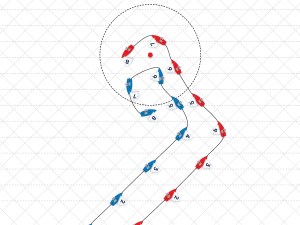
Lutz: When you sail an asymmetric spinnaker boat downwind you’re not picking one particular angle; you’re “serpentining” all the time. For people new to asymmetric spinnaker sailing this is the one tough thing to get right, right away. When you have pressure in the sail, you sail low, and when you lose it you absolutely have to sail high. So you’re continually heading up and down, using the information from the trimmer as to how much pressure is in the sail: you may sense it and you may see it, but it’s good to have the trimmer verify that for you. If the sail pressure is light and you head down, it collapses, you’re screwed, and you have to head up even higher to fill it up again-you’re basically just spinning your wheels and not getting anywhere.
Ullman: One of the most important things is developing the feel of how high to sail the boat and when to change modes between high and low. It’s a feel you have to develop-there are no set rules. You can get a sense of it by sailing your polar boatspeeds, remembering that as you go faster you can go deeper and deeper to maintain that boatspeed. My rule of thumb is to use the speedo; as long as speeds are increasing you can go deeper. As soon as they level out or go down, turn the boat up and sail higher. You want the speed increases and decreases to be at the slowest rate possible.
Nixon: In the Melges, the angles change quickly with puffs and you have to steer to the pressure. We always keep a slight curl on the spinnaker-a lot of people sail with a foot of curl-but we always keep a smaller, 2-inch curl, which makes the trimmer concentrate much more because it’s a finer trim. We don’t use a speedo because the speeds are so up and down. In big breeze people new to asymmetric sailing tend to soak a lot, and the good guys will get the boat on a plane and just rip it out to the corner and come smoking back going 5 knots faster. In heavier boats like the J/80s and 105s the angles are more similar-it’s more symmetric-spinnaker-based stuff-but in the light sport boats, when it comes to angles, planing is the most important thing. Klingler: One thing people have trouble with in a marginal planing boat (like the J/80) is not knowing when to turn the boat up to pop it onto a plane. In the 80, you go as deep as you can until you go over this 7.5-knot threshold and as soon as you hit that, you turn the boat up 25 degrees, it will pop up on a plane, and then you’re planing at 11.5 knots.
**Commandment No. 4: Thou shall use your twings only if you must. **
Lutz: When you’re tightening a twing, you’re closing down the leech a bit. There’s potentially a use for twings, but a lot of sail designers design the clews of the sails so that the boom ends up working like a tweaker [twing]. People don’t think of it this way, but the lower you go, and the more you ease the main, the more it acts like a twing, putting downward pressure on the spinnaker sheet and closing the upper leech instead of letting it open. So, without thinking about it the mainsail is helping the spinnaker fly more efficiently.
Klingler: We’re trying to design the sails so that twings are not critical. I use twings on the J/80 only to hold the sheet down so that when the spinnaker is trimmed, it doesn’t trim the main at the same time. I use just enough twing to get the sheet under the boom. In other words, I don’t like to use the boom as a twing, and I especially don’t like to having someone have to hold the boom out in lighter air. Ullman: We don’t use twings at all. In fact, we tell our J/105 customers to take them off the boat. The trouble with twings is they don’t just pull the sheet down they pull the sheet in, too.
Bouzaid: On most boats, the boom is the twing and the only reason you’d use one as the boat gets bigger is to keep the sheet away from the boom. A twing will always bring the whole bottom of the sail closer to the boat and everything you’re doing is trying to get the spinnaker away from the boat. If you can get away without using them you’re better off.
**Commandment No. 5: Thou shall always have and talk about pressure. **
Lutz: I talk a lot about the dialogue between the trimmer and helmsman, and everybody hears me, but doesn’t pay attention. But with an asymmetric, it’s even more important [than with a symmetric spinnaker]. The helmsman has to listen to what his trimmer is telling him; at the same time, the spinnaker trimmer shouldn’t be telling the helmsman how to drive the boat. The trimmer should be providing information and letting the helmsman decide what he or she should do. Instead of saying, “Head up,” or “Head down,” the trimmer might say, “I have good pressure, you can head down if you want to, it’s still good, it’s still good. Another important thing to remember is that the velocity and direction are always changing, and with the asymmetric, because the pressure allows you to sail low, it’s almost more important to get to the pressure than it is to get to the angle. With an asymmetric, a couple extra knots of pressure gives you 15 degrees to work down with, so sometimes it’s better to take the lift if it has pressure than it is to jibe into the header and have less wind.
Ullman: The combination of driving and trimming, and the communication between the two, is the biggest source of separation of boats in most fleets. The angles and pressure are always changing and you see people get real deep and the spinnaker collapses, and that’s the sign of a lack of communication. The trimmer should tell the driver, “I’m running out of pressure, we’re too deep.” And you head up 5 degrees. And as soon as you have pressure you start nursing it down. When I’m driving, I like to hear feedback only about pressure: Phrases like, “Lots of pressure,” “Little pressure,” “Losing,” “Gaining.” A third person rotating into this conversation is the guy calling puffs. You need this information to decide whether to sail high to go to new pressure, or deep to stay in the best pressure. That person wants to look at where you’ll intersect the wind. If there’s good wind, it’s looking to weather at 120 degrees or so. If it’s light, maybe 90 degrees.
Bouzaid: One important point is that sailing with over-eased asymmetric sails is slower than having them slightly over-trimmed. By sailing around with a fold down the luff half the time you’re losing that much of the span of the sail. I prefer to sail with the luff a tad more solid, as we used to with regular spinnakers. Plus, if you’re easing it way out, trimming it in, and then over-trimming it, you have a lot of sheet movement. If you keep sheet movement down, it’s quicker and easier for the helmsman to drive to the sail. Nixon: On the new designs the clews are higher and the sails are more forgiving, which makes it easier to steer the boat to it. But the dialogue between the trimmer and helmsman is paramount in a boat like the Melges. We’re talking the whole time, using the words good, average, bad, or medium to describe the pressure in the sail. With “medium,” we’re trying to hold the course, in when it’s “good” we’re trying to burn down a little bit. The dialogue has to be quick.