European 40s
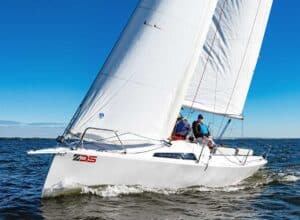
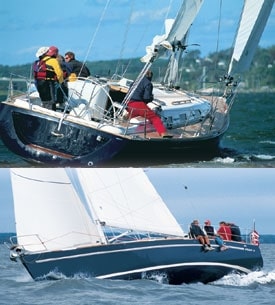
The field at last year’s Boat of the Year Awards competition (see SW Dec./Jan. ’03/’04) included several 40-something footers. They all couldn’t win awards, but that didn’t mean there weren’t several damn good boats. Two of these deserving recognition were the Grand Soleil 40 and the Elan 40 (the later won Cruising World’s Best Performance Boat award, both European-built and designed, and both with easily traced raceboat heritage. Grand Soleil 40 The Grand Soleil design philosophy has been to build one-off raceboats, see how they go, then use the knowledge gleaned from a year of hard campaigning on the European circuit to design and build a fast production boat that will race well and be reasonably comfortable downstairs. After sailing their 40-footer, we can say that the theory not only makes sense, but works well. We sailed the Grand Soleil 40 on a day when not many other boats came out to play; a cold front had brought winds that gusted well over 35 knots. Nevertheless, when it was time for our test sail, the GS 40 was waiting for us, tacking back and forth in front of the Naval Academy with two reefs in the main and the genoa rolled in partway. Our first impression on getting aboard was that the 5’3″ diameter Solimar wheel felt good, and the foot blocks were in the perfect spot. We averaged 7 knots during our sail, and thanks to the 6’10” rudder, we never spun out or broached; rather the boat just squirted ahead when the big puffs hit. BOTY judge and multihull aficionado, Meade Gougeon declared that the GS 40 was the best monohull he’d ever steered. The cockpit had room for the seven of us sailing that day. The seats are contoured, with raised edges, and the portside locker is large enough to store bricked sails. It was no problem for BOTY judge Chuck Allen to access the rudder quadrant and get at the steering cables, something we tested on each boat. The deck hardware and winches are Harken, and the solid vang by Bamar worked well during our spinnaker-less downwind legs. All control lines and halyards led aft to the cockpit and its four winches. Two additional winches for the main trimmer are optional, but would be priceless necessities for buoy racing. The roller-furling drum for the headsail is built by Facnor. Lifeline stanchions mounted inboard of the toe rail won’t be popular with crews or skippers, as they lend some difficulty and discomfort when hiking, and you can’t get your weight out as far as you could were the stanchions mounted outboard. Designed by Massimo Papperini and built by the Cantiere del Pardo yard in Forli, Italy, the hull is solid glass with vinylester and the deck is cored with foam. The standard mast, which is an aluminum rig by Sparcraft, uses wire rigging and steps on the keel. The keel is solid lead, and the rudder has a solid steel stock and steel webbing. The GS 40’s core strength comes from a built-in structural grid composed of ribs, bulkheads, and longitudinal stringers around the keel and mast step amidships. There are two and three-cabin versions available, the main difference being another head forward and an extra cabin aft under the portside cockpit seat in the three-cabin version.The fuel filters for the 40-horsepower Yanmar diesel, which powers a Saildrive unit, are easy to access. At presstime there are boats in inventory on the East Coast of the United States for $249,000; a new boat’s price will depend on the fluctuating value of the dollar versus the Euro. If you want a full-on race version, a GS 40R, with rod rigging, carbon rig, SCRIMP hull, and a 7’10” keel is available. Elan 40 The Elan company may be more familiar to Americans as a manufacturer of skis, but across the street from their ski manufacturing facility in Begunjie, Slovenia, is a boatbuilding plant that’s been producing boats for 40 years. We had the pleasure of sailing the Elan 40, a Rob Humphreys (Kingfisher, GBR Challenge) design in a 16-knot breeze. The deck gear is a mix of Harken and Lewmar, with a Furlex furler for the headsail. The rig is an aluminum Selden section popular with European builders, and, with the performance package we sailed, equipped with rod rigging and Spectra halyards. The boat has a split backstay with a hydraulic adjuster on the port side. The main sheet is set up grand-prix style, running down from near the gooseneck, which is handy when you need the sail pumped or pulled in quick for a jibe. As with the GS 40, all halyards are led to an organizer forward of the companionway. Behind the traveler, which is raised and runs between the cockpit seats, the stainless steel wheel mounts on a binnacle with room for instruments. The helmsman’s seat tilts forward for easy boarding through the open transom, which incorporates a handy swim platform/man overboard recovery area. And yes, the bow roller can easily be removed. The Elan 40’s hull is solid fiberglass, the deck cored with balsa. The keel is solid iron fin with a lead bulb, and draws 6’9″. We hit 7.2 knots upwind with the optional 155-percent genoa, and the boat felt solid and tracked nicely. When we did take a blast, the rudder gave plenty of warning before an actual stall-and recovered instantly once the main traveler was eased. Downwind in 17 knots true, sailing under spinnaker, the boat felt on edge and the cockpit a tad crowded during jibes, but we hit speeds between 7.7 to 8.2 knots; the trade-offs are well worth the performance. This is a boat that won’t take long to get used to, and will reward a competent driver. The first thing you notice as you go below are the two handholds in the companionway; somebody had their offshore thinking cap on. The fit and finish below is excellent, especially if you order the upgraded (more wood) interior. There are two different cabin versions, with the only difference being a head in the forward berth in one version. There are two cabins aft under the cockpit benches, both with closets. The J-shaped galley is to starboard, opposite that, the head. The nav station is at max beam, and faces forward. The electronics panel is well laid out and easy to get behind, but there’s only a small space left for instruments, and no cabinetwork directly forward of the desk itself where you’d like to put a display screen. With the IRC measurement rule heading for the States, it’s good to know that an Elan 40 won the British National IRC Class 2 in 2002, and you can own one for $215,000. Both the Elan and the Grand Soleil 40 demonstrate a trend in European boatbuilding towards good looking racer/cruisers that race well, so if you’re in the market, do yourself a favor and sail each. Soleil 40 LOA 40’4″ LWL 39’4″ DSPL 15,000 lbs. Beam 12’6″ Draft 7’1″/7’10” Upwind SA 915 sq. ft. www.grandsoleil.net Elan 40 LOA 40′ LWL 39′ DSPL 16,755 lbs. Beam 12’7″ Draft 6’9″ Upwind SA 779 sq. ft. www.elan-marine.com