Corsair 36
What I thought was the weirdest thing about the boat at first turned out to be one of its outstanding features. The Corsair 36 has a stern deck at the back of the cockpit with two large bench seats made of mesh and stainless steel tubes, and they looked bizarre. But after a day or two of cruising with my wife and three daughters, I looked at those seats with complete appreciation. They were the most coveted, comfortable places from which our crew would sunbathe, snooze, and read. If I was lucky, sometimes I even got to sit in one to steer.
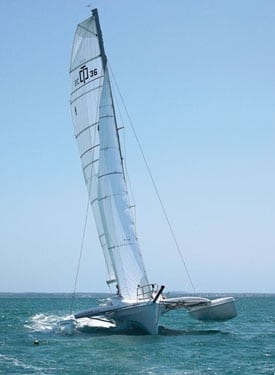
I’d been looking forward to cruising on Corsair’s new flagship and comparing it to our experience on the 31 a few years earlier (“It’s Not All About Speed,” March ’01). Like the 31, the 36 is built with a vacuum-bagged foam/glass sandwich laminate, plus carbon and Kevlar reinforcing. The beams are made entirely with carbon, and the overall weight is a little over 2,000 pounds more than the 31. With 817 square feet of upwind sail area, the tri was fast-roughly as fast as the 31, but without the same twitch in the gut when it accelerated. Under main alone we broad-reached across a windy Vineyard Sound doing a relaxed 12 knots. Later, on a beam reach in about 12 knots on Narragansett Bay, with my 12-year-old daughter steering (one hand on the tiller extension, one hand holding a book), our speed jumped from 11 knots to 15.3 as I trimmed in the main and the sprit-mounted genoa (known as a screacher). And when I crewed in a local race with Multihull Source dealer Bob Gleason, we saw 17 knots on a tight reach. I’m told that reaching speeds in the low 20s are common, but what impressed me most was the light-air trip we made from Martha’s Vineyard, to Jamestown, R.I., in seven hours-40 miles upwind. To me that’s the big benefit of a boat like the 36; you can sail it quickly and quietly, eating up the miles while others are going no faster under iron genoa.
Because of its larger accommodations, compared to the 31, the 36 got the thumbs-up from my daughters. But it’s still a trimaran with a relatively skinny main hull; that’s the price you pay for speed. The narrow waterline reduces storage, but the hull flares outboard above the waterline, which provides room for an enclosed head on one side of the daggerboard trunk, as well as the dinette, which converts to a small double berth. There’s also a small galley area to starboard with a sink and two-burner alcohol stove.
On our boat, the fridge had been removed and an Igloo cooler was used in place of the bottom companionway step; but the standard configuration has a 12-volt fridge to port, just forward of the dinette area. An option is available for a propane-fired stove and propane on-demand hot water. There were five of us aboard, with two girls in the forward cabin, one in the dinette double, and the adults in the aft double, which is reached by lifting part or all of the stern deck at the back of the cockpit. We loved sleeping in that wide aft berth, although getting in and out required agility, and changing clothes in there was like dressing inside a tent. We decided if there were a follow-up cruise, we’d claim the forward cabin and move the girls aft.
Despite the constraints of the interior, the on-deck living spaces are expansive. With amas and trampolines to port and starboard, a small foredeck, plus the stern seats, any of the five of us could escape the others when we felt like it. We could easily carry our tenders-single and double kayaks lashed between the forward and aft beam on one side-and the large-volume outer hulls had plenty of room for storing anchors, paddles, even garbage. On the foredeck and forward beam, we found plenty of room to take solar showers and/or have some fun by dashing outboard and swinging off the spinnaker halyard. Speaking of solar devices, a flexible solar panel lived on the cabintop or port netting and provided an all-day trickle charge to our batteries.
The 36 we sailed was one of the first built, and while we were racing in hard reaching conditions, we heard a crack at theinboard end of the forward beam. Installed under the beam’sinboard end was a fiberglass block that gives a tight fit for the beam after it’s unfolded and bolted to the main hull. “The block we made,” says Paul Koch, Corsair’s president and design team member, “wasn’t up to the job. We’ve replaced it on all boats with a stronger aluminum casting.” Hull No. 8 is under construction at press time.
Overall, I liked the boat’s sailhandling systems-a full-length traveler across the stern deck and pairs of winches for main, jib, and screacher or spinnaker. While racing, I went forward to help with the asymmetric spinnaker and found that it was too big for me to take down to windward unless the skipper was willing to bear off. (For some reason he wanted to keep sailing toward the mark, so we dropped it to leeward instead.) But while cruising, the combination of the roller-furling headsails (jib and screacher) and a mainsail equipped with lazy jacks and jiffy reefing made sailhandling easy.
It was tough to balance on the boom to remove the full-length batten in the square-top mainsail, and I figured that was another small price to pay for performance. I learned later from sailmaker Dave Calvert that a quick-pin on a new Tides Marine batten-car design now releases the head so the batten can lie flat along the boom. Under power, with a 15-hp, long-shaft, four-stroke Honda, the 36 moved well and steered easily thanks to a small bar that is dropped into place to link the top of the engine and the outboard, kick-up rudder. An electric starter and power tilt made getting underway simple.
Compared to other Corsairs, which go on and off their trailers quickly, the 36 is a much more substantial boat. It’s considered a “transportable,” not a “trailerable” boat, in the sense that it’s not the type of boat you’ll launch for a quick afternoon sail. Except when traveling to new sailing areas, it will probably live on the end of a dock or a mooring-or in about five minutes it can also be folded up to fit in a slip. Manufacturer estimates for stepping the mast and launching are about two hours.
If your kids like to read and swim and you like to sail from harbor to harbor-whether at 17 knots in a breeze or 6 knots in light airs, go for a test sail. With a few agile, fit crewmembers to manage the spinnaker, you can race it hard as well. Whatever you do, don’t let the funky bench seats put you off.
Corsair 36
LOA 36’0″
LWL 35’0″
Beam (overall) 25’7″
Beam (folded) 9’10”
DSPL 5,500 lbs.
Draft (hull only) 1’8″
Draft (daggerboard down) 6’0″
Mast length 47’6″
Sail area 817 sq. ft. (1,084 w/screacher)
Base price $208,000
www.corsairmarine.com