Salvage a Positive Outcome
After an ugly start, what’s the best escape? When we’re pushed near a layline, how do we avoid losing more boats as we approach the mark? What’s the exit strategy at the leeward gate when we round behind a group of boats? While these are just a few of the troubling questions that may pop up in your next race, they’re some of the most common. Let’s look at ways to get out of those problem spots, and what the escape goals are at different times around the racecourse.
One of the most predictable trouble areas for most sailors is the start. It’s easy to get clogged up, risk a foul, or just get rolled off the starting line. And worse, any mistake there gets accentuated because the fleet is so compressed.
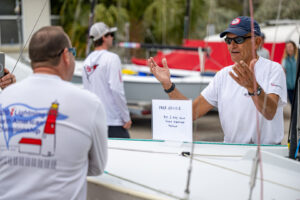
I recently taught at a clinic working with a group of young sailors. Our focus for the day was on escaping from bad starts. We spoke about the fact that, if you’re second or third row at the start, you may be in last, but only a boatlength or two out of the lead. There’s still time to recover. However, you have to act fast to get back in the race. The lesson was simple: Clear air is the first goal, and then playing the shifts. Do everything you can to get clear and be fast.
The very next day I watched one of these young sailors get a bad start and do nothing to get out of trouble. Later, I slid up next to him in my coach boat and asked if he had considered tacking away toward clear air. He said he wanted to go to the left, so he had to stay in the bad air to get there. I couldn’t fault him for having a plan, but I’m not sure it was the best one. But, I’ve been in his shoes.
He stayed in bad air, on starboard tack, quickly losing to the fleet. When he finally got the shift he expected, he was far enough behind that he had no chance to get into the top group on the left. Making matters worse, boats that had tacked right early, gotten clear air, and then tacked back to the left were also well ahead of him. What he failed to see was that everyone was gaining on him while he was in bad air, and in a matter of a minute or two, there was no way he would be among the leaders anymore.
What was his post-race analysis? He decided he was slow. But anyone could see that he didn’t understand how to free himself from his bad start.
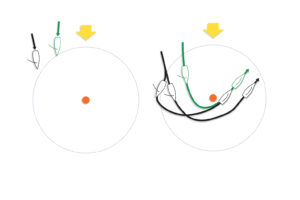
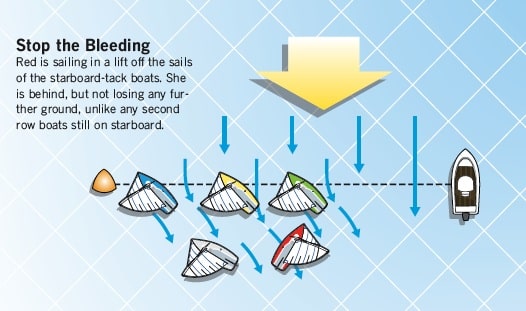
Rule No. 1 after a weak start is to get on the opposite tack to the fleet. Unless you’re one boat away from clear air on the left and reaching off will get you there, don’t stay on starboard tack. If you get onto port as soon as you can, you’ll find you stop losing to the fleet. Yes, you’re crossing behind other boats, but you’re sailing in fairly clear air, and each time you go behind another boat, you’ll feel a lift that you can use for speed or pointing, your choice.
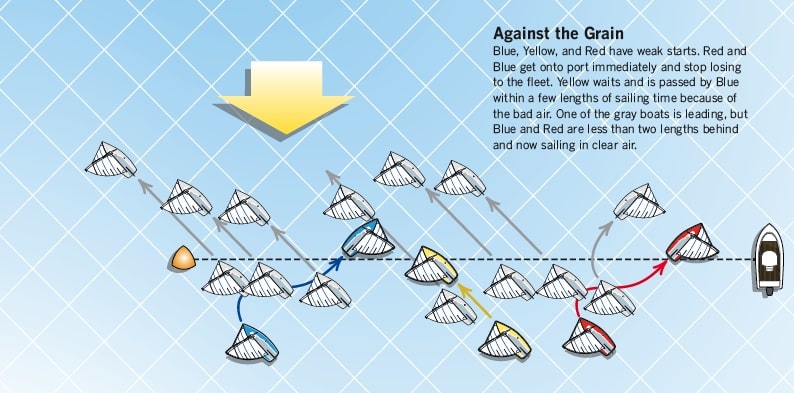
Sometimes, it seems as if there’s nowhere to go if you bail out. But boats start tacking to port very quickly after the gun, and holes open open up after you’ve been on port for as little as a length or two. The weaker starboard boats are losing ground in bad air and headers, so the space between them and the stronger boats grows quickly, often allowing port-tack boats to cross opponents they didn’t think they could seconds earlier. In fact, if you wait to tack onto port until there’s a nice, juicy hole to cross through, you’ll often find that boats you cross behind to get there will tack on you, shutting down that hole.
Don’t give up if you’re not first off the line. Make your exit choice immediately and get to work limiting the damage of your bad start. The race is just beginning, so look at any less than perfect start as an opportunity to begin gaining on the early leaders. Remember, you only collect points at the finish. Once you break through into clear air, re-examine your strategic plans and decide if you’re on the right tack. Look around, get in a clear lane, and go fast.
Weather Mark: Gains or Losses?
There are other times on the course when you may want to be patient and wait for a better—more rewarding—opportunity. The windward mark, for instance, may be a time in the race where you just have to duck a few boats, overlay the mark, and round with your group. Here, the risk might be too great for trying another route (such as tacking thin on the layline and risking hitting the mark, a competitor, or not fetching it at all).
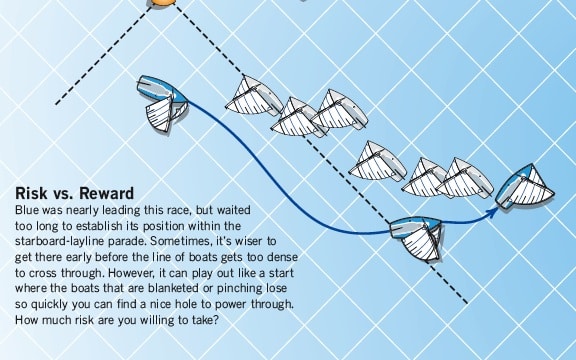
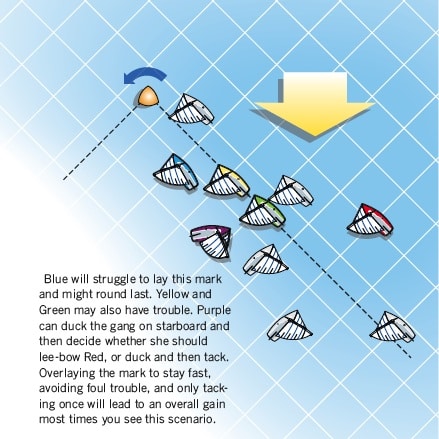
Many of the same scenarios play out at the weather mark as they do on the starting line. The fleet compresses, and everyone slows down as the boats line up on starboard tack. Unless you’re leading, there’s plenty of bad air, especially if you’re in the starboard-layline parade. Great gains can be made by approaching this group on port before it gets too crowded and then cautiously overlaying the mark so pinching or being blanketed doesn’t slow your final approach.
As with the ducking boats after the start, all the boats on port tack are crossing in a lift. Unlike the start, however, each boat you duck is an absolute place and distance lost, because the boats line up bow-to-stern, instead of perpendicular to the wind, as they are on the starting line. That makes the windward-mark rounding a situation in which you want to establish your position early, before the fleet gets too tightly packed. Setting up two to four lengths above the layline early can save you several boatlengths later, if the fleet gets really crowded and jammed up. It also sets you up for a clear-air exit from the mark.
Trouble at the Gates
Lastly, one area where I see lots of gains and losses is at leeward gates. Successfully navigating gates starts roughly halfway down the run. The desired position is to be the inside boat on the rounding so you can control your destiny after the mark. Regardless, you need a plan for what side of the course
you want upwind. Keep that “big picture” plan in mind as you escape the gate area.
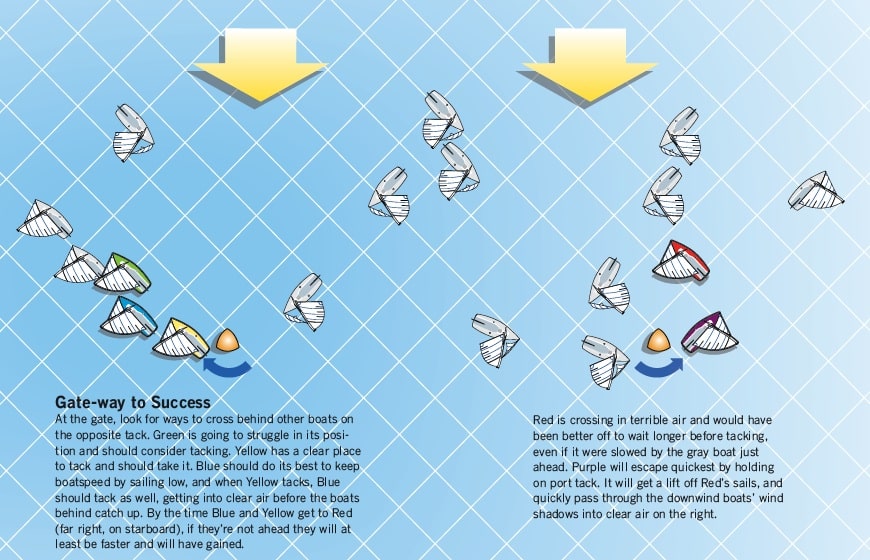
Coming into the gate, drop the spinnaker early enough to have everyone ready to hike and trim for maximum speed out of the mark. Your focus should be what happens just after the mark rounding. Boats sailing downwind toward the gate are especially painful to try and cross, if they’re on the same tack. Their wind shadow moves with you and gets worse as you get closer. So look for a lane to tack into that puts you crossing against the grain of oncoming traffic. And, much like the start, getting on the opposite tack to the upwind boats is helpful, too. You get better wind and speed than trying to hold a thin lane behind other boats on your tack. This keeps you in the game until you’re on the open course again and able to start playing the shifts normally. Once clear, review your strategy and get on the tack that takes you towards the best gain.
The bottom line is this: When you find yourself in trouble, don’t just eat bad air and watch the leaders sail away. Have an exit plan and use it if you have too. At the start, it’s urgent to get clear air so you can start playing the shifts at full speed. At the windward mark, gains come more often from a conservative approach that keeps your speed high and limits foul trouble. At gate marks, you need to thread your way through the nearby boats in a way that springs you out into clear air as soon as possible.
Hopefully, my young friend will realize he’s not slow, he just had a bad start. If he gets clear right away, he may be behind some boats initially, but not far. Then, if he plays the mark-rounding game well, he may even start to feel fast.