Sanding the Sled the past few weeks, I’ve been noticing all the old epoxy repairs marking the boat’s history. Some of them I remember—like the faint scar where the vang cleat pulled away from the centerboard trunk during a Midwinters race years ago—and some I’ve only just discovered.
The imperfections make the Sled unique, and each new blemish adds to the boat’s character. It’s like that with a lot of the belongings I treasure most. When I think of my favorite things—Thistle No. 1055, the Buick Century I recently sold, my electric guitar—they’re all mass-produced. When they were new, there was nothing to set them apart from all the other brand-new Thistles, Buicks, and Fender Telecasters. They weren’t terribly valuable new, and they haven’t appreciated since then—just ask the salesman at the car dealership who offered me $200 for the Century. Their value is mostly sentimental, and their distinguishing characteristics are the imperfections picked up along the way. In the same way I remember my Buick by the notch of vinyl that crumbled away from the steering wheel, it’s the dings the spinnaker pole puts in the foredeck grating that sentimentalize the Sled for me. Maybe that’s why Willie Nelson plays such a beat-up old acoustic, when he could’ve traded out for a nicer instrument years ago.
Of course, we don’t want the Sled to look anything like Willie Nelson’s guitar. We want the scars to disappear. And if we do a decent job fairing in the repairs, they will, entombed beneath layers of varnish and epoxy like a secret between boat and owner. That’s part of the fun of working on the boat. If we do it right, the Sled will be as good as new and more special than ever.
Okay, all this talk of epoxy is starting to sound way too romantic. Here’s how we’re coming along repairing some blisters that developed along the rails:
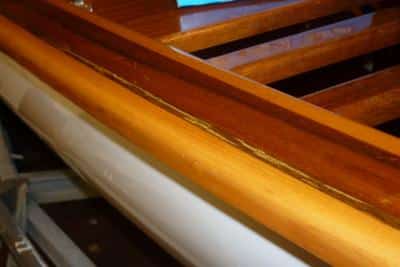
1. See how the varnish had peeled and cracked within the plies of the rails?
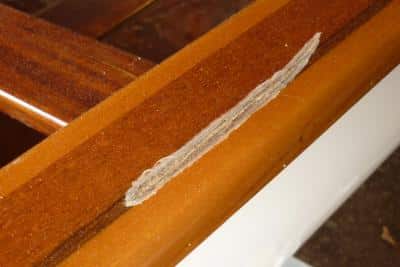
2. Using a razor blade, we chipped away the flaky varnish and epoxy, exposing bare wood in places, and tapered the repair area.
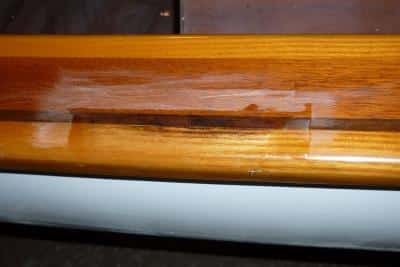
3. After roughing up the repair area, we masked it off and applied a thin layer of epoxy.
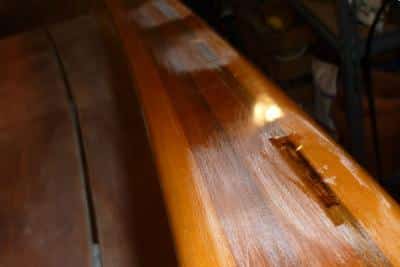
4. We performed spot treatments like this all around the boat.
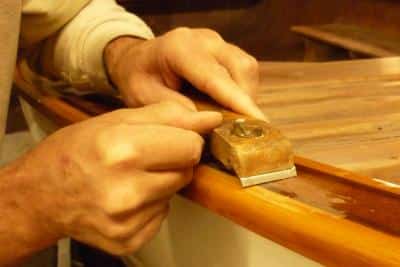
5. When the epoxy had cured—and we finally located the lost tool—we cut away the excess epoxy with a sharp scraper.
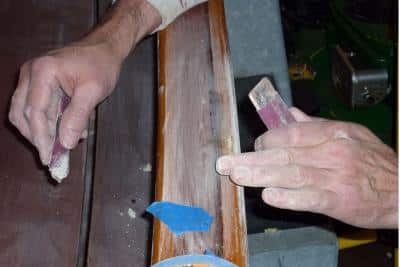
6. After the scraper did the bulk of the work, we faired the repair down to the level of the untouched rails with 150-grit sandpaper.
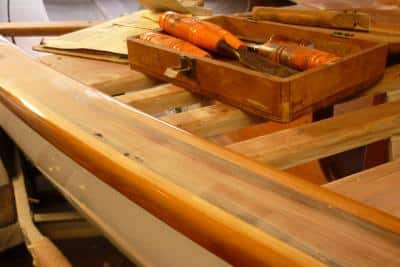
7. Now that we’ve sanded off the excess epoxy from the repaired areas, the next step will be to sand all the rails with 240- and then 320-grit paper before varnishing. Once we’ve varnished, the repairs should all but disappear.