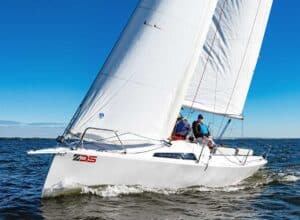
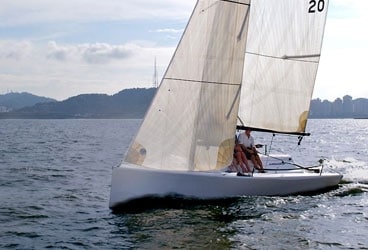
There’s no refuting that the Melges 20 incorporates the best features of all of Melges’ boats into one sweet little package. If it weren’t for the chine running through the aft section, you’d think the Zenda crew simply shrank the Melges 24. Yes, it’s like the 24 in many ways, especially how it moves through the water, but this pint-size sportboat has its own personality traits-good ones, too.
“It’s a boat that I think would be fun to just take out and day sail,” said Stewart, touting the virtues of a boat that will have you itching to leave work early whenever the breeze is up. And the ease of getting the Melges 20 to the water, particularly if it’s drysailed, is all the more reason to do so.
Intended as a straight up one-design, the class rules have no crew-weight restrictions, but the boat will sail best with three average size adults. Class rules mandate legs-in hiking, and allow professionals to be owner/drivers so long as they own the boat.
The Melges 20’s deck layout is clean and functional, and with the vang mounted above the boom, the business end of the cockpit is wide open for the forward crew to handle the spinnaker and move effortlessly from side-to-side. Spinnaker sheets are led inside the cockpit aft, which keeps them inside the stanchions (and not under the boat). Padded backrests on the upper lifelines provide comfortable support for the crew to lean outboard, out of the skipper’s line of sight.
The design brief with this boat was to keep it as simple as possible, getting away from the micro tuning that is the norm in Melges 24 class competition. Fore-and-aft adjustable shroud cars (set with pins) on short tracks can change rig tension from 200 to 700 pounds with very little effort. Rig changes can be made between races without having to break out the tools.
Getting from trailer to water with the Melges 20 is an easy task, too. With a deck-stepped carbon rig and retractable carbon keel (with kelp cutter) it’s possible to get the boat fully rigged and sailing in less than an hour.
We sailed the boat in 4 to 6 knots of breeze, but the square-top main and masthead asymmetric spinnaker gave the boat lots of power in the light stuff. “It reacts well to crew weight placement,” said Allen, “and the adjustable shrouds make adjusting the rig to different breezes a snap.”
McConaghy Boats, which will be building the 20, has a great reputation, and the Melges 20 is a fine example of their operation in China. The hull is a vinylester, resin-infused sandwich laminate with a CoreCell core, ensuring a lightweight, strong, laminate with the weight consistency weight required to uphold a strict one-design standard. The boat comes from the factory faired and ready to sail, and our test boat was finished off superbly, with virtually none of the imperfections one usually finds with early builds.
The non-skid was good, edges were smooth, and the fittings were bedded tight. In fact, Melges had enough confidence in the boats coming out of China that they offer shipping direct from the factory to the client with a promise the boat will be ready to sail, right out of the box.
The Melges 20 has all the makings to establish a strong one-design fleet in short time. Yes, the price tag is significant, but fleet discounts are available, and the support of the Melges operation is there to nurse the fledgling class along. History has proven that any new one-design, no matter how great it is, is only as good as the builder support behind it. With the Melges 20, the judges were confident that in a few years time there will be a whole bunch of these planing around the racecourse in good company.
Pros:
A quick little sportboat with firm one-design class rules, legs-in hiking, and great light-air performance. It delivers high-speed sailing and excellent stability in heavy air.
Cons:
Spinnaker system, as tested, is still in development. Advanced boathandling skills and athleticism required in heavy air (which is a pro, if that’s what you like).
Designer’s mission accomplished?
Reichel/Pugh was tasked by Melges to design a next-generation, compact one-design that would be easy to rig and sail. The judges agreed that R/P and Melges attained all these goals, and then some: a lot less technical than the Melges 24, but just as fun.
Melges 20 Specs
| LOA: | 20′ |
| Beam: | 7′ |
| Draft: | 4’6″ |
| DSPL: | 992 lbs. |
| SA (u/d): | 296/624 sq. ft. |
| Designer: | Reichel/Pugh |
| Price: | $47,000 |
Access SW’s 2009 New Boat Showcase, including reviews and photos for Boat of the Year winners and dozens of new boats.