1MinAssess
Choosing the faster side of the first leg of a race is critical to getting an early jump on the bulk of the fleet, and it’s something you can usually predict. Careful study, a disciplined approach, and simply summoning up the courage to make the call are essential ingredients. Few sailors have the resources America’s Cup sailors enjoy, but both ashore, and on the water before the start, you can do quite a bit of homework to help you make the right call.
Make a habit of reviewing your tide tables (if you’re on the coast) and forecasts in the newspaper or internet, before leaving the dock. In addition, take the time to ask local sailors what to expect; beyond the normal wind and current info, you may learn some surprising things. On one Midwestern lake, the cows near the shoreline face downwind, and the stronger the wind, the more neatly they line up. In Newport, R.I., dense dew on the grass early in the morning indicates a strong southwester will fill. Some of what you hear may not help you choose the faster side, but the process always helps orient you to the race area.
Once you leave the dock, the same applies to watching the wind. Track changes in the wind by recording compass readings, including the time. Then, well before the start, study the water carefully. Look for dark patches of water indicating more wind or a significant current effect. Study one section of the horizon at a time, standing up so you have a greater height of eye. Use polarized sunglasses because they help contrast the color of the water, and let your eyes blink naturally. There are many sources to use when reading the wind: flags, smoke stacks on shore, cruising sailboats, birds taking off, ripples on the water, the direction of anchored boats, as well as your competitors. Look to see if the boats on one side are heeling in more wind.
When you look upwind, split the leg into three sections: left, middle, and right. After a couple of minutes of study, make a guess as to which side seems better. Select a section to head for, and state your findings aloud-this is part of giving yourself the courage to make a choice. Your first instinct will usually be correct.
Now run a test; the best way is to arrange a tune-up with a competitor. While you sail upwind on one side of the course, your partner sails up the other. After 2 minutes, tack toward each other. Note which boat gains, and after crossing, head toward the opposite side for another 2 minutes. Tack back together and note the difference. Usually the boat on the same side will have gained.
Return to the starting area and make a second visual observation. Ask yourself, is the wind any different now? The key at this point is to make a definite decision to favor one section of the course. Sometimes you may think you’ll get a shift going one way but stronger wind, the other. If that’s the choice, I like to head for stronger wind because it gives me more speed and often more options.
|
|
| |
|
|
| |
| (C)David Norton|
| |
|
|
|
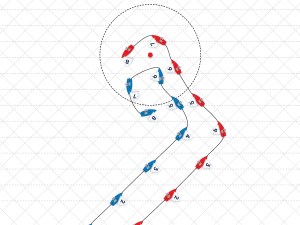
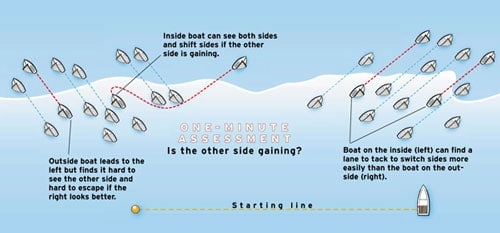
Set up your starting strategy so you’re heading toward the side you favor. If your plan is to sail to the right side, start on the right end of the line. The less sure you are of your choice, the closer to the middle of the line you should start (see diagram).
Once the race starts, head for your side at top speed. Right or wrong, speed always counts. Strategically, your biggest decision now is to monitor the rest of the fleet and consider whether to carry on or switch sides. My first instinct is always to stick with my original call. But conditions change, so one crewmember should continually analyze whether you’re gaining or losing; if you decide your side is losing within a minute or two, that’s the time to tack and stay in contact with the leaders.
Key indications may be that a new wind is blowing in from the opposite side, or maybe a few boats are making huge gains. But before taking action, ask yourself, “Will the new wind still be there when I arrive?” If you have any doubt, avoid chasing the new wind. If you decide to go for it, pick a spot just after a boat has crossed ahead of you or close behind. This boat will become a blocker as you cross the course. It’s OK to dip behind several boats if you see better wind; an early loss may translate into a big gain later.
What’s the biggest mistake sailors make when they’ve decided to switch sides? It’s second guessing themselves and tacking back again. The extra tacks cause you to fall farther behind, and your indecisiveness will make it even harder to catch up.
Later in the race watch for major windshifts or current shears (abrupt shifts in the direction the water is moving), and, when planning to go downwind, consider what you learned upwind. When you cross a current shear marked by surface debris or irregular, choppy water, analyze your performance. If you’re suddenly sailing slower than boats on the other side of the shear, consider tacking back across it.
Some years ago in a Finn Olympic Trials race, I learned the value of getting on the course early and having the courage to believe in what I discovered. I found a current shear halfway up the beat during my pre-race tune-up. To the windward side of the shear, the water was flowing toward the windward mark. All week long at this regatta, the right side had been favored thanks to a predictable starboard windshift. But in this race, after the start, I headed left and crossed the shear while the fleet headed right as usual. I rounded the first mark with a comfortable lead.
Don’t forget which part of the course was most beneficial when you consider your strategy for the downwind leg. Well before rounding the windward mark, announce where you plan to sail on the run and if you should do a bear-away spinnaker set or jibe set. My rule of thumb is that if the other jibe is favored by 15 degrees or more, a jibe set is a better option. However, with many boats, and in many fleets, it can be more efficient to set, accelerate to full speed, and then jibe, being careful to keep your wind clear.
Wind patterns caused by the surrounding land repeat themselves on the water. When you learn what works, put this knowledge into your game plan. Keep notes for future regattas. Recently I sailed in a college alumni regatta in Chicago. I reviewed my notebooks from racing four times in the Timme Angsten college regatta between 1969 and 1972. Once I started sailing I was pleasantly surprised to find that my old observations still held true and, in fact, they helped me win the regatta. Afterwards, I added a few new passages to my youthful thoughts in case I ever have to pick a side in Chicago again.