Tufts Sailing Facilities
College sailing venues vary just as much as the teams’ coaches do. After having sailed across NEISA (New England Intercollegiate Sailing Association) for three full years, I thought I’d share some highly subjective thoughts on their facilities. This is not an exhaustive list, by any means; I’ve heard that UConn has great cookouts but I’ve never personally sailed there, and a few middle-of-the-road venues—such as Salve Regina—were neither here nor there.
Boathouses
The Coast Guard Academy boathouse is a three-story architectural feat, with a large porch set up perfectly for viewing the shifts and mayhem inherent to racing on the Thames River. Built on Jacobs Rock in New London, Conn., it’s about a quarter of a mile walk to the boathouse from the road, so bring everything you need with you from your van in the morning, including lunch and any extra gear. If you’re experiencing inclement weather, it’s possible to seek shelter on the third floor and keep the sliding glass doors closed. There aren’t many tables, but there is plenty of carpeted floor space just waiting to absorb Thames from your drysuit.
The MIT (Massachusetts Institute of Technology) facilities in Cambridge, Mass., are unique in NEISA for a number of reasons. While the Fireflies are still an exciting novelty to many college sailors, an addition allowed by the generous donation of the Lowell North docks last spring, the boathouse itself has remained relatively unchanged throughout my time in college. MIT also has an inviting and open atmosphere thanks to its flourishing recreational sailing program. Beyond Fireflies and FJs, it also has Tech Dinghies—both the new carbon-fiber models and last generation’s boats—and a fleet of catboats. While you’re unlikely to be sailing the catboats at an intersectional, they do make for fantastic viewing for coaches and spectators alike, especially during fun events such as the Charles River Open. The upper porch of the boathouse, while open to the elements, is an enjoyable spot to set up on early fall and late spring days. Various bays below are also open to teams looking for a place to set up camp. Even the bathrooms provide entertainment, with graffiti of “CAMELS,” “GO JUMBOS,” and various other slogans carved in over the years, as well as yellowed articles about America’s Cup events of years past. And don’t forget, there’s always The Muddy across the street to hydrate for those of age.
The Yale Corinthian Yacht Club is the oldest collegiate sailing club in the world, dating all the way back to 1881. You would have a hard time telling, though, as it has been artfully remodeled, with two floors and a porch on the second-story. Although it’s impossible to see racing when it’s outside of the cove, when it’s inside you can get a fairly good idea of who’s going to which side from the docks. There are various picnic benches set up for snacking during offsets in pleasant weather, and enough shelter between the enclosed area upstairs and a large workroom downstairs to hide from the elements in unpleasant weather. With separate locker rooms for both sexes, it’s even possible to shower after a day of being pummeled by the epic waves that a Westerly can summon.
Sheds
If you’re sailing at Roger Williams, you better hope that your van is comfortable or that the weather is beautiful. Located on Mt. Hope Bay in Bristol, R.I., the sailing is usually quite lovely but the onshore facilities are minimal. Essentially, you drive through the campus and then off a hill into a small patch of woods, which can be quite the feat without four-wheel drive. A small shed contains sails, tillers, and RP forms, but can’t fit more than about five people at a time. Parking “spots” are just areas where there aren’t trees, and, if you’re not careful, can lead to a very unhappy sailing team pushing a van out of a muddy rut at the end of the day. In addition, it’s impossible to leave the RWU sailing site without accruing a collection of leaves and other debris from changing in the wilderness. While there is usually a Porta-Potty near the shed, if you’re desirous of a flushable toilet you need to make the short hike up the hill to the closest academic buildings, which are usually unlocked.
Although it is within sight of the Coast Guard Academy, Connecticut College, also located in New London, Conn., does not boast the same luxurious facilities. Although a shed large enough to easily house 15 people has been added since I began college, the comforts at Conn. are still minimal. Before the shed, the RP and protest forms were contained under a little lean-to made from a tarp to protect from the elements. Arriving a little early is worthwhile here due to the parking; located on the field above where the boats and water are, only some spots offer viewing of the water thanks to rogue trees and brambles that more than one coach has threatened to cut down. There are two Porta Potties and about as many picnic benches, both located close to the water. To top it all off, there’s a Native American burial site in the woods—if you’re lucky, you might even get a history lesson about it during a skippers’ meeting.
Following along in the shed trend is Bowdoin in Brunswick, Maine. Although the venue is so picturesque that it seems like a moose could step out of the trees at any moment, the facilities are, once again, minimal. With a shed that gives Conn a run for its money in terms of size, seating is relegated to the docks and the large rocks that form the beach below. Since it’s nearly impossible to see the sailing from the nearby parking lot, competitors once again should pray for sunshine. The Porta Potties are larger than those at Conn and Roger, but … they’re still Porta Potties. One highlight of Bowdoin to keep at eye out for is coach Frank Pizzo’s camouflaged motorboat—so stealthy that you might not even see it coming.
**
Bunkers**
Located on Memorial Drive close to MIT is the Harvard boathouse, also in Cambridge, Mass. This boathouse hovered between the “Boathouses” and the “Bunkers” lists, but was finally placed here because of a few deciding factors. Although there is an upstairs with a decently large room into which at least half of the teams can pack into, as well as a downstairs area with room for a couple more schools, there are no tables accessible, so delicate regatta food is likely to get stomped on by someone who realized that the other division is already headed toward the dock. Thanks to both the brains and brawn of Harvard sailors and their architects, some of their FJs are hung up at the end of the day. But after a tough day on the Charles River, full of auto-tacks and death puffs, the last thing I want to do is de-step a mast and then proceed to hang up my boat. The sinking feeling when you realize that your boat is to be hung is one that is felt at few other venues. Although Harvard has restrooms, sailors often trek across the street to invade a classy building in full spray gear.
The next school on the list could be categorized both as “Shed” and as “Bunker.” Notorious among NEISA sailors is Boston University, also located on the Charles River in Boston, Mass. The wind is shifty, the walk is long, and the rotation dock provides no shelter unless you bring a tent. The boathouse itself is well-equipped for wind or crew delays, with a large TV, a movie collection, a dartboard, and board games. There’s seating and a large board for announcements and the rotations, and a table for RP forms. Once the sailing has actually begun, however, A division sails almost a mile down the river while B division carries all the bags and food. Although I’ve never brought one, a little wagon would probably be ideal for the journey. Once at the rotation dock, you can choose to set up camp at one of a handful of picnic benches onshore (if you get there early enough), or settle down on the dock itself. If you want to go to the bathroom, you need to walk back to the closest footbridge and wander around until you find an open building (Admissions is open on Saturdays), or back to the footbridge close to the boathouse for the Law School restrooms. Neither trip is relaxing, as it’s not a short walk and missing a set is a constant fear. One highlight of the sailing site is the nearby parcourse; if you’re freezing during the offsets you can warm up with some push-ups or ab exercises.
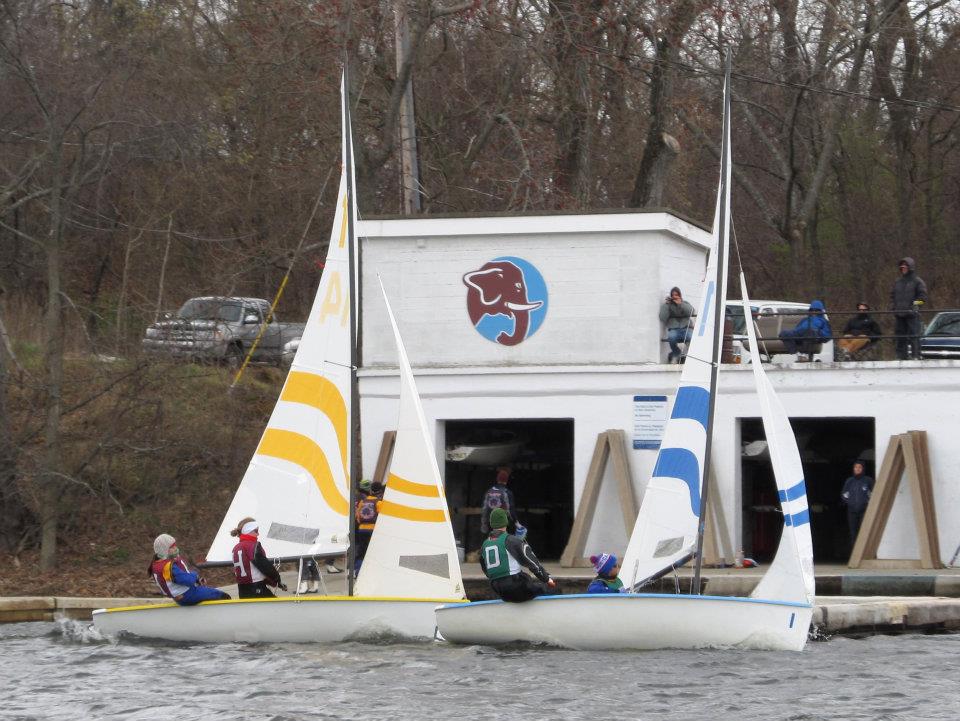
Perhaps the most deserving of the “Bunker” label of all of the NEISA boathouses is that of Tufts University. With a striking resemblance to a concrete bomb shelter, the one-story boathouse is built on Upper Mystic Lake in Medford, Mass. Two boat bays contain 24 Rondar Larks and 3 Lasers, as well as one old windsurfer. While the masts go up and down each day, they’re carbon fiber and thus are a bit more manageable. Getting the boats onto the racks still takes teamwork and muscle, even though the hulls themselves are much lighter than FJs or 420s. The main room of the boathouse quickly fills up with gear during regattas, and the drawers are labeled rather cryptically so that only an upperclassman can quickly find the correct part or tool. The concrete patio above the boathouse sports a restroom with two stalls and assorted dolly parts, as well as various posters of other sailing venues. Although there are plans in the works to remodel the boathouse, there is at least one Tufts sailor who will miss this homely, boxy, bunker.
There you have it, then: a brief tour of the boathouses of New England. Pack your vans accordingly, and don’t forget to check the weather.
Got a great shot from a college sailing road trip? Participate in SW’s College Sailing Photo Contest for the chance to win $500.