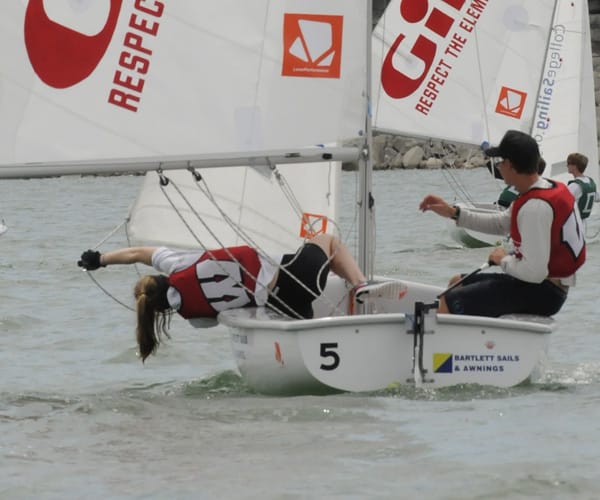
Jib Reaching
We’ve all been there. The race starts in a puff, and then that puff dies … and dies … and dies. Sailors in the back of the fleet—and their coaches—start to call the race unfair. The sailors in the front of the fleet, though, aren’t waiting to hear the whistles calling off the race; instead, they’re making every single tack and gybe count more than ever.
Considering the finicky breeze that often graces many college sailing venues, light-air FJ sailing is something that every college dinghy sailor must master if they want to succeed. For crews, this means the correct mixture of delicate movements and explosiveness, and the right mental game. Sailing in under 5 knots can be extremely stressful, but when the momentum that you come out of each maneuver with—and maintaining that momentum until your next maneuver—is so key, you’ve got to keep a cool head.
Pre-start, keeping up your flow and momentum is incredibly important. While you should be communicating with your skipper about where the next puff is and how best to set up for it, you also need to make sure that your boat never stalls out. This means rolling at about 50% while you’re setting up, and maintaining some trim even when you’re “luffing.” Be even more prepared than usual for a double tack on the line if a hole opens up above you, and make sure that you’re in full racing mode by about 15 seconds. If you can come off the line with more speed and a better angle than the boats around you, you’re already winning the race—or at least your side of the course.
If you rock to head up right before GO, make sure that your body movements are perfectly timed with your skipper’s, and that you trim in the jib slowly as your boat heads up to closehauled. Especially in FJs, trimming in the jib too quickly will not only stall you out but also drag the bow down, bringing you closer to the boat to leeward and wasting some of the hole that you just fought so hard to gain. In under 5 knots, you don’t ever want to strap the jib anyway; even when you’re pinching, you need to let your sail breathe a touch or you’ll lose all flow.
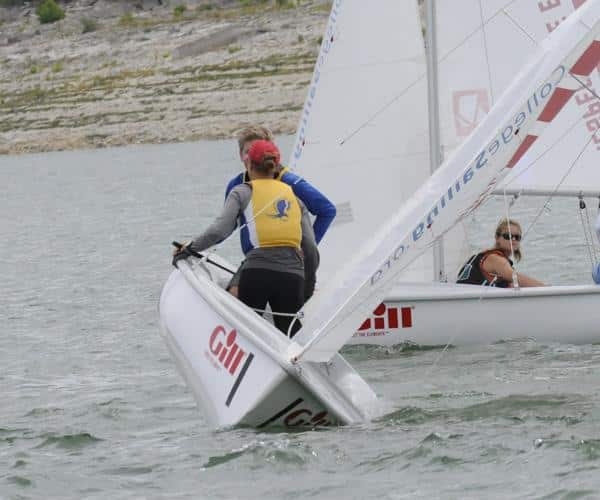
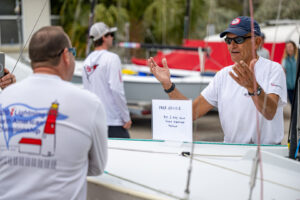
For best results, time your body movements with your skipper’s. Photo: Bill Records
This constant easing and trimming of your sail is something that crews should be doing the entire beat. When you get a lift, ease your sail and try to shift your weight—delicately—even more to leeward. Then trim back in again once your skipper heads up to the new direction, especially if the new breeze is a velocity lift. All of this easing and trimming is a matter of a few clicks; your movements while you’re traveling in a straight line should be so slight that they’re almost invisible.
Your body weight should be as far forward as possible, while also as low down in the boat as you can crouch to avoid disrupting airflow through the slot. It’s hard to see much of the breeze that’s coming down the course while you’re sitting backwards and trying to stay low in the boat, but you can watch your sail over your shoulder for changes in your apparent wind, and you can talk to your skipper about the fleet—not only about starboard tackers, but also about boats on port tack and relative angles and speeds of boats all over the course. If you’re one of the leaders, you need to be covering as much of the fleet as possible, especially when each puff makes such a huge difference.
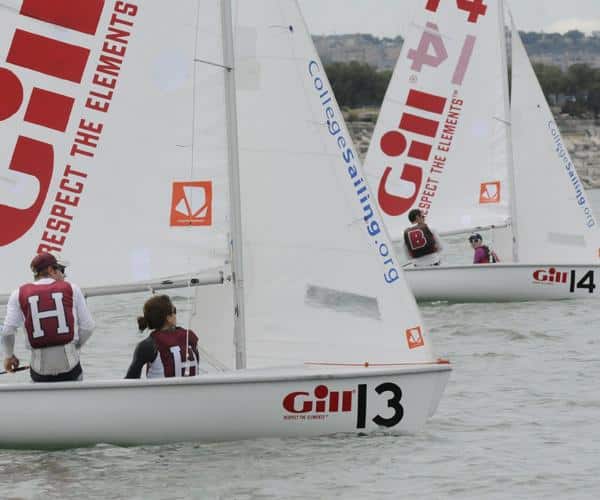
Peering around your shoulder is a pro move. Photo: Bill Records
When it’s time to tack, you should be ready to explode. I like to pretend that each tack is the last and most important tack on earth—or at least of the race. If you’re not a tiny bit afraid that you won’t be able to flatten the boat after your roll, you’re not rolling hard enough. As you begin your tack, make sure to shift a little more weight to leeward to head the boat up, then, in perfect sync with your skipper, snap your body to windward while you roll off of the centerboard trunk or the hiking straps and the opposite jib sheet. Then jump across the boat, hooking into the centerboard trunk or the traps and hitting the opposite rail with your full body weight for a fraction of a second before returning to leeward for the counter-flatten. You should be trimming your jib in to about 80% during the tack, and then _slowly _trimming it in the rest of the way as you counter-flatten and delicately return to your crouching position.
At the windward mark, once again be prepared for a double tack, especially if there’s current. Given how slowly the fleet will be moving, you should be able to accurately judge where you can punch into the layline—and make sure not to foul, because spinning will not be fast. Try to ease the controls (they shouldn’t be cranked anyway, but ease outhaul and take off the touch of Cunningham you might have on), and turn around smoothly. Ideally, you’ll have already turned around after your last tack onto starboard, but if not make sure not to shake the rig as you rotate to face forwards. If you’re gybing around the mark, get vang on and make it a huge gybe, and then ease vang, pull up the board, and settle in to jib reaching.
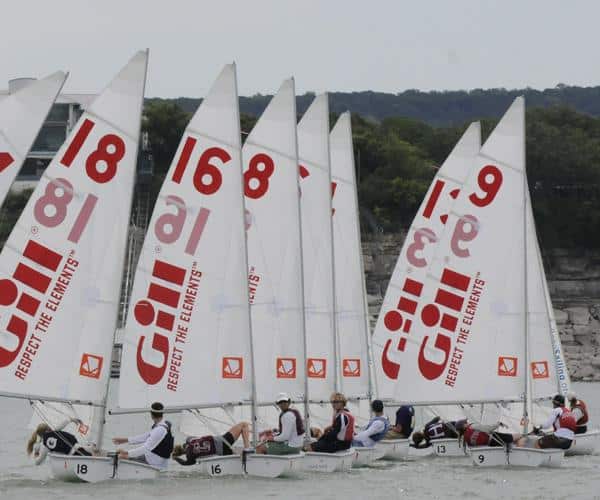
Jib reaching is an excuse to act a few inches taller. Photo: Bill Records
Jib reaching in light air is—painful. With your face nearly in the water and arms stretched out, you can’t see the breeze behind you, and you can only see the boats ahead of or alongside you. This is when it helps to have a constant dialogue with your skipper. You can be feeding him or her information about the pressure on the jib, the breeze you feel on your skin, and your angle relative to the leeward mark(s). Your skipper can be talking to you about what they see on the course and what they’re thinking about doing. Some skippers might not like to voice these thoughts, which is a style that you have to respect, but when you’re sailing with one who does it’s beneficial to both of you—both for strategizing and for staying calm—to be quietly talking the whole time.
Once again, you need to make sure that every movement you make maximizes your speed while staying within the realm of what is legal. If you do have enough breeze to go to the wing, make sure that it’s a smooth movement and that you hold out the boom with the hand that is not handing the jib sheet to your skipper, or it will collapse into the boat. Keep as much windward heel as possible, and make sure that you keep a steady angle while also peering behind you for fresh breeze. You should have the centerboard essentially all the way up as you glide downwind, and make sure that neither of your jib sheets are dragging in the water.
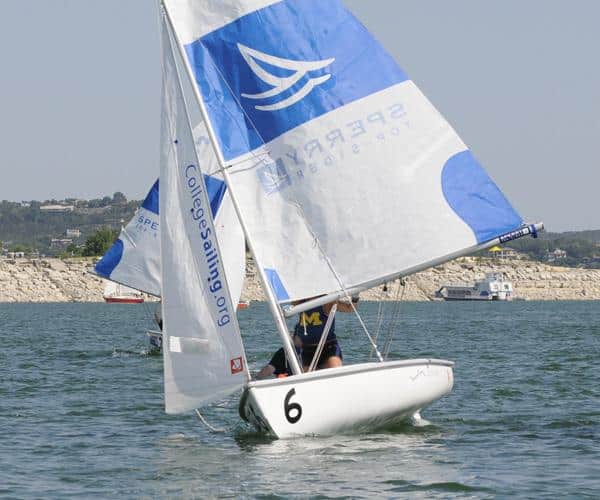
Getting your hand on the boom when you go down to a wing is critical. Photo: Bill Records
If the puff you’re in dies, or you want to head up to get clear air or set up for the next breeze, you can legally get a rock out of it if you’re careful. When your skipper tells you to take the jib back, put down the board and take the slack out of the vang and you can both do a coordinated roll to leeward—then come up to the middle to flatten—and then slide back out to counter-flatten and return to reaching while you bring the board back up to about 75% and ease vang.
Your gybes should be huge, but you need to be careful not to over-flatten or have your mast go past vertical more than once. You need to adjust your flatten based on the size of your skipper and their preferences; with a smaller skipper, you should hit the windward rail as quickly as possible before diving to leeward for the counter-flatten to prevent fishtailing, but if you have a big skipper you might just want to flatten by coming up to the center of the boat.
More than anything, you need to practice light-air racing and boathandling with the person you sail with over and over again. Don’t use glass, broken by a handful of puffs, as a reason not to practice; instead, go out and do boathandling drills of tacks and double tacks, gybes and double gybes, heading up and heading down; even practice circles. Your motions should be perfectly synchronized, and you need to be able to trust each other in order to pull off terrifyingly huge rolls successfully. Practice makes perfect, and in light air, everything needs to be perfect.
Amelia Quinn is a senior at Tufts University, studying a little bit of Arts and Sciences and a lot of sailing. Find more of her blog entries here.