121205_KevinHall
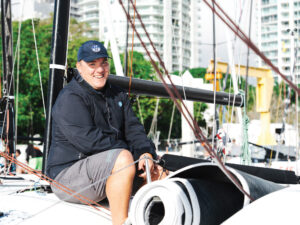
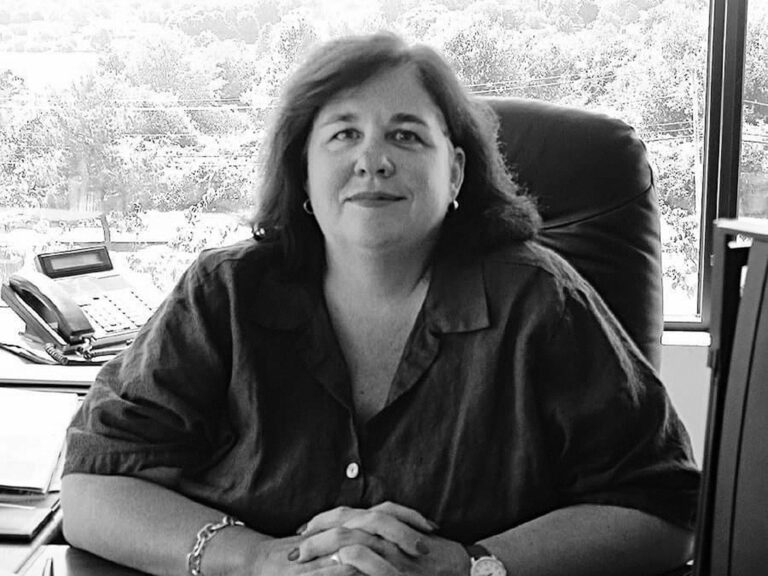
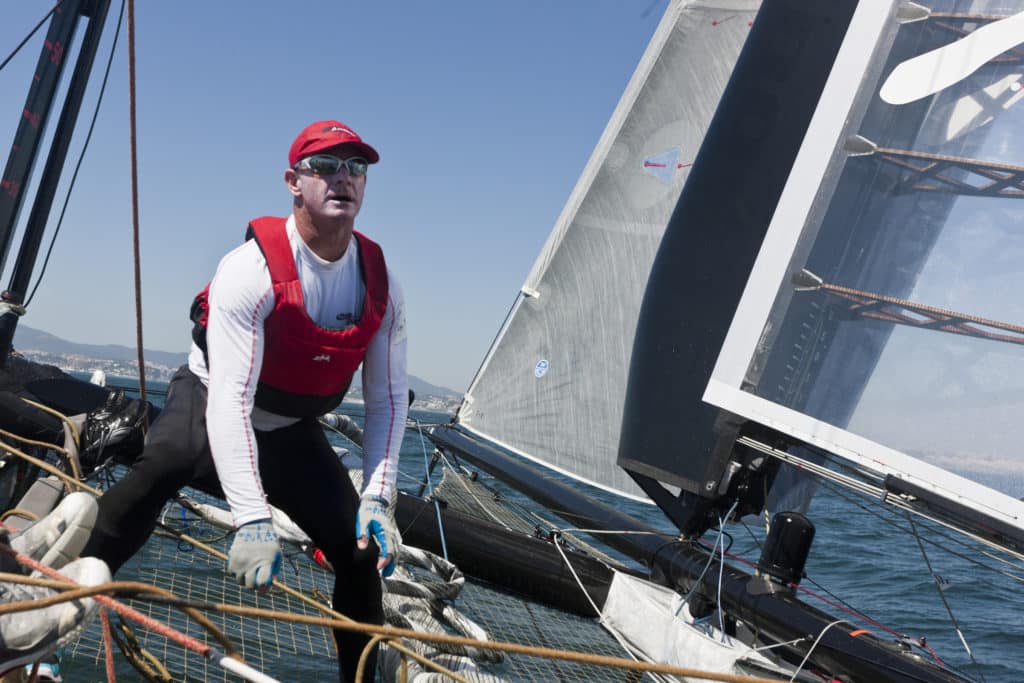
In the modern America’s Cup, the traditional navigator—even at it’s most evolved—is an endangered species. With the courses so compact and the boats so hungry for human horsepower, having one person dedicated to tracking the team’s progress around the course and keeping an eye on the competition is a luxury some teams may decide they can’t afford. But if four-time America’s Cup veteran Kevin Hall is worried about his position being flicked off the race boat, you wouldn’t know it. Perhaps that because Hall is an exceptional, and exceptionally versatile, sailor, with numerous North American and world championships medals across everything from foiling Moths to Team Racing. And he’s no slouch on the handles either. He competed in the 2004 Olympics in the grueling Finn class.
The 43-year old grew up in Ventura, Calif., attended Brown University in Providence, R.I., but his heart and permanent home is in Auckland, New Zealand, where he lives with his wife and three ‘fantastic’ kids, ages 5, 6, and 7. [ed.’s note: This interview was completed prior to the Artemis afterguard shakeup, announced on Nov. 30, that saw skipper Terry Hutchinson leave the team.]
**Your official role with Artemis is navigator. How is this position different in this campaign to others?
**KH: In the new America’s Cup there’s discussion of that role changing dramatically and not even existing as we have known it, but I am a member of the sailing team and I’m also the head of our Performance and Instruments department on the Team.
In past campaigns I have been the race navigator and also the on-water testing manager. It was quite different because there were two boats to choreograph and old school straight line testing and data to look at after that. I was more of the end user of the data. In my role now I’m part of the department that produces the data and also an end user. It’s been an opportunity for huge growth personally because there’re some people-managing aspects that I haven’t done quite this way before.
What’s your day-to-day look like?
**KH: They’re long! As a member of the sailing team I have normal gym responsibilities, which I typically enjoy but challenging when I’m just that tired. After that I come in and get confirmation that everything on the instrument system is working as it should be to go out and do some testing. I suit up with spine armor, air belt, knives and harness and double-check that’s all in place. We have a meeting to review the plan for the day and the priorities, and double-check the weather just before we go out. Once on the boat we go through the instruments once again, get off the mooring and go through the plan with the guys. **
**For our first three sails I was one of a couple of people on board watching the key loads really carefully: load and load alarm and thresholds. Toward the end of the third sail and for all of the fourth I was looking at the wing’s calibration and performance data. Sometimes I make suggestions of things we might try trim-wise to get some different data points.
We return to the mooring and I scramble into the instrumentation system to grab a USB stick and run back to the office to get all the data into the database as quickly as we can. On the water I would have started and stopped tests of good segment – we call those “wet tests”. When we get in I go through those again and usually there’s a little bit of good data right before I started the tests and sometimes I have to cut the data at the end so we do another round of that cutting which is called “dry tests”.
**When that’s done a whole bunch of graphs and reports are generated and about the time the boat is rolling into the shed, most of the key people for a debrief are able to turn up. The debrief is two-fold, one I call “field-oriented” which is impressions of systems: what we could improve on, what’s working, what’s not. The second part of it is the data part of it: are we going as close to target as we thought, the balance of the boat, lift issues.
This is a different kind of sailing for you?
**KH: What’s new for me is the pace of the day and the urgency and critical feel from knowing that you’ve only sailed once or twice or three times ever on the boat; there’s a special urgency there. There’s extra pressure and absolute directive that you do not lose any data. You just can’t afford to say, “Oh we just didn’t have that data.” So far we haven’t had to say that.
**But, a lot of it is also familiar territory as I’ve been playing around with calibrations for trimming angles and discussing the trim of the boat, weather and leeway for most of my America’s Cup career. There are some idiosyncratic things about having two hulls, it’s not a rigid structure. For example, where is the best place to have the compass? It’s not straightforward. I’ll bet most teams have gone with different solutions for that for different reasons. There’s been a lot of time spent in the office making sure all of our outputs really make sense. It’s actually trickier than it sounds, but it’s been really enjoyable process. People like [former ETNZ design guru Tom Schnackenberg] and Nobu [Masanobu Katori], they’re a real asset to the team. We’re really fortunate to have their experience there because it means we’ve gotten through some of those hurdles quicker than we otherwise might have.
**You did the ’07 campaign with ETNZ? What did you bring from that campaign to Artemis?
**KH: ETNZ are doing a good job of getting on the water regularly and what we imagine to be quite productive days. I think part of that is simply a culture that’s existed for a long time and a lot of guys who can communicate quite a bit of information without a whole lot of discussion. There’s an efficiency in what gets exchanged and what happens between the design team and the build team that doesn’t exist in any other team. Having had the experience of that, I’m looking for the shortcuts so I can achieve that at least in our little group of performance guys as quickly as we can. It comes down to communication and that’s probably not a news flash for anyone. It’s hard to know exactly what everybody knows and what they need to know and sometimes 10 extra emails just bogs people down.
**How does it feel to have your 72 on the water?
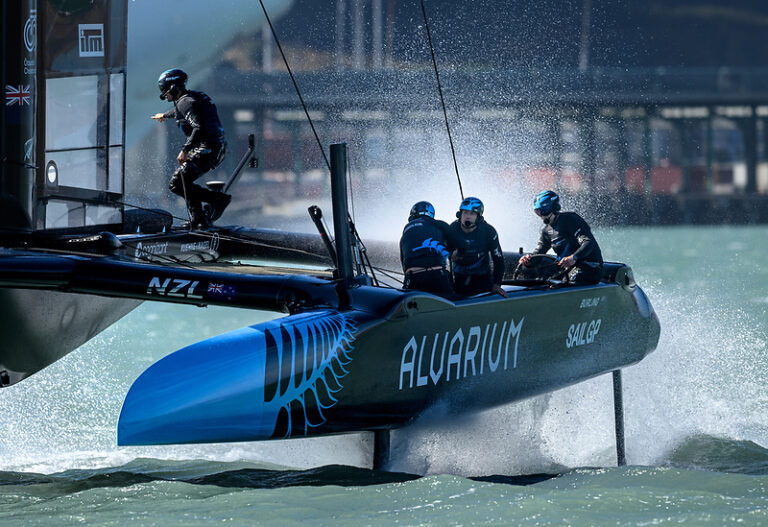
**KH: It’s fantastic. It’s a real privilege to have been sailing for the first four days on the boat and experiencing the thrill of just coming off the tow the first time and sheeting on and getting the hull up and going faster and faster. It’s been really exciting. It feels like something we’ve obviously been working toward for a very long time. After the very first little bit it’s started to feel normal very quickly. The first couple of tacks felt very different, but by the end of the last time we were sailing I’m quite pleased with how quickly it’s started to feel more comfortable that I had imagined at this stage.
You guys don’t seem to be putting much emphasis on foiling – what’s your thinking on that?
**KH: I remember being in one of the very early design team meetings and one of the assignments for the performance team was to make sure we were on top of all the things we would want to measure, maybe occasionally have some sailor input. Adam (May) and I are both Moth sailors. At that meeting, [designer] Juan [Kuoyoumdjian] and his team came in and announced that it was clear that if you could get a boat foiling and going straight and fast, there was a little bit less drag so it went faster. We had that discussion a long time ago, but it’s correct. We’re not pursuing it to the same extent that the other teams have because there’s always been the question of control. It’s one thing to get something to fly in a model and it’s another to get it to fly in the real world. Hats off to ETNZ for doing that – really!
**Then there are trade-offs after that. You pay a price for generating the lift to be able to fly—that price is the drag—then you pay another price for generating that lift in a way that also gives not active control like we have in the Moth but a form like that you can control as the height/lift/leeway changes. They’ve done a good job of making that fairly self-regulating. For us, we’re not sure that all those penalties are worth it. So while you’ll probably sure you’ll see our boat out of the water a bit, I’m not sure how much. ****
**There’s rumor that foils may be abandoned because of the size of the course.
**KH: Even on a really good day on a Moth, you do have to bear away and get up on the foils before get going fast. For that brief time you’re slower than a boat that’s designed to sail through the water traditionally. They may already have worked out that all those little times where you have to heat up after a jibe or bear away [after a tack], maybe that’s too costly. We can kind of tell a little bit what they’re doing when they’re going straight but it’s very hard to have a feel for all the dynamic stuff from faraway. Certainly they [ETNZ] know that.
**You were the first to crash your wing, what lesson’s did you learn from that?
**KH: I would say we were the first ones to put a wing up and sail with it, and with that, the first ones to crash it. But I value those days we had on the water in the trimaran quite highly because we had a heck of a lot of instrumentation in the wing and the feedback that all of that provided while sailing and during breaking it I’d like to think that’s all gone into an evolution in wing 2 that otherwise not have been there. **
**Fortunately the way that it was destroyed was remarkable and it was fixable. The way it broke and landed on the boat basically in three pieces that we towed in was pretty cool. There are so many guys who are good at what they do around here and willing to work as hard as they can to fix things, we fixed it. That’s the wing 1.1. We’re working on wing 2 and look forward to getting that on the boat eventually because it’s an evolution of the things we’ve learned from wing 1.
**Time frame on wing 2: two weeks, a month, more?
**As soon as possible – before the America’s Cup and not tomorrow!
**Progress on boat 2?
**Coming along and on a similar timeline basically. I think all the teams are wishing they could have launched a little sooner to have more of what you learn from boat 1 go into boat 2 but in order to do that your boat 2 is likely with very accelerated timelines to arrive quite late. A lot of the big decisions were made a while ago and there’s a lot of fine-tuning that can go on now and is, but we look forward to seeing boat 2 when it arrives and getting into it with that too.
**How’s your training program going to be affected by training in San Francisco during the winter?
**It’s funny you should ask. This particular week, although we’re ready and rearing to go, we’ve been blown out by this particular front. As hard as it is for all of us to sit on shore and look out what looks like sometimes really good sailing, it’s the prudent thing to do. One thing about these boats is it’s not just a question of chucking it in the water and pushing off the beach. There’s a huge amount of work and coordination just getting onto the mooring ready to get off the mooring. That means you need to pick your weather window carefully.
**Goals for the next few months?
**We’re hoping to learn to sail the boat as fast as we can in a straight line and hoping to get our boat handling to an America’s Cup-winning level.