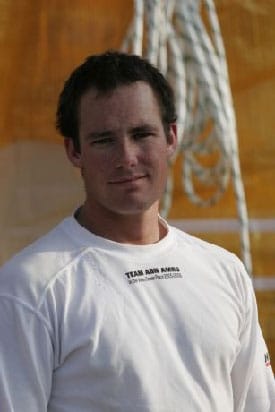
George Peet
For both ABN AMRO boats-One and Two-the windy reaching conditions of Leg 1 of the Volvo Ocean Race could not possibly been more favorable for their wide, powerful Juan Kouyoumdjian designs. After 19 days and more than 6,400 miles sailed, they were first and second into Cape Town, their boats comparatively “intact.” ABN One-under Mike Sanderson-strolled in with a 547-mile 24-hour record and ABN Two-under Sebastien Josse-a close-follow up with 538. There was hardly a day, said Sanderson, were they did anything less than 400 miles. It was an awesome performance by Sanderson and his crew, who clearly put many hours of preparation to good use, but the standout-award for the leg has to go to the “amateur” effort of ABN Two. Sure they have the advantage of hand-me-down development from the varsity team, but what they did with it is nothing short of astounding. A day after they pulled into Cape Town, we tracked down George Peet, the 25-year-old Detroit native and trimmer, to hear how it all went down. On the first night when it seemed everyone else was falling apart you guys came out ahead in the race’s first “sched.” How’d that happen? That first night really set the tone for the entire rest of the leg. When the breeze started coming on we really got caught with our pants down. We were going really fast and we started pushing it. We found a few gears and were taking reefs in and out. When that position report came through we realized we were just smoking people so we just put our heads up and went for it. Then we got the 24-hour record [504 miles] race record, were like, “Hell yeah!” Then, about 40 hours into it, our fractional went over when the Sparcraft s#$% itself. We were going 25 knots when that went into the piss. We completely tore the head in half. So we had not choice and we just put our zero on and kept going fast. Fortunately we had six days to fix the fractional and it took all of that, fixing it on every standby watch. What was it like onboard that first night? It was full noise. We were going 27 to 35 knots for 6 hours and you’re just hanging on and when the boat takes off everyone’s just really quiet. The carbon foils just hum incredibly so loud, and then you hit the next power band and go from 60 apparent to 50 apparent, the boat accelerates another 2 knots, and the whole screaming pitch of the hull goes higher. We have tethers with elastic in them, but you can be clipped in and still get shot back a meter so we were tying ourselves onto padeyes and winches. Whatever you we just get locked in. It was knarly for a while-we sheared our stacking holes, bent all our stanchions out, ripped our daggerboard fairing, blew a keel fairing, and all the graphics just peeled off the bow. The boats are a mess. Quite a character building night. That whole first 48 hours was awesome. It was good for us and set the tone for the leg and the rest of the race. We learned a lot on that 48 hours; controlling the boat and who can do what-we sorted ourselves out pretty well that night. I imagine you guys were happy to have two rudders that night. We’re lucky. The boats are forgiving with the two rudders. Honestly, I think sailing the boat the way we did with one rudder would have been deadly. I’m sure others were wiping out a lot. Mike Sanderson said both ABN boats have a secret sail, called the Spinnoa can you tell us anything about it? The Spinnoa is something pretty cool. I’m not going to say anything. We didn’t have it on until the last two days, and that’s when we tore Ericsson apart. We got passed by Ericsson 24 hours before the scoring gate, caught back up within 30 miles, and then all of a sudden they sent it. The next day Ericsson was 17 miles ahead of us at about 6 p.m. By 8 the following night they were 1.5 miles ahead and to leeward. By 2 a.m. we were 500 meters straight abeam, and by sunrise the next morning they were 5 miles behind us. How’s Sebastien [Josse] acclimating to the team environment? He’s excellent. His forte is making the right sail choices and angles for the weather he’s so onto the routing and navigation and at keeping us on the right sails and when to change gears. To be honest, Seb makes all the calls, and Si Fi [navigator Simon Fisher] runs the software. For the upcoming legs I hope Seb realizes we can sail the boat without him grilling us all the time and focus on the navigation instead of being more concerned with the mechanics of sailing the boat fast. How was the arrival into Cape Town? Awesome. We showed up and they were blaring our theme song from the White Stripes “Seven Nation Army,” and all these pigeons came flying out of the buildings, lit up by all the spotlights-thousands of them. It was awesome. What do you focus on most for the next leg? We will focus a lot on sails. We have a good jump, but the other guys aren’t slouches they’ll catch on fast so we need to stay a step ahead for another leg or two. Plus, there’s the other stuff like safety and living onboard. We broke so much stuff that we never thought would go. We’ll be looking at systems and ways to keep the boat drier. For example, we had an inspection port on one of our daggerboard cases blow out that first night after we lost the fairing plate. We had water 200 liters of water in one part of the boat and it took three hours to bail out. It was up near the keel controls, sloshing around, and it flooded the generator case, fried the terminals to the battery. How did losing the daggerboard fairing affect your sailing? Is that the 49-mile finishing difference you guys had to the black boat? As soon as it was gone you could feel it dragging, all this turbulence down the side of the hull, wanting to pull the bow down all the time. Maybe it was the difference, but we were honestly surprised how close we were. From the two-boat testing we know how much faster it [ABN One] could be than us. When we were as close as we were early on, we were nervous because we thought maybe we were pushing a little too hard. Three days later Moose called us saying he wished we were weren’t pushing so hard.